




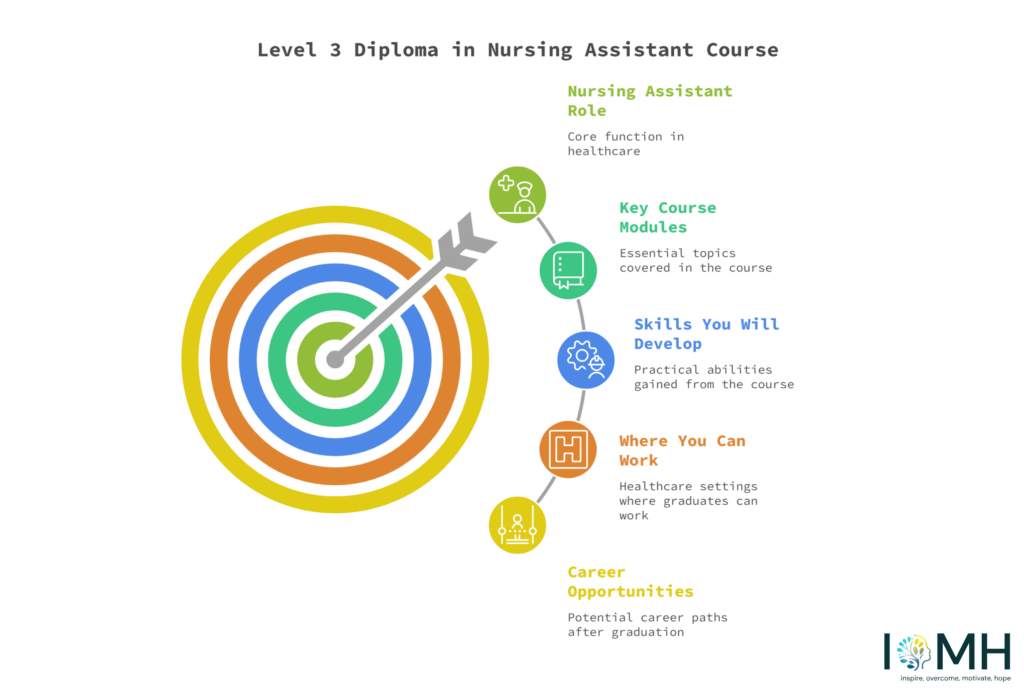
If you are thinking about starting a career in healthcare, a Level 3 Diploma in Nursing Assistant Course is an excellent first step. This qualification gives you the knowledge and understanding needed to work confidently as a Nursing Assistant. You can apply these skills in hospitals, care homes, and community settings across the UK.
Healthcare continues to grow, and trained support staff are in high demand. Completing a recognised Nursing Assistant Course can open the door to a wide range of Nursing Assistant jobs and future career progression.
In this guide, we explain exactly what you will learn, the skills you will develop, and how this qualification prepares you for real-world Nursing Assistant positions.



What Is a Nursing Assistant?
In some countries, the term Certified Nursing Assistant (CNA) is used. In the UK, employers usually prefer candidates with recognised qualifications, such as a Level 3 Nursing Assistant Course, which proves you have the skills and knowledge needed to work safely in healthcare.
Nursing Assistants can work in many settings, including:
- NHS hospitals
- Private clinics
- Care homes
- GP surgeries
- Community healthcare services

They play a key role in keeping patients comfortable, safe, and supported during their recovery. By assisting with personal care, mobility, and daily needs, Nursing Assistants are an essential part of the healthcare team
Key Modules in a Level 3 Diploma in Nursing Assistant Course
In a Level 3 Diploma in Nursing Assistant Course, you’ll gain the knowledge and understanding needed to start your career in healthcare. While the course is mainly theoretical, each module covers essential aspects of patient care, professional practice, and healthcare procedures. Let’s explore the key modules in detail:
Nursing and the Role of a Nursing Assistant
This module introduces you to the nursing profession and the vital role of a Nursing Assistant. You’ll learn how Nursing Assistants support registered nurses, contribute to patient care, and work effectively within a healthcare team. Key topics include patient-centred care, professional standards, and the importance of empathy and compassion in daily practice.
Working in Different Healthcare Settings
Healthcare assistants work in a variety of environments, each with unique challenges and routines. In this module, you’ll explore care delivery in NHS hospitals, private clinics, residential care homes, and community settings. Understanding these differences prepares you for a range of Nursing Assistant positions and helps you adapt your care approach to meet patient needs.
Legal, Ethical, and Professional Practice
Providing care safely and responsibly requires knowledge of legal and ethical standards. In this module, you’ll study patient rights, confidentiality, data protection, safeguarding vulnerable adults, and professional conduct. Understanding these principles ensures you provide care with integrity and comply with UK healthcare regulations, making you a reliable and trusted Nursing Assistant.
Effective Communication in Healthcare
Communication is at the heart of patient care. This module focuses on developing skills to communicate clearly and compassionately with patients, families, and healthcare teams. You’ll learn how to listen actively, provide reassurance, and document patient information accurately. Strong communication skills enhance patient safety, satisfaction, and teamwork in all Nursing Assistant jobs.
Health, Safety, and Hygiene in Care Environments
A safe healthcare environment is critical for patients and staff. In this module, you’ll study health and safety regulations, risk assessments, safe manual handling, fire safety procedures, and personal hygiene practices. Applying these standards reduces accidents, prevents injuries, and supports a healthy, efficient workplace.
Infection Control and Aseptic Practice
Preventing the spread of infection is a core responsibility of a Nursing Assistant. In this module, you’ll learn about how infections are transmitted, proper hand hygiene, correct use of personal protective equipment (PPE), and aseptic techniques. Mastering these practices ensures you can maintain safety for both patients and colleagues in all healthcare settings.

Medication Awareness
While Nursing Assistants may not always administer medication independently, understanding medication safety is crucial. This module covers the types of medications, dosage awareness, recognising potential side effects, and proper storage. You’ll also learn how to safely support nurses and other healthcare professionals during medication procedures, ensuring accurate and safe patient care.
Understanding the Human Body and Patient Needs
This module gives you foundational knowledge of human health and wellbeing. For example, you’ll explore the immune system, nutrition, hydration, fluid and electrolyte balance, oxygenation, pain management, and rest care. In addition, you’ll learn how to assist patients with mobility challenges, immobility issues, and elimination needs, always maintaining dignity and respect. As a result, these skills are essential for performing daily Nursing Assistant duties effectively.
Overall, each of these modules equips you with the knowledge, confidence, and professional understanding to succeed in Nursing Assistant positions and to progress toward further healthcare qualifications. As a result, completing this course lays the groundwork for a rewarding career supporting patients and contributing to high-quality care.
Skills You Will Develop
Completing a Level 3 Nursing Assistant Course will help you build the key skills needed to succeed in healthcare. These skills are essential for anyone looking to start a career as a Nursing Assistant, Healthcare Assistant, or in other entry-level healthcare roles.
By the end of the course, you will be able to:
- Understand Patient Care: Learn how to assist patients with personal hygiene, mobility, feeding, and daily needs while supporting their comfort and wellbeing.
- Gain Confidence in Healthcare Procedures: Develop the knowledge to safely support nurses in procedures, monitor vital signs, and respond effectively in healthcare settings.
- Communicate Professionally: Improve your ability to speak clearly, listen actively, and share information with patients, families, and healthcare teams.
- Follow Legal and Ethical Standards: Understand patient rights, confidentiality, safeguarding, and professional responsibilities to provide safe and ethical care.
- Prepare for Entry-Level Healthcare Roles: Acquire practical knowledge and skills that employers value when hiring for Nursing Assistant jobs or Healthcare Assistant positions.
These skills make you a valuable member of any healthcare team and provide a strong foundation for career growth in the healthcare sector.
Career Opportunities After Completing a Level 3 Nursing Assistant Course
Completing a Level 3 Nursing Assistant Course opens the door to many exciting roles in healthcare. With this qualification, you can apply for:
- Nursing Assistant positions in hospitals, care homes, clinics, and community health settings
- Healthcare Assistant roles where you support nurses and patients with daily care
- Support worker jobs in residential or community care, helping patients with their daily needs
This course also provides a strong foundation for career progression. With further training and experience, you could move into roles such as:
- Senior Healthcare Assistant, taking on supervisory responsibilities and mentoring other staff
- Nurse Associate, bridging the gap between Nursing Assistants and registered nurses
- Registered Nurse, after completing a nursing degree
For learners interested in international opportunities, the Level 3 Nursing Assistant qualification can also serve as a pathway to CNA training and becoming a Certified Nursing Assistant (CNA) in countries where this title is recognised.
With a Level 3 Nursing Assistant Course, you gain the skills, knowledge, and recognised certification needed to pursue a rewarding career and access a wide range of Nursing Assistant jobs.
Is This Course Right for You?
A Level 3 Nursing Assistant Course is ideal for anyone who wants to start or grow a career in healthcare. It suits beginners and those already working in care. It is also a good choice for learners who want a recognised qualification to improve their career prospects.
You do not need an advanced medical background to join this course. You only need dedication, a willingness to learn, and a genuine interest in helping others. By completing the course, you will build the knowledge and confidence needed for real-world Nursing Assistant jobs. You will also learn how to support healthcare teams effectively.
Key Areas That Make This Course Suitable for You:
- Starting a Healthcare Career: If you want to enter the healthcare sector, this course provides the essential skills and recognised certification needed for Nursing Assistant positions.
- Career Progression in Care: If you are already working in care, a Level 3 Nursing Assistant Course gives you a formal qualification to advance into senior or specialised roles.
- Pathway to Nursing: This course is a solid foundation if you plan to study further and progress to become a Nurse Associate or Registered Nurse.
- Enhancing Knowledge and Skills: You will develop practical and theoretical skills in patient care, communication, health and safety, and professional conduct, improving your confidence and employability.
By completing this course, you will be well-prepared to take on Healthcare Assistant roles, move into specialised Nursing Assistant positions, or continue your journey towards a nursing career. It is an ideal choice for anyone committed to a rewarding role helping others in healthcare.
Skills Required for Care Coordinators
To excel as a care coordinator in health and social care, a combination of personal, professional, and technical skills is essential. These skills ensure that patient care is well-organised, efficient, and compassionate. Key skills include:
- Communication Skills: A care coordinator must clearly explain medical information to patients and families, answer questions, and actively listen. Strong communication ensures everyone understands treatment plans, appointments, and care options, supporting smooth patient care coordination.
- Organisational Skills: Coordinators manage multiple patients, treatments, and care plans at once. Excellent organisational skills keep tasks on track, prevent missed appointments, and ensure coordinated care across multidisciplinary teams.
- Problem-Solving Skills: Healthcare is unpredictable. Changes in patient conditions or scheduling conflicts require quick thinking and adaptable solutions to maintain seamless care.
- Empathy: Understanding patients’ emotional and physical needs allows coordinators to provide compassionate care. Empathy builds trust with patients and families, enhancing the overall healthcare experience.
- Attention to Detail: Accurate documentation and monitoring subtle changes in patients’ conditions are crucial. Attention to detail prevents errors and ensures all aspects of care are delivered correctly.
- Technical Skills: Familiarity with electronic health records (EHR), patient management software, and effective collaboration within care coordination teams is highly valued. Technology skills help streamline tasks, maintain accurate records, and improve efficiency.
By combining these skills, a care coordinator can deliver high-quality, personalised care, maintain clear communication between patients and healthcare teams, and ensure smooth coordination of services.
Conclusion
A Level 3 Diploma in Nursing Assistant Course provides the key knowledge and skills needed to start a career in healthcare. It covers infection control, patient care, professional standards, and effective communication. This course helps you prepare for real-world Nursing Assistant roles with confidence.
Whether you aim to work as a Healthcare Assistant, take on specialised Nursing Assistant roles, or continue your studies to become a Registered Nurse, this qualification offers a strong foundation. Healthcare is a profession built on compassion, responsibility, and continuous learning. With the right training, you can begin a rewarding journey supporting patients, making a positive impact, and contributing meaningfully to the NHS and the wider healthcare sector every day.

- All Courses
 Personal Development (1283)
 Career Bundle (479)
 Management & Administration (460)
 Employability (439)
 Health & Social Care (411)
 Health and Safety (382)
 Business (320)
 Teaching & Education (268)
 IT & Software (263)
 Health and Fitness (238)
 QLS Endorsed Courses (219)
 Mental Health & Counselling (168)
 Science & Technology (153)
 Accounting & Finance (144)
 Sales & Marketing (128)
 Construction & Engineering (126)
 Art & Design (125)
 Compliance & Law (112)
 Language (86)
 Photography & Lifestyle (58)
 Animal Care (57)
 Food Safety & Hygine (53)
 Diet & Nutrition (49)
 Sports & Fitness (47)
 Makeup & Beauty (43)
 First Aid (39)
 Agriculture (2)
0 responses on "What You’ll Learn in a Level 3 Diploma in Nursing Assistant Course"