



Working with children involves countless everyday decisions. Whether you are comforting an upset pupil, supervising a one-to-one activity or communicating with parents, knowing how to maintain professional boundaries matters.
Safer working practice means following appropriate standards of behaviour, professional boundaries and safeguarding procedures when working with children. It helps protect children’s welfare, supports responsible decision-making and ensures adults can carry out their roles with confidence and accountability.
For teachers, teaching assistants, nursery practitioners and volunteers, safer working practice is not just about avoiding inappropriate behaviour. It is about understanding what appropriate conduct looks like in everyday situations.
This guide explains the principles of safer working practice, current guidance in England and practical examples for schools and childcare settings.
Working With Children? Build Your Safeguarding Knowledge
Learn safeguarding fundamentals, how to recognise abuse and how to respond to disclosures with IOMH's online Child Protection course.
- Safeguarding fundamentals
- Recognising abuse and responding to disclosures
- Safe working practices
What Is Safer Working Practice?
Safer working practice refers to the professional behaviour and precautions adults should follow when working with children and young people.
It provides a framework for maintaining appropriate relationships, recognising potential risks and responding responsibly when situations become uncertain.
In practice, it involves:
- Maintaining clear professional boundaries with children.
- Following safeguarding policies and staff codes of conduct.
- Using appropriate physical contact and communication.
- Keeping professional interactions transparent.
- Respecting children's dignity, privacy and individual needs.
- Reporting safeguarding concerns through the correct procedures.
The Safer Recruitment Consortium’s guidance for safer working practice provides advice for professionals working in education settings.
Its guidance is non-statutory, meaning it supports good practice but does not replace legal requirements or an organisation’s safeguarding policies.
The central principle is straightforward: adults should act in children’s best interests while maintaining appropriate professional boundaries.
Why Is Safer Working Practice Important?
Children rely on adults to provide safe, supportive and respectful environments. Clear professional expectations help ensure that relationships remain appropriate and safeguarding responsibilities are understood.
Safer working practice helps organisations:
- Protect children: Reduce avoidable safeguarding risks and support children's wellbeing.
- Maintain trust: Build positive relationships between staff, children and families.
- Support professional judgement: Help adults recognise when an interaction needs additional care or advice.
- Promote accountability: Encourage transparent decisions and appropriate record-keeping.
- Strengthen safeguarding culture: Make it easier to recognise and raise concerns about inappropriate behaviour.
For example, a teaching assistant supporting a pupil outside normal classroom activities should know which supervision arrangements apply and when to inform another member of staff.
These expectations form part of wider UK child protection laws and guidance, which establish safeguarding responsibilities across different organisations.
What Does UK Guidance Say About Safer Working Practice in 2026?
Safer working practice is supported by statutory safeguarding requirements, non-statutory guidance and individual workplace policies.
These sources are related, but they do not all have the same legal status.
Statutory safeguarding duties and professional guidance
In England, Keeping children safe in education 2026 sets out statutory safeguarding guidance for schools and colleges.
The September 2026 version requires all school and college staff to read Part One in full and follow their organisation’s safeguarding policies and procedures.
The Safer Recruitment Consortium also provides non-statutory guidance on professional conduct, including boundaries, communication and appropriate behaviour.
Early years providers must follow the relevant Early Years Foundation Stage (EYFS) statutory framework.
Wider safeguarding responsibilities, including how organisations work together to support children, are addressed in Working Together safeguarding guidance.
Although this article focuses primarily on England, professionals in Scotland, Wales and Northern Ireland should follow the safeguarding legislation and guidance applicable to their location.
Professional Boundaries Adults Must Maintain With Children
Professional boundaries help adults build positive relationships without creating inappropriate familiarity, favouritism or confusion about their responsibilities.
These boundaries apply during lessons, extracurricular activities, online communication and interactions outside the usual workplace.
Maintaining appropriate professional relationships
Adults should treat children fairly, communicate respectfully and keep interactions appropriate to their professional roles.
This includes avoiding unnecessary personal disclosures, maintaining suitable language and ensuring children are not encouraged to keep inappropriate secrets.
Staff should also recognise the responsibilities associated with a position of trust.
For example, a teacher can offer encouragement and emotional support without becoming involved in a pupil’s personal life in ways that cross professional boundaries.
Gifts, favouritism and personal relationships
Giving rewards is a normal part of education. However, unexplained gifts, repeated special treatment or personal attention directed towards one child may raise concerns.
Staff should follow workplace policies on gifts, rewards and professional relationships.
They should also avoid using personal relationships or social media to communicate privately with children outside approved arrangements.
Being transparent and accountable
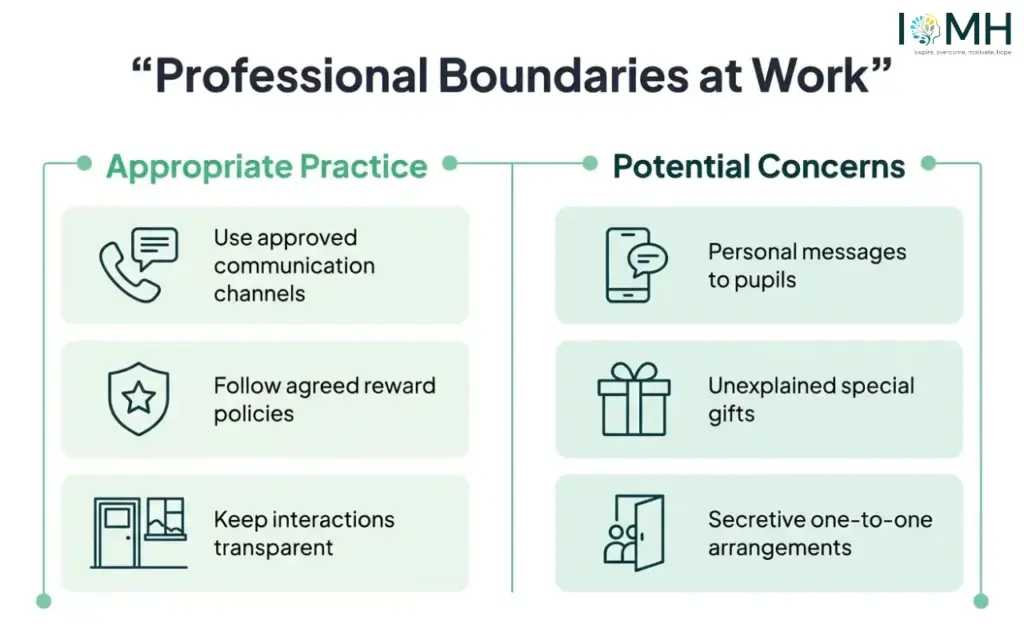
Professional decisions should be reasonable, appropriate and capable of being explained.
| Appropriate professional conduct | Behaviour that may raise concerns |
|---|---|
| Using approved school communication systems | Sending private messages through personal accounts |
| Following agreed reward policies | Giving one child repeated unexplained gifts |
| Maintaining consistent professional boundaries | Encouraging secrecy or personal dependency |
| Following supervision arrangements | Arranging unnecessary private meetings without appropriate safeguards |
| Seeking advice when uncertain | Ignoring concerns about professional boundaries |
When uncertain, staff should consult their manager, designated safeguarding lead or another appropriate person under the organisation’s procedures.
Safer Working Practice During One-to-One Situations
Teachers, teaching assistants and childcare professionals sometimes need to work individually with children.
One-to-one working is not automatically inappropriate. However, it requires suitable arrangements to protect the child and maintain professional accountability.
Can an adult work alone with a child?
Yes, where the activity is appropriate and follows the organisation’s safeguarding procedures.
For example, a teaching assistant may provide individual reading support or help a pupil complete an assessment.
Before arranging one-to-one activities, staff should consider:
- Whether the location is suitable for the activity.
- Whether appropriate colleagues are aware of the arrangements.
- Whether the activity follows school safeguarding policies.
- Whether visibility or supervision arrangements are appropriate.
- Whether additional precautions are needed for the child's circumstances.
A child’s privacy should also be respected. Visibility and transparency should not come at the expense of dignity or confidentiality.
Safe supervision and recording arrangements
Staff should follow agreed supervision procedures and record relevant information when required.
If an activity changes unexpectedly, such as moving to a different location or continuing beyond the agreed time, the adult should follow workplace procedures and seek advice where necessary.
Good practice means making one-to-one interactions appropriate, proportionate and accountable rather than avoiding them altogether.
Physical Contact, Personal Care and Children's Individual Needs
Physical contact can be a necessary and appropriate part of supporting children.
A nursery practitioner may need to help a child with personal care, while a teaching assistant might provide physical assistance to a pupil with mobility difficulties.
The important consideration is whether contact is necessary, appropriate and consistent with the child’s needs and relevant policies.
When is physical contact appropriate?
Physical contact should have a clear, appropriate purpose.
Adults should consider the child’s age, understanding, preferences, individual circumstances and any relevant care plan.
For example, providing reassurance to a distressed child may be appropriate. However, adults should remain sensitive to the child’s response and avoid unnecessary contact.
Supporting children with additional care needs
Some children require assistance with dressing, toileting, mobility or other personal care activities.
Staff should:
- Follow the child's individual care plan where applicable.
- Respect privacy and dignity.
- Use appropriate techniques and equipment.
- Follow organisational safeguarding procedures.
- Complete any necessary role-specific training.
- Raise concerns about changes in a child's needs.
In England, the EYFS statutory framework establishes safeguarding and welfare requirements for early years providers.
Safer practice should always balance protection with the child’s right to appropriate care and support.
Digital Communication, Social Media and Personal Devices
Technology has made communication between schools, families and children easier. It has also created situations where professional boundaries need particular attention.
Staff should understand which communication methods their organisation permits and how to handle personal information securely.
Communicating with children online
Professional communication should normally take place through authorised school or organisational systems.
Adults should avoid using personal social media accounts or private messaging services to contact pupils outside approved arrangements.
For example, if a pupil contacts a teacher through a personal social media account, the teacher should avoid continuing an informal conversation and follow the school’s reporting and communication procedures.
Staff should also keep their online conduct consistent with professional expectations.
Using phones, cameras and digital information safely
Schools and childcare settings should have clear expectations about personal devices, photographs and sharing children’s information.
Staff should:
- Use authorised devices and systems where required.
- Follow policies when photographing or recording children.
- Protect confidential information.
- Avoid sharing children's personal details through unapproved applications.
- Follow relevant safeguarding procedures when using digital or AI tools.
The Department for Education’s mobile phones in schools guidance supports schools in managing mobile-phone use. Its pupil-focused rules should not be confused with staff conduct requirements.
Digital safeguarding also connects with wider responsibilities, including Prevent Duty responsibilities where relevant to schools and childcare providers.
Five Real-Life Examples of Safer Working Practice
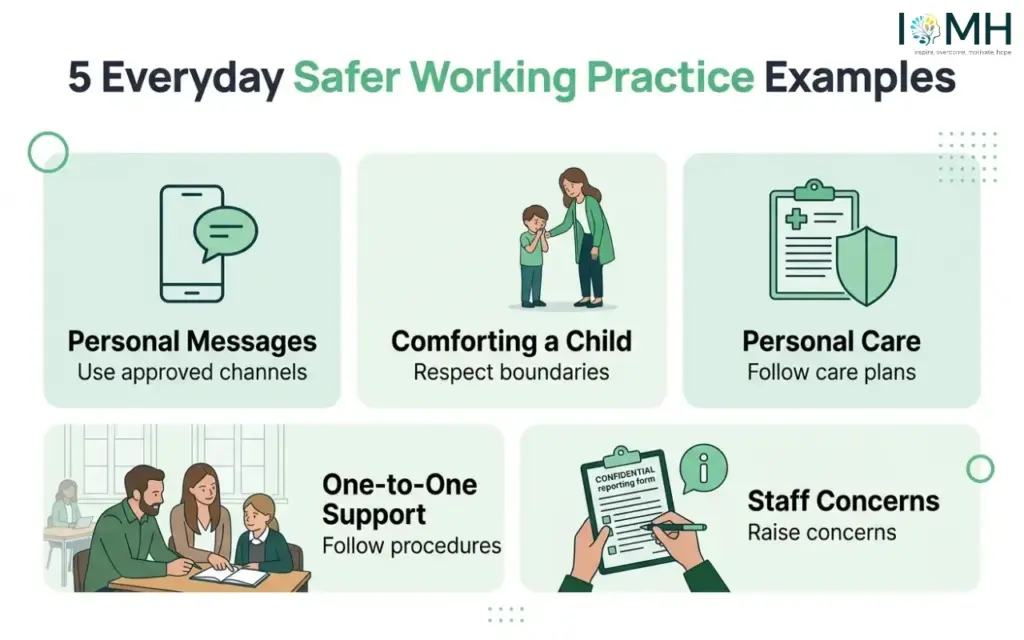
Everyday situations can be more complicated than written policies suggest. These examples show how safer working principles can guide professional decisions.
Example 1: A pupil sends a personal message
A pupil contacts a teaching assistant through a personal messaging account after school.
Safer response: Avoid continuing an informal conversation. Follow the school’s communication policy and report or record the contact as appropriate.
Example 2: A child becomes distressed
A young child becomes upset during an activity and seeks reassurance from a nursery practitioner.
Safer response: Offer age-appropriate comfort while considering the child’s preferences, needs and the setting’s expectations for physical contact.
Example 3: Supporting a child with intimate care
A teaching assistant needs to help a pupil who requires support with toileting.
Safer response: Follow the agreed care plan, maintain the child’s dignity and use the organisation’s approved safeguarding arrangements.
Example 4: A volunteer works alone with a child
A volunteer is asked to supervise a child separately from the main group.
Safer response: Check that the arrangement is authorised and appropriate, and follow the organisation’s supervision procedures.
Example 5: A colleague shows unusual favouritism
A staff member notices that a colleague repeatedly gives one pupil special gifts and attention.
Safer response: Avoid making assumptions or investigating independently. Record relevant facts and raise the concern through the appropriate procedure.
These situations reinforce the importance of children’s welfare, a principle reflected in the key principles of the Children Act 1989.
What Should Staff Do When Safer Working Boundaries Are Crossed?
Not every concern about professional behaviour involves deliberate misconduct. However, uncertainty should not prevent staff from taking appropriate action.
Where behaviour appears inconsistent with safeguarding expectations, the correct response is to follow the organisation’s reporting procedures.
Recognise, report and record concerns
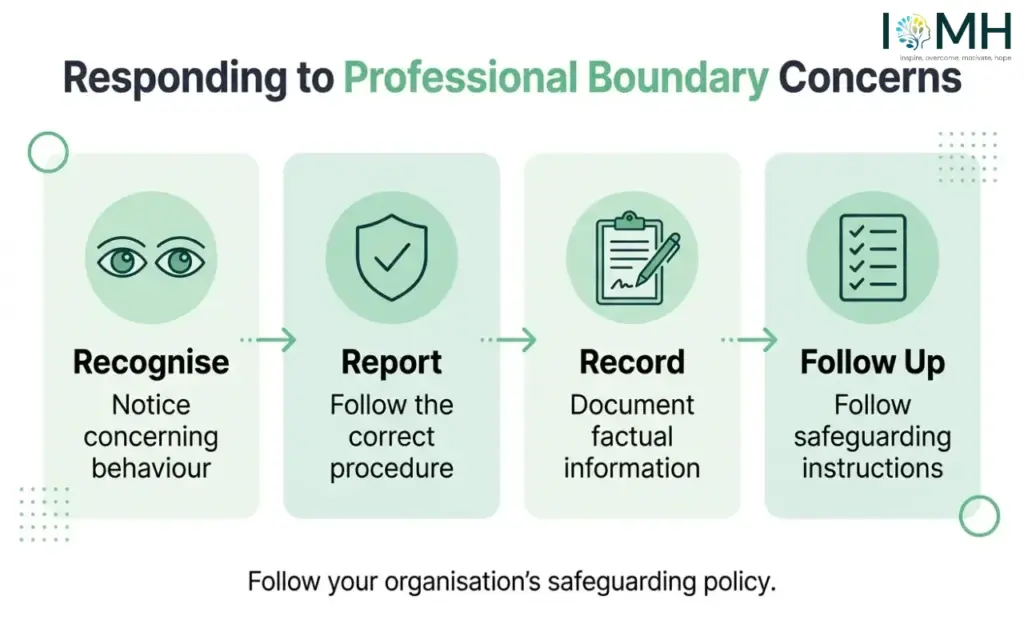
Staff should:
- Recognise the concern. Identify behaviour that may fall outside professional expectations.
- Report promptly. Use the designated reporting route for concerns about adults, which may differ from the route for concerns about a child’s welfare.
- Record factual information. Include relevant observations, dates and actions without speculation.
- Maintain confidentiality. Share information only with those who need it for safeguarding purposes.
- Follow further instructions. Do not conduct an informal investigation or promise absolute confidentiality.
The Department for Education’s safeguarding information for all staff reinforces the need to act promptly and follow established procedures. Its overview does not replace reading KCSIE Part One in full.
Staff can also benefit from guidance on recognising and reporting low-level concerns, particularly when behaviour does not appear to meet the threshold for a more serious allegation.
If a child is in immediate danger, contact emergency services on 999.
Safer Working Practice Checklist for Staff
Before or during activities involving children, use this checklist to reinforce professional expectations.
- Maintain appropriate professional boundaries.
- Follow your organisation's safeguarding policies.
- Use approved communication channels.
- Keep one-to-one working arrangements appropriate and transparent.
- Respect children's privacy, dignity and individual needs.
- Follow agreed personal care and supervision procedures.
- Record and share information appropriately.
- Report concerns promptly through the correct route.
- Seek advice whenever a situation is unclear.
The checklist supports everyday professional judgement but does not replace workplace policies or safeguarding training.
How Can Safeguarding Training Support Safer Working Practice?
Safeguarding training can help adults recognise risks, understand professional responsibilities and respond appropriately to concerns.
For those wishing to develop their knowledge, IOMH offers a Child Protection course covering safeguarding fundamentals, recognising abuse, responding to disclosures and safe working practices.
The online course offers a CPD-accredited completion certificate option. It does not replace employer-required safeguarding training, statutory guidance or role-specific qualifications.
Conclusion
Safer working practice starts with professional boundaries, thoughtful decisions and consistent safeguarding procedures. Understanding these expectations helps adults protect children, maintain trust and respond responsibly in everyday situations.

Frequently Asked Questions About Safer Working Practice
Examples include maintaining professional boundaries, using authorised communication systems, following appropriate supervision arrangements, respecting children’s dignity and reporting safeguarding concerns through established procedures.
Yes. One-to-one working can be appropriate when it follows the organisation’s safeguarding policies and suitable supervision arrangements.
No. Appropriate physical contact may be necessary for reassurance, personal care, mobility support or safety. Adults should consider the child’s needs, dignity, circumstances and relevant procedures.
Yes. Volunteers working with children should follow the safeguarding policies, professional boundaries and reporting procedures relevant to their roles.
The Safer Recruitment Consortium’s safer working practice guidance is non-statutory. However, organisations and staff must still comply with applicable legal requirements and relevant statutory guidance, alongside their safeguarding and conduct policies.

- All Courses
 Personal Development (1283)
 Career Bundle (479)
 Management & Administration (460)
 Employability (439)
 Health & Social Care (416)
 Health and Safety (383)
 Business (320)
 Teaching & Education (268)
 IT & Software (263)
 Health and Fitness (238)
 QLS Endorsed Courses (219)
 Mental Health & Counselling (169)
 Science & Technology (153)
 Accounting & Finance (144)
 Sales & Marketing (128)
 Construction & Engineering (126)
 Art & Design (125)
 Compliance & Law (112)
 Language (86)
 Photography & Lifestyle (58)
 Animal Care (57)
 Food Safety & Hygine (53)
 Diet & Nutrition (49)
 Sports & Fitness (47)
 Makeup & Beauty (43)
 First Aid (39)
 Agriculture (2)
0 responses on "Safer Working Practice for Adults Who Work With Children"