




The Children Act 1989 is one of the most important laws protecting children’s welfare in England and Wales. It establishes principles concerning children’s upbringing, parental responsibility, family support and situations where authorities may need to intervene.
This Children Act 1989 summary explains the law in simple terms, including its key principles, Sections 17, 20, 31 and 47, and what these provisions mean for safeguarding children.



What Is the Children Act 1989?
The Children Act 1989 is legislation designed to safeguard children’s welfare while recognising the importance of family life. It establishes responsibilities for parents, legal powers for courts and duties for local authorities.
The Children Act 1989 legislation provides a framework for supporting children in need, protecting those at risk of significant harm and making decisions about their care.
It is a central part of the wider framework of child protection legislation.
For professionals and volunteers developing their safeguarding knowledge, IOMH’s Child Protection course covers recognising abuse, responding to disclosures and understanding child protection responsibilities.
What Are the Key Principles of the Children Act 1989?
The Act is built around several important principles that guide decisions affecting children.
1. The child’s welfare comes first
Under Section 1, a child’s welfare is the court’s paramount consideration when making specified decisions about their upbringing. Courts must consider relevant factors, including the child’s needs, wishes and any risk of harm.
2. Parents have responsibilities towards their children
Parental responsibility includes the legal rights, duties and authority involved in caring for a child and making important decisions about their upbringing.
3. Unnecessary delays should be avoided
The Act recognises that delays in proceedings concerning a child’s upbringing can harm their welfare. Courts must therefore consider the potential impact of delay.
4. Court orders should only be made when beneficial
The no-order principle means courts should not make an order under the Act unless doing so would be better for the child than making no order.
5. Families should receive appropriate support
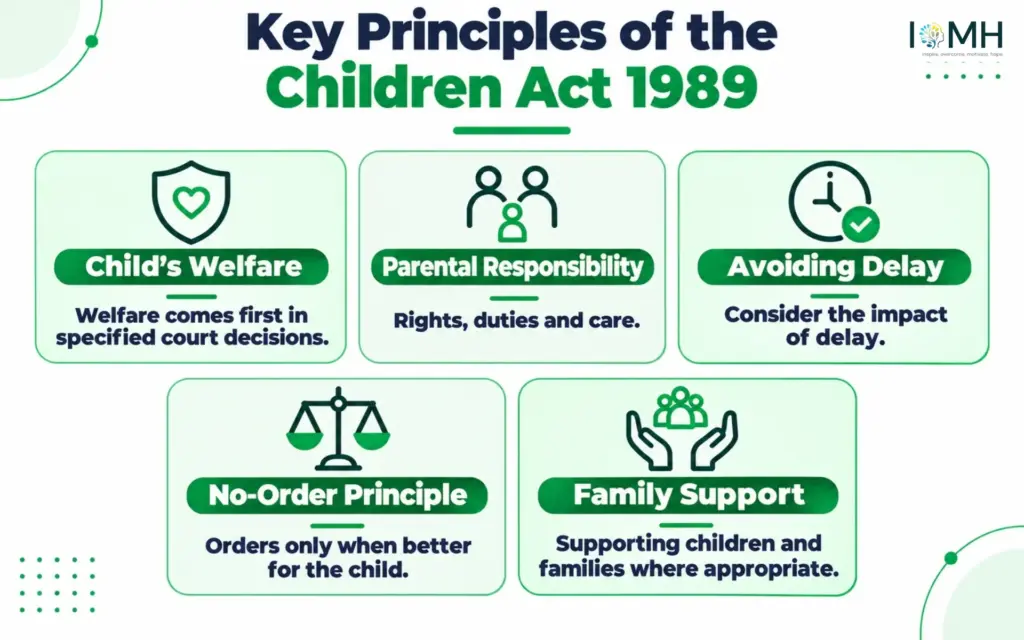
The Act promotes supporting children within their families where consistent with their welfare. Children’s wishes and feelings must also be considered in relevant decisions.
These principles provide a legal foundation for decisions about children. Professionals can explore the related expectations of safer working practice.
Children Act 1989: Key Sections Explained
Several sections are particularly important for understanding how the law supports and protects children.
Section 17 — Support for Children in Need
Section 17 of the Children Act 1989 places a general duty on local authorities in England to safeguard and promote the welfare of children in need within their area.
A child may be considered in need because they require additional support to maintain their health or development, or because they have a disability.
Support may include family assistance, practical services or help accessing suitable provision.
Example: A child with additional needs may require support services to help them participate in everyday activities and maintain their wellbeing.
The purpose is to support the child and, where consistent with their welfare, help them remain within their family.
Section 47 — Child Protection Enquiries
Section 47 requires local authorities to make appropriate enquiries where they have reasonable cause to suspect that a child is suffering, or is likely to suffer, significant harm. Other specified circumstances also trigger this duty.
Significant harm may involve serious concerns about abuse, neglect or damage to a child’s health or development.
Example: A school identifies concerning signs of possible abuse and shares the information through appropriate safeguarding channels. Children’s social care may then determine whether Section 47 enquiries are required.
Section 47 is different from Section 17 because it concerns enquiries into potential significant harm, rather than the general provision of support for children in need.
Section 20 — Accommodation for Children
Section 20 provides for local authorities in England to accommodate children in specified circumstances.
This may apply when a child has been abandoned, has nobody with parental responsibility or cannot receive suitable care from their usual carer.
For example, temporary accommodation may be necessary if a parent is hospitalised and no suitable alternative care is available.
Section 20 accommodation is not the same as a court-ordered removal. Parental responsibility, objections and the child’s wishes are important considerations, subject to the applicable legal provisions.
Section 31 — Care and Supervision Orders
Section 31 allows courts to make care or supervision orders when the relevant statutory conditions are satisfied.
A court must be satisfied that the child is suffering, or is likely to suffer, significant harm attributable to the circumstances specified in the Act.
A care order places the child in the care of a designated local authority. A supervision order places the child under local authority supervision.
These orders require judicial decisions. A safeguarding concern alone does not automatically justify either order.
Quick Comparison of the Main Sections
| Section | Main purpose |
|---|---|
| 17 | Support children in need and their families |
| 20 | Provide accommodation in specified circumstances |
| 31 | Enable courts to make care and supervision orders |
| 47 | Require enquiries into suspected significant harm and other specified circumstances |
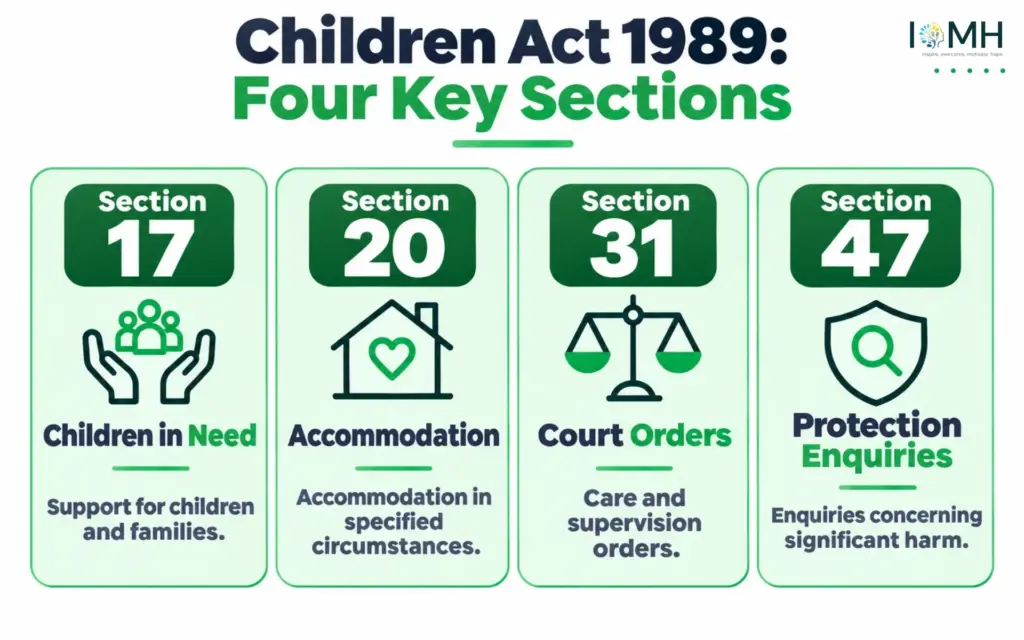
Understanding these differences helps practitioners recognise which statutory responsibilities may be relevant to a child’s circumstances.
How Does the Children Act 1989 Apply to Safeguarding Practice?

The Children Act 1989 provides an important foundation for safeguarding decisions in schools, childcare settings, healthcare and social care.
Professionals working with children should understand how to recognise concerns, record factual information and follow their organisation’s safeguarding procedures.
For example, a teacher who notices persistent signs of neglect should share their concerns with the designated safeguarding lead (DSL), following the school’s procedures. The DSL can then consider appropriate next steps, including contacting children’s social care.
Recognising and reporting concerns does not mean the teacher personally carries out a Section 47 enquiry. That statutory responsibility belongs to the local authority.
It is also important to distinguish concerns about children’s welfare from concerns about adults’ professional conduct.
Where staff behaviour raises questions, organisations should follow appropriate procedures for low-level concerns.
Allegations meeting the relevant criteria may require involvement from the local authority designated officer. Understanding the role of the LADO helps organisations recognise when specialist allegations-management arrangements apply.
Children Act 1989 vs Children Act 2004: What Changed?
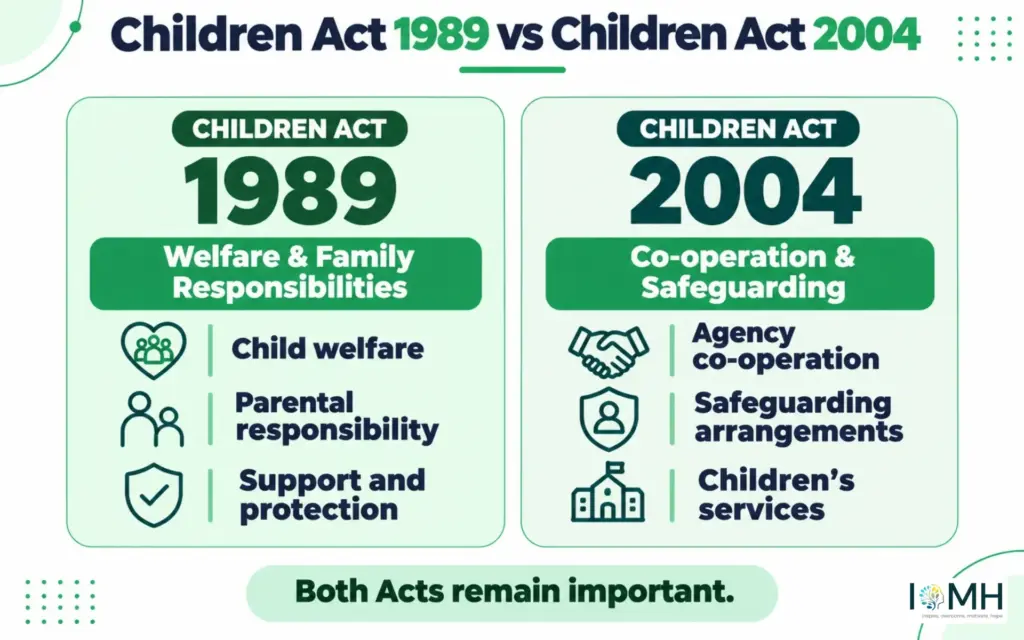
The Children Acts 1989 and 2004 are closely connected, but they serve different purposes.
The Children Act 1989 focuses on children’s welfare, parental responsibility, support services and legal arrangements for protecting children.
The Children Act 2004 strengthened arrangements for co-operation between agencies and safeguarding responsibilities.
The 2004 Act did not replace the 1989 Act. Both remain important parts of the legal framework, as amended.
Other safeguarding duties also exist. For example, the Prevent duty concerns preventing people from being drawn into terrorism and has a separate statutory basis.
Is the Children Act 1989 Still in Force?
Yes. The Children Act 1989 remains in force, although it has been amended and operates alongside later legislation.
In England, professionals should also refer to current safeguarding guidance for England, including Working Together to Safeguard Children 2026.
This statutory guidance explains expectations for multi-agency working to help, support and protect children.
The legal framework differs in Wales. Although provisions of the Children Act 1989 remain relevant, the Social Services and Well-being (Wales) Act 2014 provides an important framework for social care duties.
Practitioners should therefore follow the legislation and statutory guidance applicable to their jurisdiction.
Understanding the Children Act 1989
The Children Act 1989 remains fundamental to protecting children’s welfare and supporting families. Understanding its principles and key sections helps practitioners recognise how legal responsibilities relate to safeguarding practice.
Readers wishing to develop their knowledge can explore child protection training online, including IOMH’s Child Protection course, which covers safeguarding fundamentals and responding to concerns.

Frequently Asked Questions About the Children Act 1989
The Act establishes duties and powers concerning children’s welfare and protection. Section 17 addresses support for children in need, while Section 47 requires enquiries where relevant conditions, including reasonable suspicion of significant harm, are met. It also provides for care and supervision arrangements.
There is no single official statutory list of exactly five principles. Commonly discussed themes include the child’s welfare, parental responsibility, avoiding unnecessary delay, avoiding unnecessary court orders and supporting families. These should not be confused with the five historical Every Child Matters outcomes.
The Act was introduced to reform and clarify the law concerning children. It established a more coherent framework for parental responsibility, children’s welfare, family support and protective intervention, placing particular importance on children’s interests when courts make relevant decisions.

- All Courses
 Personal Development (1283)
 Career Bundle (479)
 Management & Administration (460)
 Employability (439)
 Health & Social Care (416)
 Health and Safety (383)
 Business (320)
 Teaching & Education (268)
 IT & Software (263)
 Health and Fitness (238)
 QLS Endorsed Courses (219)
 Mental Health & Counselling (169)
 Science & Technology (153)
 Accounting & Finance (144)
 Sales & Marketing (128)
 Construction & Engineering (126)
 Art & Design (125)
 Compliance & Law (112)
 Language (86)
 Photography & Lifestyle (58)
 Animal Care (57)
 Food Safety & Hygine (53)
 Diet & Nutrition (49)
 Sports & Fitness (47)
 Makeup & Beauty (43)
 First Aid (39)
 Agriculture (2)
0 responses on "Children Act 1989 Summary: Key Principles and Sections Explained"