




Healthcare systems depend on accurate information to provide safe and effective care. One important role that supports this process is clinical coding. Although many people may not know much about it, clinical coding plays a major role in hospitals, GP services, and other healthcare organisations across the UK.
Today, the demand for trained clinical coders is growing quickly, especially within the NHS. Many people are now exploring clinical coding jobs because they offer stable employment, career growth, and opportunities to work in the healthcare sector without direct patient care.
In this guide, you will learn what clinical coding is, how it works in the NHS, the skills needed for the role, available training courses, and the career opportunities available in the UK



Understanding Clinical Coding
Clinical coding is the process of turning medical information into standardised codes. These codes are taken from patient records, including diagnoses, treatments, procedures, and operations.
Clinical coders carefully review medical notes written by doctors, nurses, and healthcare professionals. They then assign the correct codes using official coding systems such as:
- ICD-10 (International Classification of Diseases)
- OPCS-4 (Classification of Interventions and Procedures)
These are often called clinical codes NHS because they are widely used throughout NHS healthcare systems.
The coded information helps healthcare organisations record patient care accurately and consistently.
Why Clinical Coding Is Important
Clinical coding is not just office work or paperwork. It is a very important part of how the NHS and other healthcare services operate in the UK. Every day, hospitals depend on accurate coding to manage patient information, funding, and planning.
Without proper clinical codes NHS systems, healthcare data would be messy, unclear, and difficult to use. That is why it plays a key role in modern Health and Social Care services.
1. Supports Patient Care
Good clinical coding helps create accurate medical records. When information is coded correctly, doctors and healthcare professionals can quickly understand a patient’s medical history, diagnosis, and treatment. This improves patient care and decision-making.
2. Helps NHS Funding
The NHS uses coded healthcare data to decide how much funding each hospital receives. Correct coding ensures hospitals are fairly funded based on the services they provide. This makes NHS systems very important for financial planning.
3. Improves Healthcare Planning
Clinical coding data helps the government and NHS understand health trends across the UK. This information is used to plan future services, manage resources, and respond to public health needs.
4. Supports Medical Research
Researchers use coded data to study diseases, treatments, and outcomes. This helps improve medical knowledge and develop better healthcare solutions in the future.
5. Keeps Healthcare Data Organised
With millions of patients in the UK, healthcare systems need a structured way to store information. Clinical coding keeps everything organised, making it easier to find and use patient data when needed.
Because of all these reasons, clinical coding NHS departments are essential in hospitals. They ensure that healthcare information is accurate, reliable, and useful for patient care, funding, and research

Clinical Coding Jobs and Positions
There are many different clinical coding jobs available across the UK, and they suit people at different stages of their careers. Whether you are just starting out or already have experience in healthcare, there are clear opportunities to progress in this field.
Entry-Level Roles
One of the most common starting points is the Trainee Clinical Coder role. This position is ideal for beginners who are new to the field. In this job, you will learn while working, gaining hands-on experience in clinical coding systems and medical terminology. It is a great way to build knowledge step by step while being supported in a real working environment.
Mid-Level Roles
After gaining experience, you can move into a Clinical Coder position. In this role, you will work more independently. Your main responsibility is to accurately review patient records and assign the correct clinical codes. At this stage, you are expected to have a solid understanding of coding systems and NHS guidelines.
Senior Roles
A Senior Clinical Coder handles more complex medical cases and may also support and guide junior staff members. This role requires strong knowledge and experience in clinical coding, as well as good decision-making skills.
Specialist Roles
There are also specialist clinical coding positions such as Clinical Coding Auditor, who checks the accuracy and quality of coded data, and Clinical Coding Manager, who leads teams and ensures coding standards are maintained across the organisation.
These roles are available in both NHS hospitals and private healthcare organisations throughout the UK.
Clinical Coding Jobs UK Opportunities
There are many Clinical Coding Jobs UK opportunities available across the country. Most NHS trusts regularly advertise new vacancies, as hospitals always need skilled coders to manage and process medical information correctly.
Clinical coding is becoming more important in modern healthcare, which means demand for trained professionals continues to grow. Whether you are just starting out or looking to progress in your career, there are many chances to work in this field.

Why These Jobs Are in Demand
There are several key reasons why clinical coding jobs are increasing in the UK:
- Increasing patient data: The NHS deals with millions of patient records every year, all of which need to be coded accurately.
- Expansion of NHS services: As healthcare services grow, more staff are needed to manage medical data and support hospital systems.
- Digital healthcare systems: The UK healthcare system is becoming more digital, which increases the need for accurate and structured coding.
- Need for accurate medical records: Correct coding is essential for patient safety, funding, reporting, and healthcare planning.
Career Stability and Growth
Clinical coding offers stable and long-term employment. It is a reliable career choice for people interested in healthcare but who do not want to work directly with patients.
Because of its importance in the NHS and wider Health and Social Care sector, clinical coding continues to offer strong career progression and ongoing job security.

Skills Needed for Clinical Coding
To work in clinical coding, you do not need to be a doctor or nurse. However, you do need a set of important skills to do the job well. These skills help you understand medical information and turn it into accurate codes used in the NHS and other healthcare settings.
Attention to Detail
One of the most important skills in clinical coding is attention to detail. Even a small mistake in coding can affect hospital records, patient data, and NHS funding. Clinical coders must carefully check every detail before finalising codes.
Medical Knowledge
You also need a basic understanding of medical terms. This includes knowledge of diseases, treatments, and procedures. You do not need advanced medical training, but you must be comfortable learning medical language used in healthcare records.
Analytical Skills
Clinical coders must be able to read and understand complex medical notes. This requires strong analytical skills to break down information and choose the correct codes from coding systems.
IT Skills
Most clinical coding jobs are done using computer systems. You need to be confident using digital tools, databases, and healthcare software to record and manage information accurately.
Organisation Skills
In many clinical coding positions, you will deal with a large number of patient records every day. Good organisation skills help you manage your workload, stay focused, and meet deadlines.
Developing These Skills
The good news is that these skills are not fixed. They can be developed through a clinical coding course, training, and practical experience. With time and practice, many learners build strong coding skills and move into successful clinical coding NHS careers.
Skills Needed for Clinical Coding Social Care?
To work in clinical coding, you do not need to be a doctor or nurse. However, you must have a strong set of skills to accurately read medical information and turn it into correct codes used in the NHS and wider healthcare system. These skills are important because even small errors can affect patient records, hospital reports, and funding.
Key Skills Required:
- Attention to detail: Small mistakes in coding can lead to incorrect medical records or financial issues for hospitals.
- Medical knowledge: A basic understanding of medical terms, conditions, and treatments is essential for accurate coding.
- Analytical skills: You must be able to read and understand complex medical notes and select the correct codes.
- IT skills: Most coding work is done using computer systems, so confidence with digital tools is important.
- Organisation skills: Clinical coders often handle large amounts of data, so staying organised is essential.
These skills can be developed through a clinical coding course and regular practice in real healthcare settings.
- Providing personal care in the client’s home
- Preparing meals and supporting nutrition and hydration
- Offering medication reminders (if trained and permitted)
- Providing companionship and emotional support
- Assisting with light household tasks and daily routines
NCCQ Clinical Coding Qualification
One of the most respected qualifications in the field of clinical coding is the NCCQ clinical coding qualification.
NCCQ stands for the National Clinical Coding Qualification. It is widely recognised across the UK healthcare system and is especially valued within the NHS. This qualification shows that a clinical coder has the knowledge and skills needed to code medical information accurately and professionally.
Why NCCQ Is Important
- Recognised across NHS hospitals: The NCCQ is accepted in most NHS trusts, making it a strong standard for clinical coding roles.
- Improves job opportunities: Having this qualification can help you apply for more clinical coding jobs and stand out from other candidates.
- Helps you move into senior roles: Many clinical coding positions, such as senior coder or auditor roles, require or prefer NCCQ certification.
- Increases salary potential: Qualified coders often have a better chance of earning higher salaries than those without certification.
Many people first complete a clinical coding course UK, gain practical experience in clinical coding NHS departments, and then work towards the NCCQ qualification. It is a strong step for building a long-term career in Health and Social Care and progressing in clinical coding roles.
This means qualified professionals are always in demand, making it a stable and future-proof career choice.

Career Path in Clinical Coding
A career in clinical coding has a clear and structured pathway, which makes it a great option for people who want long-term stability and growth in healthcare. As you gain experience and knowledge, you can move step by step into more advanced roles within the NHS or private healthcare sector.
Typical Career Progression
- Trainee Clinical Coder: This is the starting point for beginners. You will learn the basics of coding while working under supervision and often alongside a clinical coding course.
- Clinical Coder: At this stage, you work more independently. You review patient records and assign accurate clinical codes using NHS systems.
- Experienced Clinical Coder: With more practice, you handle more complex cases and develop stronger technical skills in coding systems used in clinical coding NHS departments.
- Senior Clinical Coder: Senior coders take on difficult cases, support junior staff, and help maintain coding quality across teams.
- Clinical Coding Auditor or Manager: These advanced clinical coding positions focus on checking accuracy, improving standards, and managing coding teams.
Other Career Options
Some professionals also progress into wider roles such as:
- Healthcare data analysis
- NHS information management
- Health and Social Care administration
These roles use coding knowledge in broader healthcare systems and data roles.
Overall, clinical coding jobs offer strong career progression, making it a reliable and long-term choice for those interested in healthcare and data work.
Salary in Clinical Coding Jobs UK
Salaries in clinical coding jobs UK depend on your experience, skills, and job level. As you progress through different clinical coding positions, your salary can increase steadily, especially within the NHS and other healthcare organisations.
Typical UK Salary Ranges
-
Trainee Clinical Coder: £22,000 – £26,000
This is the starting point for beginners. You will learn the basics of coding while working under supervision and often alongside a clinical coding course. -
Clinical Coder: £27,000 – £35,000
At this stage, you work more independently. You review patient records and assign accurate clinical codes using NHS systems. -
Senior Clinical Coder: £35,000 – £45,000+
Senior coders take on difficult cases, support junior staff, and help maintain coding quality across teams. -
Clinical Coding Manager:
Salary varies and is higher depending on NHS band and responsibilities
These roles involve managing teams, overseeing processes, and maintaining high standards across departments.
Salary Growth and Progression
With experience and further training, salaries can increase significantly. Completing a recognised qualification such as NCCQ clinical coding can improve your chances of higher-paying roles and faster career progression.
Overall, clinical coding jobs offer strong financial stability and long-term earning potential within the UK healthcare system.

Challenges in Clinical Coding
Like any profession, clinical coding comes with its own set of challenges. While it is a rewarding career, it also requires focus, patience, and continuous learning to perform well in clinical coding jobs.
Complex Medical Notes
One of the main challenges is dealing with detailed medical records. Some patient notes can be long, technical, and difficult to understand. Clinical coders must carefully read and interpret this information before assigning the correct codes.
Constant Learning
In clinical coding NHS environments, guidelines and systems can change over time. This means coders must keep learning and updating their knowledge regularly to stay accurate and compliant.
Accuracy Pressure
Accuracy is extremely important in this job. Even small mistakes in coding can affect patient records, hospital reports, and funding. Because of this, there is always pressure to ensure everything is correct.
Busy Workload
Hospitals deal with a high number of patient records every day. This can lead to a busy and fast-paced working environment, especially in larger NHS trusts.
Final Thought
Even with these challenges, many people still find clinical coding positions interesting and rewarding. With proper training, such as a clinical coding course UK, and experience, these challenges become easier to manage over time, making it a stable and respected career in Health and Social Care.
Future of Clinical Coding in the UK
The future of clinical coding UK looks very strong and promising. As the healthcare system becomes more advanced and digital, the need for accurate medical data is growing every year. This makes clinical coding an important and stable career choice in the NHS and wider Health and Social Care sector.
Today, hospitals and healthcare organisations rely heavily on data to make decisions. Clinical coders play a key role in turning medical information into structured codes that can be used for planning, funding, and reporting.
Reasons for Growth
There are several key reasons why demand for clinical coding jobs is expected to increase in the UK:
- NHS expansion: The NHS continues to grow and treat more patients, which increases the need for accurate coding.
- More patient data: With millions of records being created every year, there is a constant need for skilled coders to manage information.
- Digital healthcare systems: The shift towards digital records and electronic systems means this is more important than ever in clinical coding NHS departments.
- Increased focus on healthcare reporting: The NHS uses coded data to improve services, track performance, and plan future healthcare needs.
Strong Career Opportunities Ahead
Because of these changes, there are expected to be more healthcare coding roles available in the future. People who complete a UK clinical coding course and gain recognised qualifications such as the NCCQ will have a stronger chance of securing stable, well-paid roles in the healthcare sector.
Overall, this profession is becoming a future-proof career path, offering strong long-term opportunities within the UK healthcare system.

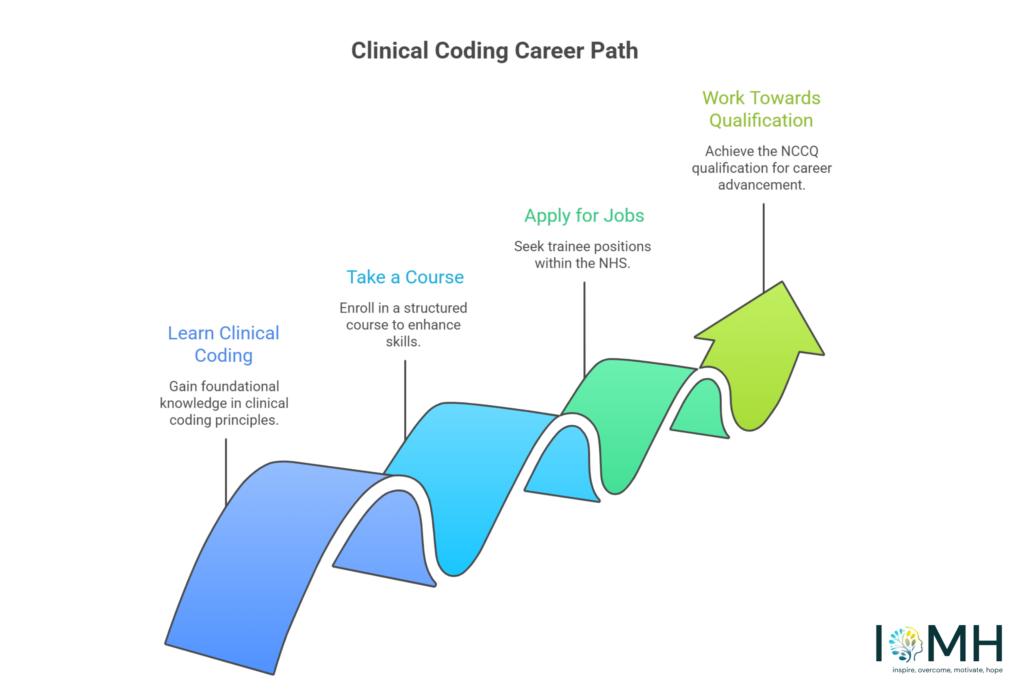
How to Start a Career in Clinical Coding
If you are interested in clinical coding, starting a career in this field is simple if you follow the right steps. It is a great option for people who want to work in healthcare but do not want direct patient contact. A career in clinical coding jobs also offers stability, growth, and long-term opportunities within the NHS.
Step 1: Learn About Clinical Coding
First, you should understand what clinical coding is and what the job involves. This includes learning how medical information is turned into standard codes used in hospitals and clinical coding NHS departments.
Step 2: Take a Clinical Coding Course
Next, join a clinical coding course UK. This will teach you the basic skills, including how to use coding systems and understand medical records. A good clinical coding course is the foundation for your career.
Step 3: Build Your Knowledge
Start studying medical terminology, anatomy, and coding systems. This knowledge is very important for understanding patient records and working accurately in clinical coding positions.
Step 4: Apply for Entry-Level Jobs
Once you have basic training, look for entry-level clinical coding jobs UK, such as trainee roles in NHS hospitals. These roles allow you to learn while working.
Step 5: Gain Experience
Practice is very important in clinical coding. The more experience you gain, the better your accuracy and confidence will become.
Step 6: Work Towards NCCQ Qualification
Finally, aim for the nccq qualification. This is a highly respected certification that can help you move into senior roles and improve your career opportunities.
By following these steps, you can build a strong and successful career in Health and Social Care through clinical coding..
Conclusion
Clinical coding is a vital part of the UK healthcare system. It helps the NHS manage patient data, improve services, and support funding decisions.
With growing demand for this jobs, this field offers strong career opportunities in Health and Social Care.
By completing a clinical coding course, gaining experience, and working towards NCCQ clinical coding, you can build a successful and stable career.
Whether you are just starting or looking for a career change, This is a great choice with long-term growth in the UK healthcare system.


- All Courses
 Personal Development (1283)
 Career Bundle (479)
 Management & Administration (460)
 Employability (439)
 Health & Social Care (411)
 Health and Safety (382)
 Business (320)
 Teaching & Education (268)
 IT & Software (263)
 Health and Fitness (238)
 QLS Endorsed Courses (219)
 Mental Health & Counselling (168)
 Science & Technology (153)
 Accounting & Finance (144)
 Sales & Marketing (128)
 Construction & Engineering (126)
 Art & Design (125)
 Compliance & Law (112)
 Language (86)
 Photography & Lifestyle (58)
 Animal Care (57)
 Food Safety & Hygine (53)
 Diet & Nutrition (49)
 Sports & Fitness (47)
 Makeup & Beauty (43)
 First Aid (39)
 Agriculture (2)
0 responses on "Clinical Coding in the UK: Courses, NHS Jobs, and Career Opportunities"