



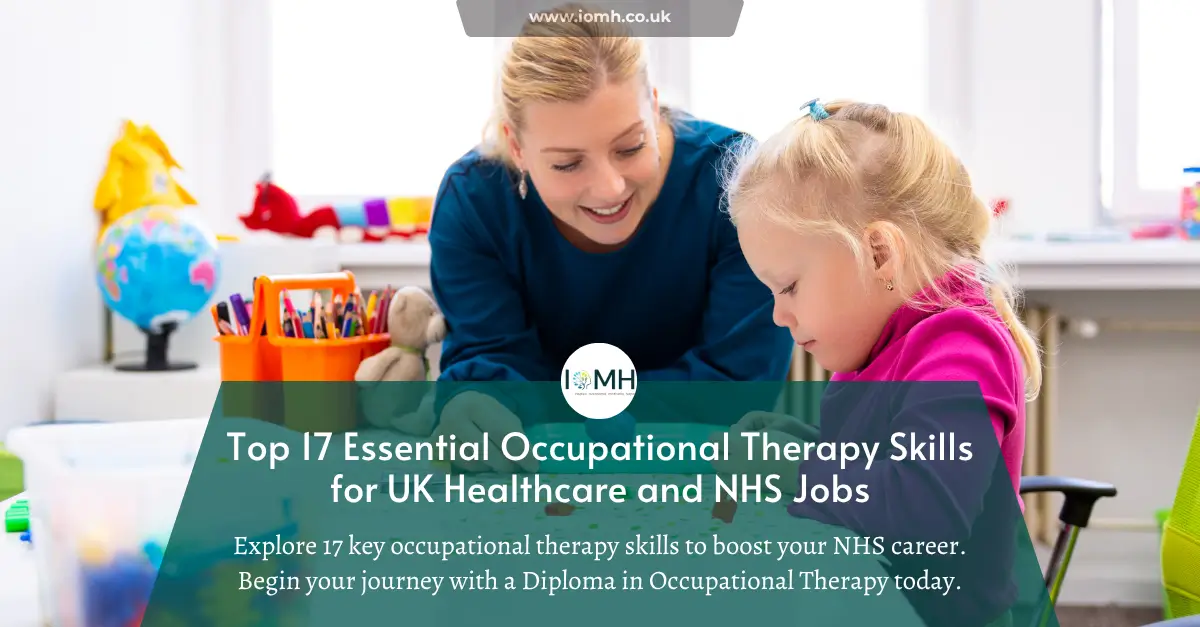
An occupational therapist helps patients recover from temporary challenges such as depression, stress-related problems, traumatic injuries, or eating disorders. They also support people living with lifelong conditions like spinal cord injuries, cerebral palsy, and muscular dystrophy. Trained to assist with everything from daily tasks like cooking, dressing, and eating, to more advanced skills such as returning to work or using a computer, occupational therapists play a vital role in helping people live independently. Their responsibilities change depending on the type of illness or disability each patient is facing.
If you are considering a Diploma in Occupational Therapy, an occupational therapy apprenticeship, or other occupational therapy courses, then you need to know the essential skills that will help you succeed. Want to discover what it takes to stand out in this career? Let’s explore the top 17 occupational therapy skills that will help you thrive in occupational therapy jobs across the UK.



What Does Occupational Therapy Mean?
Occupational therapy is about helping people live their daily lives as independently and safely as possible. Patients may be recovering from illness, adjusting to disability, or managing mental health conditions. An occupational therapy graduate works with these patients to improve mobility, build confidence, and manage everyday routines such as eating, dressing, or working.
In simple words, occupational therapy helps people do the things that matter to them, no matter what difficulties they face.
The role itself can vary widely:
- An occupational therapy assistant supports qualified therapists in hospitals, schools, and care homes.
- A fully trained therapist with a Diploma in Occupational Therapy or an occupational therapy master’s degree can assess needs, plan treatment, and create personalised rehabilitation programmes.
In the NHS, all occupational therapy services are regulated by the CQC (Care Quality Commission) to ensure patients receive safe, effective, and high-quality care.
Why Pursue a Diploma in Occupational Therapy?
A Diploma in Occupational Therapy is one of the best ways to begin your career in this rewarding field. The diploma equips you with the practical skills and knowledge needed to work in a variety of healthcare settings, from NHS hospitals to schools, care homes, and private clinics.
Here are some key reasons to consider this qualification:
- Career Opportunities: Completing a diploma or other occupational therapy courses opens doors to both NHS and private sector jobs. You could work in hospitals, care homes, or community services.
- Clear Pathways: Many people start their journey in Health and Social Care as a Nursing Assistant or support worker. These roles provide valuable hands-on experience with patients, which becomes an excellent stepping stone into occupational therapy through further study or a Diploma in Occupational Therapy.
- Flexibility: With options such as part-time study, online courses, and occupational therapy apprenticeships, you can train while balancing other responsibilities.
- Job Security: The demand for occupational therapy jobs continues to grow across the UK, and many listings appear under occupational therapy jobs near me, showing the local need.
For those wanting to specialise further, an occupational therapy master’s degree can lead to advanced roles and higher responsibility.
4. Top 17 Essential Occupational Therapy Skills for UK Healthcare and NHS Jobs

1. Empathy and Compassion
Empathy is the ability to truly understand what your patients are going through, while compassion is the drive to support them through it. Many patients feel anxious, frustrated, or even hopeless as they face daily challenges. By showing kindness and care, you help them feel understood and valued. Empathy builds trust, which is the foundation of every successful therapy session. Whether you’re an occupational therapy graduate or assistant, this skill makes patients more comfortable and motivated to work towards recovery.
2. Communication Skills
Occupational therapists must be excellent communicators. You’ll be working with patients of all ages, from children to elderly people, and each will have different levels of understanding. Sometimes you’ll need to break down complex instructions into very simple steps. You’ll also collaborate closely with doctors, nurses, and occupational therapy assistants. Clear communication ensures that patients know what to do and that other professionals understand your reports. Without strong communication skills, therapy plans can quickly become confusing or ineffective.
3. Active Listening
Listening is more than hearing words—it’s about paying attention to emotions, tone, and body language too. Patients may say they feel fine, but their behaviour might reveal they are struggling. As a therapist, practising active listening helps you design care plans that address real needs, not just surface issues. Patients also feel valued when you take time to listen to them properly. This skill strengthens trust and makes your therapy sessions more effective, whether in the NHS or private care.
4. Problem-Solving Skills
No two patients are ever alike, which means every therapy plan must be tailored. Strong problem-solving skills allow you to think creatively and practically. For example, one patient may need adaptive equipment to get dressed, while another might benefit from rearranging their home to make life easier. Occupational therapy often feels like solving puzzles, where each solution is unique to the person. In both NHS and private occupational therapy jobs, problem-solving ensures that patients regain independence in the best possible way.
5. Patience
Recovery can be slow and sometimes frustrating. Some patients improve in weeks, while others may take months or even years. As a therapist, you’ll meet people who are angry, unmotivated, or upset, but you must remain calm and supportive throughout. Patience allows you to keep encouraging them, even when progress feels small. It also makes therapy a more positive experience for patients. In occupational therapy, patience isn’t just helpful—it’s essential for building trust and achieving long-term results.
6. Adaptability
Every patient is different, and every day brings new challenges. One morning you might work with a child on motor skills, and in the afternoon, you could be supporting an elderly patient in a care home. Adaptability means adjusting your approach to suit each situation. Sometimes schedules will change suddenly, or patients may respond differently than expected. By staying flexible, you can deliver effective therapy in any setting, whether in hospitals, schools, or community care services.
7. Creativity
Occupational therapy is about more than exercises—it’s about making daily life enjoyable again. Creativity helps you design therapy sessions that feel meaningful and fun. You might use art, games, or cooking tasks to engage patients while building their confidence and skills. For children, creativity is especially powerful, turning play into therapy. A creative therapist can think of new solutions for everyday challenges, keeping patients motivated and making therapy something they look forward to instead of something they dread.
8. Critical Thinking
Therapists must make quick and safe decisions every day. Critical thinking allows you to analyse situations, identify risks, and choose the best solutions. For example, you may need to decide which piece of equipment is safest for a patient or how to adapt a workplace for someone with a disability. This skill combines knowledge with good judgement. In NHS roles, where everything must meet CQC (Care Quality Commission) standards, critical thinking ensures your care is effective, practical, and safe.
9. Organisation
An occupational therapist’s day is often busy, with multiple patients, appointments, and reports to complete. Strong organisational skills keep everything on track. You’ll need to manage therapy plans, record progress, and ensure that no details are overlooked. Organisation helps you balance patient care with paperwork, so nothing falls behind. In NHS jobs, where caseloads can be heavy, being organised also reduces stress. A well-organised therapist can give better attention to each patient while still meeting deadlines and requirements.
10. Teamwork
Occupational therapy is rarely a one-person job. You’ll be part of a team that might include doctors, nurses, physiotherapists, and assistants. Teamwork ensures patients receive complete, well-rounded care. For example, while a nurse may manage medication, you focus on daily living activities. Good teamwork requires respect, cooperation, and clear communication. By working well with others, you make care more effective and enjoyable for everyone. Teamwork is especially valued in occupational therapy NHS jobs, where collaboration is essential.
11. Time Management
Managing time is vital when you have a busy caseload. Patients rely on you to be punctual and focused, and you must balance multiple appointments in one day. Time management ensures that each session is effective and that paperwork is completed on time. Without it, you risk leaving patients waiting or rushing through care. In both NHS and private practice, good time management helps you stay professional, reduce stress, and make sure every patient receives fair and equal support.
12. Attention to Detail
In occupational therapy, even the smallest observation can be important. A slight improvement in grip strength or a small change in balance might show that therapy is working—or signal a new risk. Attention to detail ensures you spot these changes and act quickly. It’s also crucial when writing patient notes or reports, where accuracy can affect care decisions. In NHS roles, detail-oriented therapists are highly valued because they help ensure patient safety and maintain professional standards.
13. Resilience
Working in occupational therapy can be emotionally demanding. You may support patients who face lifelong conditions or encounter slow progress in recovery. Resilience allows you to handle these challenges without losing motivation. A resilient therapist bounces back from stressful days and continues to give their best. This strength not only helps you but also inspires patients to stay hopeful. Resilience proves your dedication to the profession and makes you dependable, whether you work in NHS hospitals or private practice.
14. Cultural Awareness
The UK is home to people from many different cultural and religious backgrounds. As an occupational therapist, you need to respect and understand these differences. Cultural awareness helps you design therapy that fits a patient’s lifestyle and beliefs. For example, dietary needs, clothing, or daily routines may be influenced by culture. Patients feel more comfortable and respected when you acknowledge their values. By being culturally aware, you provide inclusive care that works for everyone, no matter their background.
15. Technical Skills
Modern occupational therapy often involves technology and equipment. You may use mobility aids, assistive devices, or NHS digital systems. Having strong technical skills ensures you can handle these tools confidently and teach patients how to use them. Whether adjusting a wheelchair, setting up adaptive software, or recording patient data, technical ability makes therapy more effective. Employers value therapists who are comfortable with technology because it improves care and helps patients live more independently with the right support.
16. Leadership Skills
As you grow in your career, you may take on supervisory responsibilities. Leadership skills allow you to guide occupational therapy assistants, mentor new staff, and ensure high standards of care. A good leader supports their team, solves problems, and inspires confidence in others. Leadership is also about making sure services meet CQC (Care Quality Commission) requirements. Even early in your career, developing leadership qualities will prepare you for senior occupational therapy jobs where you can shape services and motivate teams.
17. Commitment to Continuous Learning
Healthcare is always changing, and therapists must keep learning to stay effective. Commitment to continuous learning means updating your knowledge with new techniques, attending workshops, or completing more occupational therapy courses. Some therapists also go on to study for an occupational therapy master’s degree to specialise in certain areas. Employers value professionals who never stop improving. By committing to lifelong learning, you ensure you can always provide the best care for patients and grow in your career.
Occupational Therapy Jobs and Career Growth in the UK

The UK has a growing demand for occupational therapists, especially in NHS hospitals and community services. Some professionals first gain experience in Health and Social Care as a Nursing Assistant or healthcare support worker. This early experience builds practical skills in patient care and communication, which are highly transferable when progressing into occupational therapy roles.
Career paths include:
- Occupational Therapy Assistant Jobs – supporting qualified therapists.
- Graduate Roles – for those with a diploma or degree.
- Specialist Roles – focusing on areas like paediatrics, elderly care, or mental health.
- Senior or Managerial Positions – leading services and supervising teams.
Salaries vary depending on role and experience. An occupational therapy assistant earns less to start with, while a qualified therapist’s occupational therapy salary UK usually ranges between £28,000 and £45,000. Senior roles can offer higher pay, especially in private healthcare.
Whether you search for occupational therapy jobs London or look for occupational therapy jobs near me, opportunities are expanding across the country.
How to Start Your Career in Occupational Therapy
Here’s a simple pathway to get started:
- Study a Diploma in Occupational Therapy – or choose an apprenticeship if you prefer learning while working.
- Gain Experience in Health and Social Care – roles such as Nursing Assistant or healthcare support worker are great starting points.
- Apply for Entry-Level Jobs – such as occupational therapy assistant jobs to build skills and confidence.
- Continue Learning – through further occupational therapy courses or even an occupational therapy master’s degree.
- Stay Compliant – in the NHS, all work must meet CQC (Care Quality Commission) standards.
By combining education with hands-on experience, you’ll be well-prepared for a career that changes lives.
Conclusion
Occupational therapy is one of the most rewarding professions within UK Health and Social Care. It gives you the chance to help people regain independence and improve their quality of life. Starting with a Diploma in Occupational Therapy, an apprenticeship, or even early experience as a Nursing Assistant, you can build the foundation for a fulfilling career.
The 17 essential skills—from empathy and patience to adaptability and leadership—are what make a great occupational therapist. With demand rising across the NHS and private healthcare, now is the perfect time to take your first step. If you are passionate about helping people and want a career with purpose, occupational therapy could be the ideal path for you.


- All Courses
 Personal Development (1283)
 Career Bundle (479)
 Management & Administration (460)
 Employability (439)
 Health & Social Care (411)
 Health and Safety (382)
 Business (320)
 Teaching & Education (268)
 IT & Software (263)
 Health and Fitness (238)
 QLS Endorsed Courses (219)
 Mental Health & Counselling (168)
 Science & Technology (153)
 Accounting & Finance (144)
 Sales & Marketing (128)
 Construction & Engineering (126)
 Art & Design (125)
 Compliance & Law (112)
 Language (86)
 Photography & Lifestyle (58)
 Animal Care (57)
 Food Safety & Hygine (53)
 Diet & Nutrition (49)
 Sports & Fitness (47)
 Makeup & Beauty (43)
 First Aid (39)
 Agriculture (2)
0 responses on "Top 17 Essential Occupational Therapy Skills for UK Healthcare and NHS Jobs"