



Health and social care professionals make important decisions every day. These decisions can affect the health, safety, and wellbeing of individuals receiving care. Because of this, it is important for care workers to learn from their experiences and continuously improve their practice.
Reflective practice in health and social care helps professionals think about their actions, understand what worked well, and identify areas for improvement. It supports better decision-making, improves care quality, and encourages professional development.
Whether you are a Care Assistant, Healthcare Assistant, Nursing Assistant, support worker, social worker, or studying for a Level 3 Diploma in Health and Social Care, understanding reflective practice can help you become a more effective and confident professional.



What Is Reflective Practice in Health and Social Care?
Reflective practice in health and social care is the process of thinking about and reviewing your experiences at work to improve future practice.
Instead of simply completing tasks and moving on, professionals take time to consider:
- What happened?
- Why did it happen?
- What went well?
- What could have been improved?
- What can be learned for the future?
Reflective practice helps professionals develop self-awareness and improve the quality of care they provide.
When people ask, “What is Reflective Practice in Health and Social Care?”, the simple answer is that it is a way of learning from experience to improve future care and professional performance.
Reflective practice is widely used across the NHS, Adult Social Care services, hospitals, care homes, community care settings, and social work environments.
Why Is Reflective Practice Important in Health and Social Care?
Health and social care professionals work in busy and often demanding environments where they support people with a wide range of needs. Every day, they may face situations involving communication challenges, safeguarding concerns, risk assessments, medical care, emotional support, and teamwork. Reflective practice is important because it allows professionals to think about their experiences, learn from them, and improve their future performance.
By taking time to reflect, care workers can identify what went well, recognise areas for improvement, and develop new skills. This helps ensure that individuals receive safe, effective, and person-centred care.
Reflective practice supports:
- Better patient and service user outcomes
- Improved communication skills
- Safer working practices
- Stronger safeguarding awareness
- Better teamwork and collaboration
- Greater confidence in professional roles
- Continuous learning and development
Reflective practice is also closely linked to professional standards within the NHS and Adult Social Care sector. Many organisations encourage regular reflection as part of Continuing Professional Development (CPD), helping staff maintain high standards of care and continuously improve the quality of services they provide.

Key Benefits of Reflective Practice for Care Professionals
Reflective practice offers many benefits for health and social care professionals. By regularly reviewing their experiences, workers can improve their skills, provide better support, and continue developing throughout their careers. Reflection encourages continuous learning and helps professionals deliver safe, effective, and person-centred care.
Improves Quality of Care
Reflecting on daily experiences helps professionals identify what worked well and what could be improved. This allows them to adapt their approach and provide higher-quality care that meets the individual needs of service users.
Increases Self-Awareness
Reflection helps professionals understand how their actions, attitudes, and behaviours affect the people they support. Greater self-awareness can lead to more positive interactions and improved professional practice.
Supports Better Decision-Making
By reviewing previous situations and outcomes, care professionals can learn from experience and make better decisions when facing similar challenges in the future.
Strengthens Communication Skills
Reflective practice encourages professionals to evaluate how they communicate with patients, residents, families, and colleagues. This can help improve listening skills, empathy, and overall communication effectiveness.
Enhances Safeguarding Practice
Reflecting on safeguarding concerns helps workers review their actions, identify lessons learned, and improve future reporting and risk management procedures.
Builds Confidence
Learning from both successes and challenges helps professionals develop confidence in their knowledge, skills, and ability to provide high-quality care.
Supports Emotional Wellbeing
Health and social care work can be emotionally demanding. Reflective practice gives professionals an opportunity to process difficult experiences, reduce stress, and build emotional resilience.
Examples of Reflective Practice in Health and Social Care
Reflective practice can take place in many different situations within health and social care settings. Professionals often use reflection to review their actions, identify lessons learned, and improve future practice. Whether the experience was positive or challenging, reflection helps workers develop their skills and provide better care.
Reflecting After a Communication Challenge
A Healthcare Assistant notices that a patient seemed confused after receiving information about their care plan. After reflecting on the interaction, they realise that using simpler language, speaking more slowly, and checking the patient’s understanding could have improved communication. This helps them communicate more effectively in future situations.
Reflecting After a Medication Incident
A Nursing Assistant reflects on a delay in medication administration that occurred because important information was not shared properly during a shift handover. By reviewing what happened, they identify ways to improve communication and ensure smoother handovers in the future.
Reflecting on Safeguarding Concerns
A support worker reviews how they handled a safeguarding concern involving a vulnerable individual. They reflect on whether they recognised the signs quickly enough and followed the correct reporting procedures. This helps strengthen their safeguarding knowledge and confidence.
Reflecting After a Complaint
A Care Assistant receives feedback from a family member who felt communication could have been better. The Care Assistant reflects on the situation and identifies practical ways to improve communication and build stronger relationships with families.
Reflecting on Teamwork
A care professional reflects on a disagreement within the team that affected service delivery. By considering different viewpoints and communication styles, they identify ways to improve teamwork, collaboration, and problem-solving in future situations.

Reflective Practice in Different Care Settings
Reflective practice is used across all areas of health and social care. It helps professionals and carers think about their experiences, learn from situations, and improve the quality of support they provide. Different care settings use reflection in slightly different ways depending on the needs of the people they support.
Hospitals and NHS Services
In hospitals and NHS services, reflective practice is widely used to improve patient safety, clinical decision-making, and communication between staff. Healthcare professionals often reflect on emergencies, treatment decisions, and teamwork to ensure continuous improvement in care delivery.
Care Homes
In care homes, staff use reflective practice to improve daily care for residents. This includes areas such as dementia care, falls prevention, nutrition and hydration support, and promoting overall wellbeing. Reflection helps care workers provide more compassionate and person-centred care.
Adult Social Care
In Adult Social Care, professionals reflect on safeguarding situations, care planning, and support for vulnerable individuals. This helps ensure that care is safe, respectful, and tailored to each person’s needs.
Community Care
Community care workers use reflection after home visits and interactions with individuals and families. They review risk assessments, communication methods, and support plans to improve the quality of care provided in the community.
Informal Care in Health and Social Care
Even in Informal Care in Health and Social Care, such as family members supporting loved ones at home, reflection can be valuable. It helps carers think about what support works best, manage challenges more effectively, and maintain their own emotional and physical wellbeing.
Best Practices for Effective Reflective Practice
To get the most benefit from reflective practice in health and social care, professionals should follow some simple but important best practices. These help ensure reflection leads to real learning, improvement, and better care for service users.
Be Honest
It is important to reflect honestly on both strengths and areas for improvement. Being open about what went well and what did not helps professionals grow and improve their practice.
Reflect Regularly
Reflection should be part of everyday practice, not something done only after serious incidents. Regular reflection helps professionals continuously improve their skills and decision-making.
Focus on Learning
The main purpose of reflection is learning and development, not self-criticism. Professionals should focus on what they can learn from each situation to improve future care.
Use Evidence
Good reflection is based on real information such as feedback from service users, observations, care records, and outcomes. This helps ensure reflections are accurate and meaningful.
Create Action Plans
After reflecting, professionals should identify clear and practical steps for improvement. This ensures that learning is applied in future practice.
Discuss Reflections
Sharing reflections in supervision sessions or team meetings can provide valuable feedback and support. It also helps improve teamwork and ensures consistent high-quality care across services.

Common Models of Reflective Practice
Many health and social care professionals use structured models of reflection to help them think clearly about their experiences. These models provide a simple framework that guides reflection and ensures learning is useful and consistent.
Gibbs’ Reflective Cycle
Graham Gibbs developed this model in 1988. It is one of the most widely used reflective models in health and social care. It includes six clear stages:
- Description
- Feelings
- Evaluation
- Analysis
- Conclusion
- Action Plan
This structure helps professionals break down an experience and identify exactly what can be improved for the future.

Kolb’s Learning Cycle
Kolb’s model focuses on learning through experience. It is often used in training and professional development. The cycle includes:
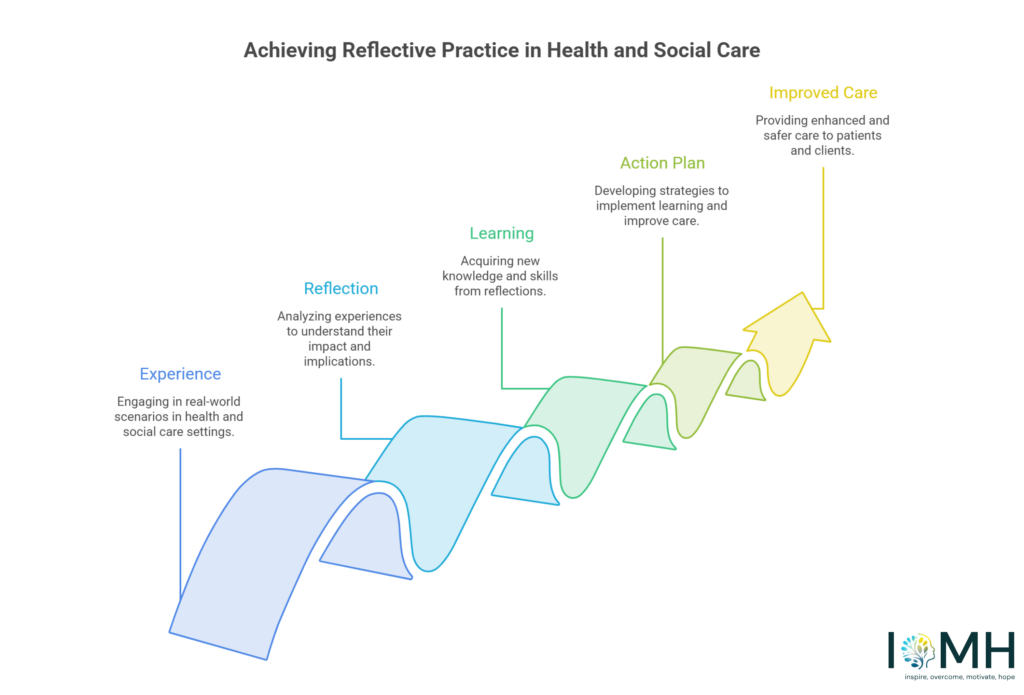
- Experience
- Reflection
- Learning
- Application
It highlights how real-life experiences can be turned into meaningful learning and future improvement.
Driscoll’s Model of Reflection
Driscoll’s model is simple and easy to use. It is based on three key questions:
- What?
- So What?
- Now What?
This model is popular in health and social care because it is quick to apply and works well in busy environments.
Johns’ Model of Reflection
Johns’ model encourages deeper and more detailed reflection. It focuses on emotions, actions, ethics, and professional knowledge. This helps professionals understand not just what happened, but why it happened and how it connects to professional values and care standards.
Challenges of Reflective Practice and How to Overcome Them
Although reflective practice in health and social care has many benefits, professionals may also face some challenges when trying to apply it in their daily work. Understanding these challenges and knowing how to overcome them can make reflection more effective and meaningful.
Lack of Time
One of the most common challenges is a lack of time. Busy workloads, shift patterns, and staffing pressures can make it difficult for staff to reflect properly.
Solution: Professionals can manage this by setting aside short reflection periods after shifts or using supervision sessions to reflect on key experiences.
Fear of Criticism
Some staff may worry that reflecting on mistakes could lead to criticism or judgement from others.
Solution: Organisations should promote a positive and supportive culture where reflective practice is seen as a learning tool, not a way to blame staff.
Emotional Difficulty
Reflecting on difficult situations such as safeguarding concerns, emergencies, or end-of-life care can be emotionally challenging.
Solution: Staff should seek support from supervisors, mentors, or colleagues and take time to process their emotions in a safe environment.
Limited Training
Some workers may not fully understand how to carry out reflective practice effectively.
Solution: Including reflective practice in Care Assistant Training, Nursing Assistant development, and Health and Social Care Level 3 programmes can help improve confidence and skills in reflection.
Reflective Practice and Professional Development
Reflective practice in health and social care plays a key role in supporting ongoing professional development and career growth. It helps professionals learn from their everyday experiences and use that learning to improve their skills and knowledge over time.
Reflective practice supports:
- Continuing Professional Development (CPD)
- Professional registration requirements
- Skills development
- Leadership development
- Career progression
By reflecting regularly, care professionals can identify what they are doing well and where they need further improvement. This helps them set clear learning goals and continuously improve their practice.
Students studying a Diploma in Health and Social Care or a Health and Social Care Level 3 Diploma are often required to show reflective learning in their assignments and practical work. Reflection is an important part of building understanding and applying knowledge in real care settings.
Reflective practice is also widely used in:
- Level 3 Diploma in Health and Social Care
- Health and Social Care level 3 programmes
- Care Assistant Training courses
- Nursing Assistant training
- Healthcare Assistant development programmes
By using reflective practice consistently, professionals in the NHS, Adult Social Care, and other care settings can continue to build confidence, improve performance, and provide higher-quality, person-centred care.

How Technology Supports Reflective Practice in Health and Social Care
Technology is making reflective practice in health and social care easier, faster, and more effective. Digital tools help professionals record their reflections, track progress, and improve the quality of care they provide.
Digital Reflective Journals
Electronic reflective journals allow care professionals to record their experiences securely. They can also track learning over time, making it easier to see progress and identify areas for improvement.
Mobile Applications
Mobile apps support reflective practice by providing quick access to reflection prompts, reminders, and Continuing Professional Development (CPD) tracking tools. This is especially helpful for busy Care Assistants, Healthcare Assistants, and Nursing Assistants working in fast-paced environments.
E-Learning Platforms
Online learning systems support reflective exercises and professional development activities. These platforms allow staff to revisit training materials, complete reflective tasks, and strengthen their knowledge and skills.
Data Analytics
Organisations can use data analytics to review trends in incidents, complaints, and feedback. This helps identify patterns and areas that need improvement, supporting better decision-making and reflective learning.
Electronic Care Records
Electronic Care Records help professionals review care decisions, treatment plans, and outcomes more accurately. This improves communication, accountability, and the quality of reflection.
As technology continues to develop, reflective practice is becoming more accessible and integrated across the NHS, Adult Social Care, and wider health and social care services.
Conclusion
Reflective practice in health and social care is an essential tool for learning, professional growth, and continuous improvement. By regularly reviewing experiences, professionals can improve communication, strengthen safeguarding practice, enhance decision-making, and deliver higher-quality care.
Whether you work within the NHS, Adult Social Care, community care, residential care, or are studying for a Level 3 Diploma in Health and Social Care, reflective practice can help you become a more effective and confident professional.
By combining regular reflection with training, supervision, and modern technology, health and social care professionals can continue providing safe, compassionate, and person-centred care while supporting their own professional development.
Frequently Asked Questions
Reflective practice in health and social care is the process of reviewing experiences, actions, and decisions to improve future care and professional performance.
It helps professionals improve care quality, develop skills, strengthen communication, and learn from experience.
Reflective practice is used by Care Assistants, Healthcare Assistants, Nursing Assistants, nurses, social workers, support workers, managers, and other health and social care professionals.
Benefits include improved care quality, better communication, stronger safeguarding awareness, increased confidence, and ongoing professional development.
Gibbs’ Reflective Cycle is one of the most commonly used models in health and social care because it provides a clear and structured approach.
Yes. Reflective practice is commonly included in the Level 3 Diploma in Health and Social Care and many other professional training programmes.
Reflection helps professionals recognise unconscious bias, improve cultural awareness, and provide inclusive, person-centred care to individuals from diverse backgrounds.
Reflection helps professionals evaluate whether their practice follows current laws, regulations, safeguarding duties, and professional standards.


- All Courses
 Personal Development (1283)
 Career Bundle (479)
 Management & Administration (460)
 Employability (439)
 Health & Social Care (411)
 Health and Safety (382)
 Business (320)
 Teaching & Education (268)
 IT & Software (263)
 Health and Fitness (238)
 QLS Endorsed Courses (219)
 Mental Health & Counselling (168)
 Science & Technology (153)
 Accounting & Finance (144)
 Sales & Marketing (128)
 Construction & Engineering (126)
 Art & Design (125)
 Compliance & Law (112)
 Language (86)
 Photography & Lifestyle (58)
 Animal Care (57)
 Food Safety & Hygine (53)
 Diet & Nutrition (49)
 Sports & Fitness (47)
 Makeup & Beauty (43)
 First Aid (39)
 Agriculture (2)
0 responses on "Reflective Practice in Health and Social Care: Examples, Benefits and Best Practices for Care Professionals"