


Choosing between Level 1 and Level 2 safeguarding training can be confusing, especially when different jobs have different requirements. Understanding the differences will help you choose training that suits your responsibilities.
The main difference between Level 1 and Level 2 safeguarding is the depth of knowledge expected. Level 1 generally focuses on recognising safeguarding concerns and knowing how to report them. Level 2 builds on that knowledge, with more attention to responding appropriately, following procedures and escalating concerns.
However, safeguarding levels are not standardised across every UK sector. The right training depends on your role, workplace and applicable guidance.
If you’re looking to build your safeguarding knowledge, IOMH’s Online Safeguarding Course – Level 2 offers flexible online learning covering safeguarding principles, procedures, documentation and relevant legislation. It’s a practical option to explore if you need more detailed safeguarding training, subject to your employer’s requirements.
Level 1 vs Level 2 Safeguarding: Key Differences
Both levels support safer working practices, but they usually involve different learning expectations.
| Comparison | Level 1 Safeguarding | Level 2 Safeguarding |
|---|---|---|
| Main focus | Basic safeguarding awareness | More detailed safeguarding knowledge |
| Learning depth | Introductory | Builds on foundational learning |
| Recognising abuse | Identifying common signs and concerns | Understanding concerns in greater depth |
| Reporting concerns | Knowing when and how to report | Understanding reporting and escalation procedures |
| Safeguarding procedures | Basic workplace responsibilities | More detailed procedures and appropriate responses |
| Typical learners | Staff needing introductory awareness | Staff whose responsibilities require additional knowledge |
| Training requirements | Depend on role and sector | Depend on role and sector |
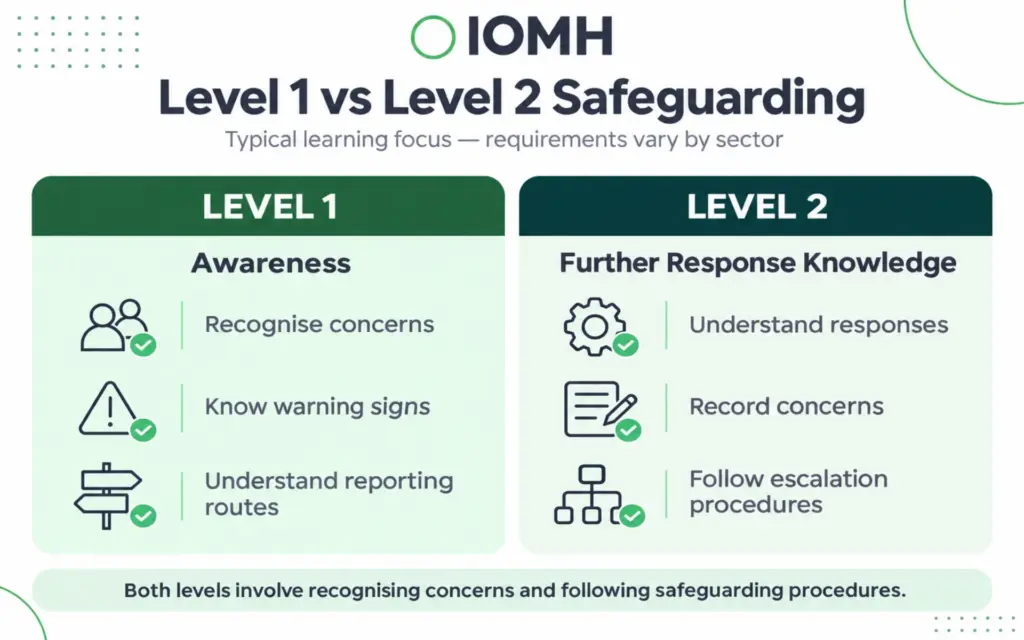
The distinction is especially clear in the 2025 healthcare safeguarding competencies, which describe Level 1 as Recognition and Level 2 as Response.
This does not mean Level 1 learners only recognise concerns or that Level 2 learners are authorised to investigate abuse. Everyone must respond appropriately within their role and follow safeguarding procedures.
What Is Level 1 Safeguarding Training?
Level 1 safeguarding training introduces the knowledge needed to recognise potential abuse, neglect and exploitation. It helps learners understand their responsibilities and know what to do when something seems wrong.
What Does Level 1 Safeguarding Cover?
Introductory training typically explains different forms of abuse, common warning signs, professional responsibilities and the importance of reporting concerns promptly.
For example, a volunteer might notice that someone they support appears frightened around a particular individual. Safeguarding awareness helps them recognise that the situation may require attention and understand how to raise the concern.
Level 1 may be suitable for people who need introductory safeguarding knowledge. However, some roles require additional competencies even when they involve limited direct contact with vulnerable people.
Understanding why safeguarding is important can also help beginners appreciate why early recognition and appropriate reporting matter.


What Is Level 2 Safeguarding Training?
Level 2 safeguarding training generally builds on introductory awareness and develops a more detailed understanding of safeguarding responsibilities.
It is particularly relevant when an individual’s duties require additional knowledge of recognising concerns, responding appropriately and following organisational procedures.
What Does Level 2 Safeguarding Cover?
Although course content varies, common areas include safeguarding legislation, indicators of abuse and neglect, responding to disclosures, information sharing, documentation, referral procedures and escalation.
For instance, someone undertaking Level 2 training may explore how to record a concern accurately, who should receive the information and what to do if the usual reporting route is unavailable.
These skills support appropriate action rather than independent investigations, which require specific responsibilities and expertise.
For a deeper explanation, read our Safeguarding Level 2.
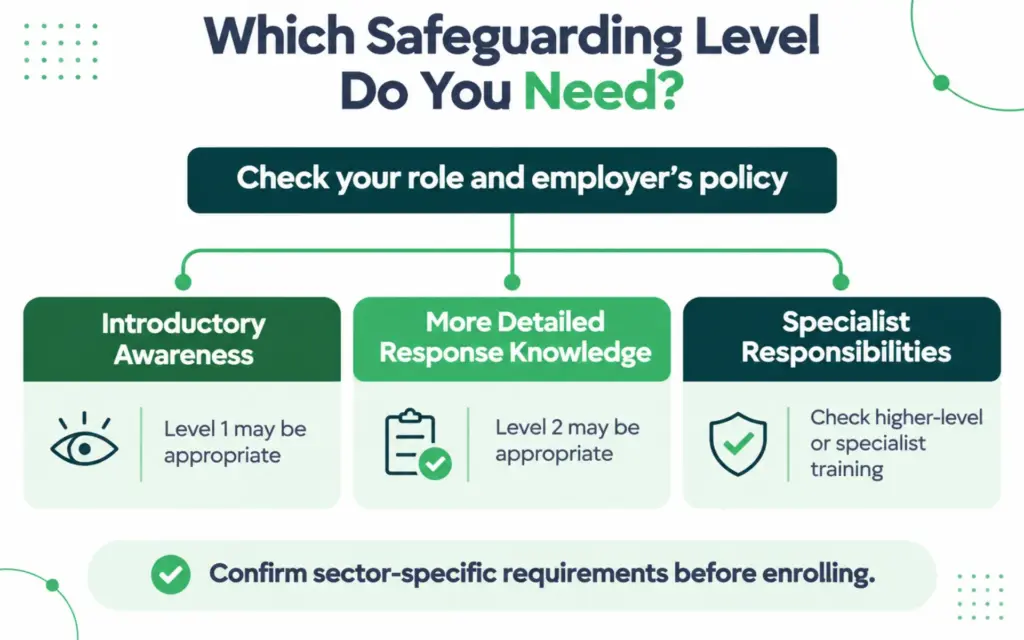
Which Safeguarding Level Do You Need for Your Job?
The most suitable level depends on your responsibilities, the people you work with and your employer’s training requirements.
When Might Level 1 Be Suitable?
Introductory safeguarding training may be appropriate for staff or volunteers who need foundational knowledge of recognising and reporting concerns.
This could include people beginning voluntary work, joining community organisations or preparing for roles where safeguarding awareness is relevant.
However, introductory training alone may not meet the requirements of their particular position.
When Might Level 2 Be Suitable?
Level 2 may be appropriate for workers who require additional safeguarding knowledge because of their contact with children or adults at risk, or their responsibilities within an organisation.
Consider these examples:
| Workplace Role | Training Considerations |
|---|---|
| Care worker | May need more detailed knowledge of recognising, reporting and responding to safeguarding concerns |
| Teaching assistant | Must complete training appropriate to school responsibilities and safeguarding policy |
| Healthcare support worker | Relevant healthcare competency requirements depend on the role and contact with patients |
| Community support worker | Training should reflect the people supported and the organisation's procedures |
| Volunteer | Requirements depend on safeguarding responsibilities and the setting |
These are examples, not universal training rules.
In healthcare, the 2025 intercollegiate framework expects some non-clinical staff who encounter children to have Level 2 competencies, while clinical staff providing services to children generally require Level 3 competencies.
For schools in England, Keeping Children Safe in Education 2026 requires appropriate safeguarding and child protection training. It does not prescribe one universally named Level 2 course for every employee.
If you are comparing occupational requirements, explore who needs Level 2 safeguarding training.
Before enrolling, check your job description, employer’s safeguarding policy and relevant professional guidance. A course’s level label alone does not guarantee that it meets your workplace requirements.
Can You Take Level 2 Safeguarding Without Level 1?
Yes, some training providers allow learners to enrol directly on Level 2 safeguarding courses without first completing a separate Level 1 programme.
However, this depends on the provider and the requirements of your role. Certain professional frameworks expect learners to demonstrate competencies across both levels, whether through combined or separate training.
For example, IOMH’s Level 2 safeguarding course has no formal educational qualification or previous experience requirements. Learners must be at least 16 years old.
If you already have relevant workplace knowledge, direct entry may be a suitable learning option. Nevertheless, confirm whether your employer requires specific prior training or assessments.
Level 1 vs Level 2 Safeguarding: A Practical Example

Imagine a care worker notices that an older resident has unexplained bruising and becomes unusually anxious when a particular person enters the room.
With Level 1 safeguarding awareness, the worker should recognise that these observations may indicate a concern. They should take the situation seriously, follow reporting procedures and avoid making unsupported assumptions.
With more developed Level 2 knowledge, the worker may better understand how to document observations objectively, respond to any disclosure, share information appropriately and follow the relevant escalation process.
Importantly, neither level gives a worker automatic authority to conduct a formal safeguarding investigation.
The essential principle is the same: act promptly, follow the appropriate procedures and prioritise the person’s safety. Training should help workers understand how to do this within their responsibilities.
How to Choose an Online Level 2 Safeguarding Course
Before choosing a course, consider what you need to learn and whether the programme matches your workplace requirements.
Start by reviewing the course curriculum. Check whether it addresses safeguarding children, adults or both, and whether the learning outcomes are relevant to your role.
Next, look at the assessment arrangements, study format and certification options. Online training can offer flexibility, but employers may also require workplace induction, practical learning or other role-specific training.
Finally, verify the certificate type rather than assuming every course labelled Level 2 leads to the same qualification.
Is a Level 2 Safeguarding Certificate a Qualification?
Not necessarily. A Level 2 safeguarding course may provide a completion certificate or professional development certificate without awarding a regulated qualification.
For example, a Quality Licence Scheme (QLS) endorsement applies to non-regulated learning. A QLS Certificate of Achievement is not the same as an Ofqual-regulated Level 2 qualification.
Always check the awarding organisation and qualification status if a job specifically requires a regulated qualification.
Final Thoughts: Choosing Between Level 1 and Level 2 Safeguarding
The difference between Level 1 and Level 2 safeguarding comes down to learning depth and the responsibilities your training needs to support.
Level 1 generally provides introductory safeguarding awareness, while Level 2 develops more detailed knowledge of safeguarding procedures and appropriate responses. Neither course level automatically meets every workplace requirement.
Ready to develop your safeguarding knowledge further? IOMH’s Online Safeguarding Course – Level 2 covers identifying concerns, safeguarding procedures, documentation and relevant legislation through flexible online study. With 12 months’ course access and optional certificates available after successful completion, you can explore the curriculum and choose whether it meets your learning needs. Explore the course and take your next step in safeguarding training.
FAQs
Level 3 safeguarding involves more advanced knowledge and responsibilities. In the children’s healthcare competency framework, it includes action and safeguarding expertise relevant to clinical staff providing services to children and young people. However, Level 3 is not automatically equivalent to designated safeguarding lead training in every sector.
Not always. Level 2 may describe the depth of a training course rather than a regulated qualification. IOMH’s Level 2 safeguarding course is QLS-endorsed non-regulated training, with certificate options available after successful completion. Check the qualification status if your employer requires a formally regulated award.
Yes. Some safeguarding frameworks include Levels 4 and 5. In the children’s healthcare framework, Level 4 relates to leadership and additional safeguarding responsibilities, while Level 5 involves strategic oversight. These levels are not applied identically across every sector.
For the wider framework, see: safeguarding training levels
The duration depends on the training provider, learning format and assessment requirements. Some short online programmes take only a few hours, while more extensive courses require additional study.
IOMH lists 1 week, 5 days as the duration of its Level 2 safeguarding course, alongside 12 months’ course access. This advertised duration should not be treated as a fixed number of study hours for every learner.

- All Courses
 Personal Development (1283)
 Career Bundle (479)
 Management & Administration (460)
 Employability (439)
 Health & Social Care (416)
 Health and Safety (383)
 Business (320)
 Teaching & Education (268)
 IT & Software (263)
 Health and Fitness (238)
 QLS Endorsed Courses (219)
 Mental Health & Counselling (169)
 Science & Technology (153)
 Accounting & Finance (144)
 Sales & Marketing (128)
 Construction & Engineering (126)
 Art & Design (125)
 Compliance & Law (112)
 Language (86)
 Photography & Lifestyle (58)
 Animal Care (57)
 Food Safety & Hygine (53)
 Diet & Nutrition (49)
 Sports & Fitness (47)
 Makeup & Beauty (43)
 First Aid (39)
 Agriculture (2)
0 responses on "Level 1 vs Level 2 Safeguarding: Which Do You Need?"