



Why Legal Protection Is Crucial for UK Healthcare Professionals
Healthcare professionals in the UK face increasing scrutiny from regulators, patients, and the media. From clinical errors to ethical dilemmas, even well-intentioned decisions can lead to complaints, investigations, or litigation. The Francis Inquiry and the Williams Review have shown how system failures can unfairly expose individuals to blame.
Legal protection ensures that professionals are not left vulnerable when things go wrong. It provides a framework for fair investigation, proportionate accountability, and access to support when facing regulatory or legal challenges.
What Is UK Health Law?
UK health law is the legal framework that governs how healthcare is delivered, regulated, and safeguarded across the country. For healthcare professionals, understanding these laws isn’t just about compliance—it’s about protecting patients, defending your practice, and ensuring ethical, high-quality care.
Your Legal Rights as a Healthcare Professional in the UK
As a healthcare professional in the UK, you are not only a caregiver—you are also a rights-holder. The NHS Constitution, professional codes of conduct, and national legislation collectively protect your ability to practise safely, ethically, and with dignity.
Key Legal Rights You’re Entitled To
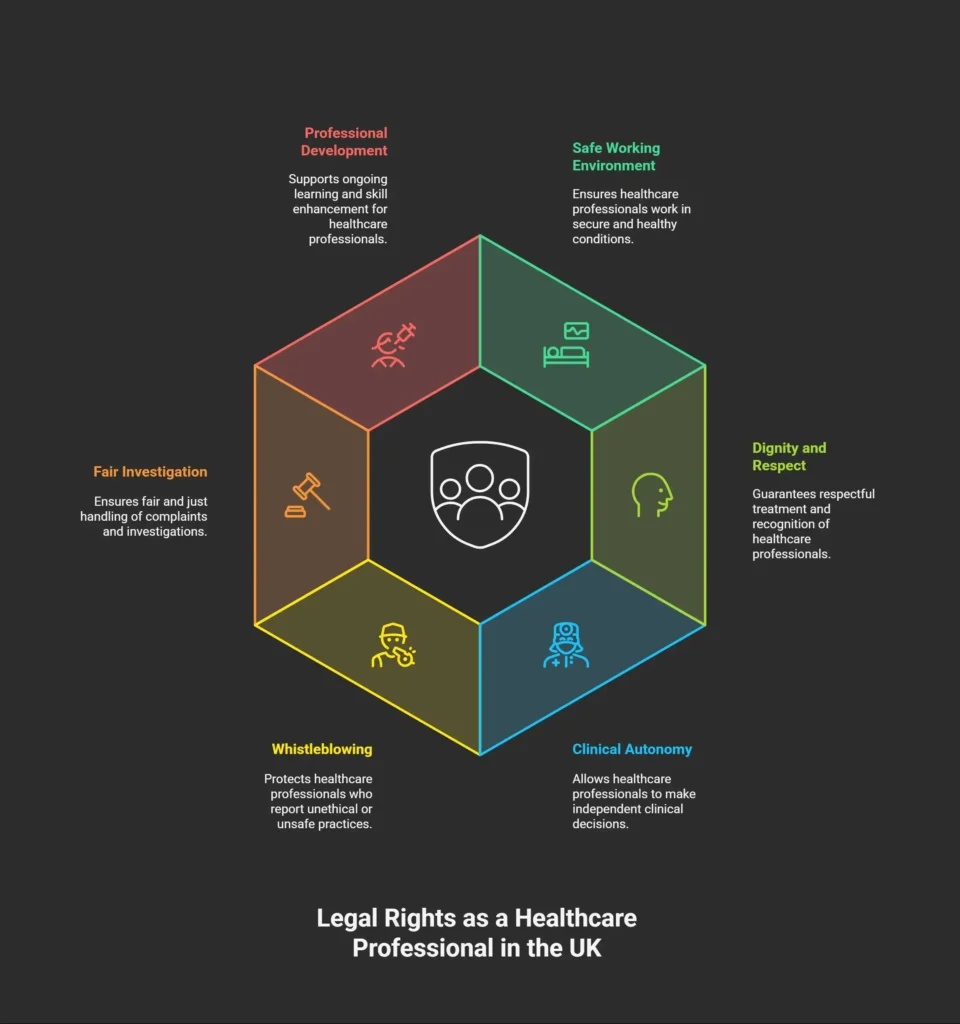
Whether you work in the NHS or a private setting, your legal rights include:
- Right to a safe working environment protected under the Health and Safety at Work Act 1974 and reinforced by NHS Trust policies.
- Right to be treated with dignity and respect is enshrined in the Human Rights Act 1998 and the NHS Constitution, this includes protection from harassment, discrimination, and abuse.
- Right to clinical autonomy You are entitled to exercise professional judgement within the scope of your training and regulatory standards, such as those set by the GMC, NMC, or HCPC.
- Right to raise concerns (whistleblowing) Under the Public Interest Disclosure Act 1998, you are legally protected when reporting unsafe practices, misconduct, or systemic failures.
- Right to fair investigation and representation. If you face a complaint or regulatory inquiry, you have the right to legal support, union representation, and a fair process.
- Right to continuing professional development (CPD) Employers must support your access to training and education under employment law and NHS workforce policies.
Understanding GMC, NMC, and HCPC: Who Regulates Your Practice?
Legal protection for healthcare professionals in the UK is closely tied to the work of regulatory bodies. These organisations don’t just enforce standards—they also safeguard your professional rights, ensure fair investigations, and promote safe, ethical care.
General Medical Council (GMC)
The GMC is the independent regulator for doctors and, since 2024, also for physician associates and anaesthesia associates.
Nursing and Midwifery Council (NMC)
The NMC regulates over 700,000 professionals across the UK. It maintains a public register, sets standards for education and conduct, and investigates concerns about fitness to practise.
Health and Care Professions Council (HCPC)
The HCPC regulates 15 professions, including paramedics, physiotherapists, radiographers, and occupational therapists. Its fitness to practise process focuses on current risk rather than past mistakes.
Medical Negligence and Duty of Care
Even the most skilled and compassionate healthcare professionals can face legal scrutiny when outcomes go wrong. Understanding how UK law defines medical negligence and the duty of care is essential for protecting your practice and your patients.
What Is Medical Negligence?
Medical negligence—also known as clinical negligence—occurs when a healthcare professional provides substandard care that results in harm, injury, or deterioration of a patient’s condition. It applies to both NHS and private treatment.
To succeed in a legal claim, three elements must be proven:
- 01. Duty of care: You had a legal responsibility to care for the patient.
- 02. Breach of duty: Your actions fell below acceptable professional standards.
- 03. Causation: The breach directly caused harm or worsened the patient’s condition.
What Is the Duty of Care in UK Healthcare?
The duty of care is a legal and professional obligation to act in the best interests of patients. It applies to all healthcare roles—from consultants and nurses to paramedics and support workers.

Legal Tests: Bolam and Bolitho Principles
UK courts use two key tests to assess negligence:
- Bolam Test: Was the practitioner’s action supported by a responsible body of clinical opinion?
- Bolitho Test: Is that opinion logically defensible and not merely respectable?
These tests ensure that clinical judgement is respected—but also held accountable.
What Happens If You’re Accused?
If a patient alleges negligence:
- The case may be handled by NHS Resolution (for NHS staff) or through civil litigation.
- You’ll need to demonstrate that your care met professional standards and that any harm was not caused by your actions.
- Legal support, union representation, and indemnity cover are essential.
Most claims are resolved without going to court, but the process can be lengthy and emotionally taxing.
Protecting Yourself in Practice
To reduce risk:
- Document thoroughly and accurately.
- Follow clinical guidelines and protocols.
- Communicate clearly with patients and colleagues.
- Seek advice when unsure—especially in complex or high-risk cases.
Healthcare Assistant Training
How to Handle Complaints and Investigations
The NHS Complaints Procedure
Under the NHS Constitution, patients have the right to complain about any aspect of care, treatment, or service. Complaints can be made directly to the provider (e.g. GP, hospital, clinic) or to the commissioner of services (e.g. Integrated Care Board).
The standard process includes:
- 01. Local Resolution: Most issues are resolved informally by speaking to staff or using feedback forms.
- 02. Formal Complaint: Submitted in writing or online, often with support from the Patient Advice and Liaison Service (PALS).
- 03. Escalation: If unresolved, complaints can be referred to the Parliamentary and Health Service Ombudsman.
Healthcare professionals involved in complaints should:
- Respond promptly and professionally.
- Document all relevant interactions and decisions.
- Seek advice from their employer, union, or legal advisor.
Regulatory Investigations: What to Expect
If a complaint escalates to a professional regulator (GMC, NMC, HCPC), the process may involve:
- Initial triage and evidence review.
- Fitness to practise hearings.
- Possible sanctions, suspension, or removal from the register.
These investigations are not criminal trials—but they can have serious career implications. Legal representation and emotional support are strongly recommended.
Patient Safety Investigations: Learning, Not Blame
The Health Services Safety Investigations Body (HSSIB) conducts independent reviews of serious patient safety incidents across England. These investigations:
- Focus on system learning, not individual blame.
- Are confidential and legally protected.
- Aim to improve care through national recommendations.
If you’re involved in an HSSIB investigation, you’ll be treated as a contributor—not a defendant. Still, it’s wise to seek guidance from your employer or legal team.
Legal Support for Healthcare Professionals
Several organisations offer expert legal advice and representation:
- BMA Law: Provides support for doctors on GMC matters, employment disputes, and partnership agreements.
- Doctors' Defence Service (DDS): Offers medico-legal advice, defence in fitness to practise hearings, and representation in civil or criminal matters.
- Medical Defence Organisations: Such as MDU, MPS, and MDDUS, offer indemnity cover and legal support for members.
These services can help you:
- Draft responses to complaints.
- Prepare for hearings or interviews.
- Understand your rights and obligations.
- Protect your professional registration.
Proactive Protection: What You Can Do
To minimise risk:
- Maintain accurate, timely documentation.
- Communicate clearly and respectfully with patients.
- Follow clinical guidelines and ethical standards.
- Seek early advice when concerns arise.
Ethical Standards in UK Healthcare
Legal protection may shield you from unfair treatment—but it’s ethical practice that earns public trust. In the UK, healthcare ethics are not just philosophical ideals; they are embedded in professional codes, regulatory standards, and everyday clinical decisions.

What Are Ethical Standards in Healthcare?
Ethical standards are the moral principles that guide how healthcare professionals behave, make decisions, and interact with patients and colleagues. They go beyond legal compliance to promote integrity, compassion, and fairness in care delivery.
The Health and Care Professions Council (HCPC) outlines ten core ethical duties, including:
- Promoting the interests of service users.
- Communicate effectively and respectfully.
- Managing risk and reporting safety concerns.
- Being honest, trustworthy, and open when things go wrong.
The British Medical Association (BMA) adds further depth, especially for doctors, with guidance on:
- Consent and refusal of treatment.
- Confidentiality and health records.
- Ethical dilemmas in end of life care.
- Responsibilities in safeguarding and mental capacity.
Key Ethical Principles Every Clinician Should Uphold
Across professions, the following principles are widely recognised:
- Autonomy: Respecting patients’ rights to make informed decisions—even when those decisions differ from clinical advice.
- Beneficence: Acting in the patient’s best interests to promote health and wellbeing.
- Non-maleficence: Avoiding harm through careful, evidence-based practice.
- Justice: Providing fair, equitable care regardless of background, identity, or ability to pay.
- Confidentiality: Protecting patient information and only sharing it when legally or ethically justified.
These principles are echoed in the Public Health Ethics Framework, which also emphasises transparency, accountability, and proportionality in decision-making during public health interventions.
Ethics in Action: Common Dilemmas
Ethical challenges often arise in:
- End-of-life care: Balancing patient wishes, family input, and clinical judgement.
- Mental Health Treatment: Assessing capacity and respecting autonomy while ensuring safety.
- Safeguarding: Deciding when to breach confidentiality to protect vulnerable individuals.
- Resource Allocation: Making fair decisions in times of scarcity, such as during pandemics.
In each case, ethical reasoning complements legal guidance—helping clinicians make defensible, compassionate choices.
Conclusion: Stay Protected, Stay Informed
Legal protection is essential for every UK healthcare professional. From safeguarding your clinical decisions to navigating complaints and ethical dilemmas, understanding health law empowers you to practise safely and confidently.
Key points to remember:
- Know your rights under UK health law and the NHS Constitution.
- Follow ethical standards to strengthen legal protection.
- Engage with regulators like GMC, NMC, and HCPC.
- Seek legal support early when facing complaints or investigations.
- Stay updated on reforms that affect your practice.
Legal literacy isn’t just defence—it’s professional empowerment. Stay informed, stay protected, and continue delivering care with confidence.


- All Courses
 Personal Development (1283)
 Career Bundle (479)
 Management & Administration (460)
 Employability (439)
 Health & Social Care (411)
 Health and Safety (382)
 Business (320)
 Teaching & Education (268)
 IT & Software (263)
 Health and Fitness (238)
 QLS Endorsed Courses (219)
 Mental Health & Counselling (168)
 Science & Technology (153)
 Accounting & Finance (144)
 Sales & Marketing (128)
 Construction & Engineering (126)
 Art & Design (125)
 Compliance & Law (112)
 Language (86)
 Photography & Lifestyle (58)
 Animal Care (57)
 Food Safety & Hygine (53)
 Diet & Nutrition (49)
 Sports & Fitness (47)
 Makeup & Beauty (43)
 First Aid (39)
 Agriculture (2)
0 responses on "Legal Protection and Rights for Healthcare Professionals in the UK Under Health Law"