



What Is the Health and Social Care GCSE?
The Health and Social Care GCSE is a nationally recognised qualification offered to students in Keacross England, Wales, and Northern Ireland. Designed to introduce learners to the principles of health, wellbeing, and care provision, this course bridges academic study with real-world relevance—making it an ideal choice for students interested in careers within the NHS, social services, or early years education.
Through a combination of theory and practical application, students explore how health and social care professionals support individuals across the lifespan. Topics range from human development and communication skills to safeguarding and ethical responsibilities in care settings.
Whether you’re aiming for a future in nursing, social work, or public health, the GCSE Health and Social Care provides a strong foundation for further study and employment. It also helps learners develop empathy, critical thinking, and an understanding of the diverse needs of individuals in society.
Why Health and Social Care GCSE Course was Created
The Health and Social Care GCSE course was developed to meet a growing demand for education that reflects the realities of modern care environments. As the UK’s health and social care sectors continue to expand—driven by an ageing population, evolving public health needs, and increased awareness of mental wellbeing—this qualification equips young learners with the foundational knowledge and values needed to thrive in these fields.
The course was designed to:
- Introduce students to the core principles of care, including dignity, respect, and safeguarding.
- Prepare learners for further study in vocational or academic pathways such as BTEC Health and Social Care, A-level Psychology, or healthcare apprenticeships.
- Promote understanding of the diverse needs of individuals across different life stages.
- Encourage empathy, ethical thinking, and effective communication—skills essential for careers in nursing, social work, and early years education.
By aligning with national priorities and workforce development goals, the GCSE Health and Social Care helps bridge the gap between classroom learning and real-world care delivery. It also supports the UK’s commitment to inclusive, person-centred care across all settings.



What Skills Can You Learn from this Health and Social Care GCSE?
The Health and Social Care GCSE equips learners with a blend of academic knowledge and practical skills that are highly valued across the UK’s care sectors. Whether you’re planning to pursue further education or enter the workforce, this qualification lays the groundwork for success in health, social care, and early years settings.
Core Skills Developed:
- Effective Communication: Learn how to interact sensitively and professionally with individuals of all ages and backgrounds.
- Empathy and Compassion: Understand the emotional and psychological needs of service users, promoting person-centred care.
- Teamwork and Collaboration: Work alongside others to deliver safe, ethical, and supportive care.
- Problem-Solving: Apply critical thinking to real-life scenarios involving health conditions, care plans, and safeguarding.
- Understanding Legislation: Gain familiarity with UK laws and policies that govern health and social care practices.
These skills are not only essential for careers in nursing, social work, and healthcare support—they’re also transferable to roles in education, counselling, and community outreach.
What Are the 6 C's in GCSE Health and Social Care?
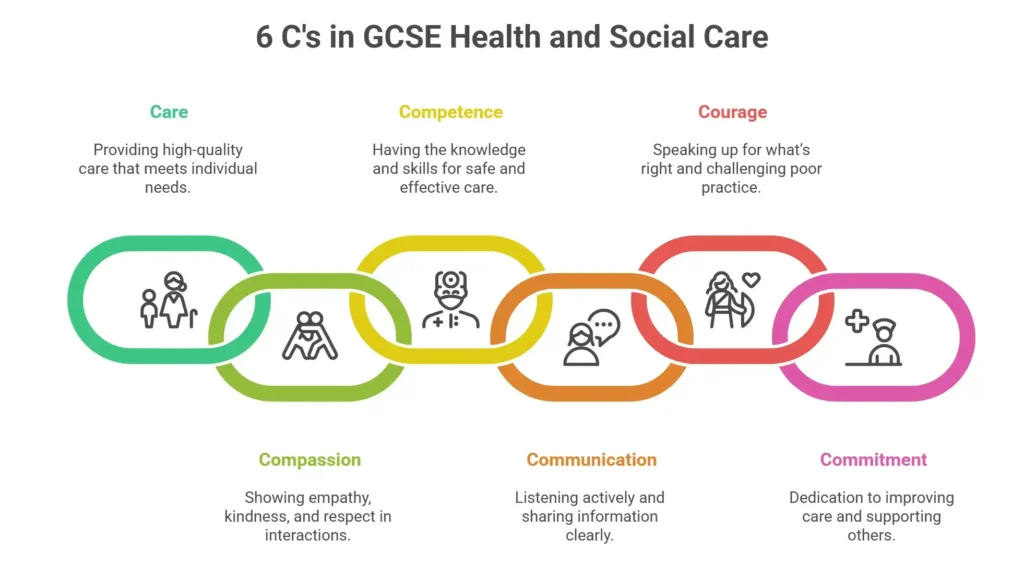
The 6 C’s of Health and Social Care are a set of core values introduced by the NHS to guide professionals in delivering compassionate, high-quality care. These principles are embedded throughout the GCSE Health and Social Care curriculum, helping learners understand the ethical and interpersonal foundations of effective care practice.
The 6 C’s Explained:
- 1. Care – Providing high-quality care that meets the needs of individuals.
- 2. Compassion – Showing empathy, kindness, and respect in every interaction.
- 3. Competence – Having the knowledge and skills to deliver safe and effective care.
- 4. Communication – Listening actively and sharing information clearly and respectfully.
- 5. Courage – Speaking up for what’s right and challenging poor practice.
- 6. Commitment – Dedication to improving care and supporting others consistently.
These values are not just theoretical—they are applied in real-life scenarios, coursework, and assessments. Understanding and demonstrating the 6 C’s is essential for learners who aspire to work in nursing, social work, or any role within the UK’s health and social care system.
Course Structure and Curriculum of The Health and Social Care GCSE Course
The Health and Social Care GCSE course is structured to provide learners with both theoretical understanding and practical insight into the UK’s care systems. It is typically delivered over two academic years (Years 10 and 11), and can be tailored by schools to suit different learning styles and assessment preferences.
Course Components:
- Core Units: These cover essential topics such as human lifespan development, health and wellbeing, and values of care.
- Optional Units (varies by exam board): May include areas like nutrition, public health, and promoting health and wellbeing.
- Controlled Assessment: Learners complete coursework based on real-life scenarios, demonstrating their ability to apply care principles.
Exam Boards Offering This Course:
- OCR Health and Social Care GCSE.
- Pearson Edexcel GCSE Health and Social Care.
- AQA (limited availability; often replaced by BTEC options).
Each board offers slightly different content and assessment formats, but all align with national standards and aim to prepare students for further study or entry-level roles in care settings.
Key Topics and Learning Outcomes of Health and Social Care GCSE
The GCSE Health and Social Care curriculum is designed to give learners a comprehensive understanding of how health and social care services operate, and how professionals support individuals across different life stages. It blends theoretical knowledge with practical application, ensuring students are well-prepared for further study or entry-level roles in the care sector.

Key Topics Covered:
- Human Lifespan Development: Physical, intellectual, emotional, and social development across life stages.
- Health and Wellbeing: Factors affecting health, lifestyle choices, and methods of health promotion.
- Values of Care: Principles such as dignity, respect, confidentiality, and safeguarding in care settings.
- Legislation and Policy: Key UK laws that protect individuals and guide professional practice.
- Communication in Care: Verbal and non-verbal communication, barriers to communication, and strategies to overcome them.
- Nutrition and Health: Dietary needs and the impact of nutrition on wellbeing (varies by exam board).
Learning Outcomes:
By the end of the course, students will be able to:
- Apply care values in realistic scenarios.
- Analyse health needs and suggest appropriate support strategies.
- Understand the role of legislation in protecting service users.
- Communicate effectively in health and social care contexts.
- Reflect on personal development and career aspirations in the sector.
These outcomes align with the UK’s emphasis on person-centred care, safeguarding, and inclusive practice—making the qualification both relevant and impactful.
Health and Social Care GCSE Course Assessment
Assessment in the Health and Social Care GCSE is designed to evaluate both theoretical understanding and practical application of care principles. It ensures that learners are not only knowledgeable but also capable of applying their learning to real-world scenarios.
What Will Learners Be Assessed On?
Students are assessed on:
- Knowledge of Human Development: Understanding how individuals grow and change across life stages.
- Application of Care Values: Demonstrating principles like dignity, respect, and safeguarding in realistic case studies.
- Health and Wellbeing Analysis: Evaluating factors that influence health and suggesting appropriate interventions.
- Communication Skills: Identifying barriers and proposing effective communication strategies.
- Understanding of Legislation: Applying UK laws and policies to protect service users.
How Will Learners Be Assessed?
Assessment methods vary slightly by exam board, but typically include:
- Written Examination: Testing theoretical knowledge through structured questions.
- Controlled Assessment / Coursework: Learners complete tasks based on case studies, showing how they would respond in professional care settings.
- Scenario-Based Tasks: Applying care values and decision-making to simulated situations.
This dual approach ensures learners are prepared for both academic progression and vocational pathways in health and social care.
Study Tips and Revision Strategies for Health and Social Care GCSE
Success in the Health and Social Care GCSE depends not only on understanding the curriculum, but also on adopting effective study habits. With a mix of coursework and exam-based assessment, learners need to balance practical application with theoretical knowledge. Here are proven strategies to help students stay on track and perform confidently.
Study Techniques for GCSE Health and Social Care
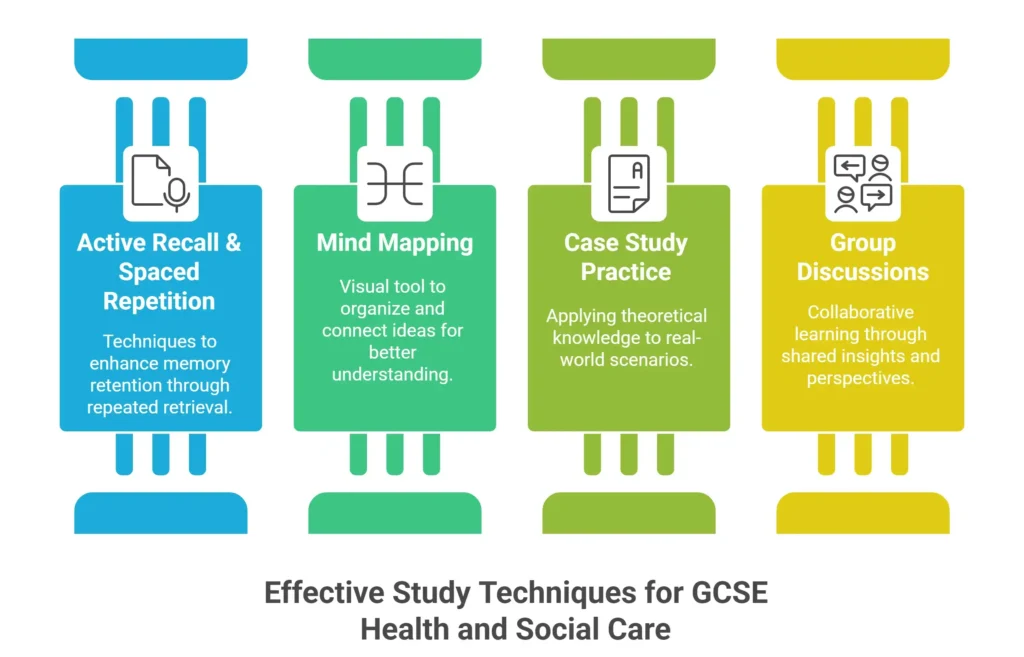
- Active Recall & Spaced Repetition: Use flashcards and quizzes to reinforce key concepts like the 6 C’s, care values, and legislation.
- Mind Mapping: Visualise topics such as human development stages or communication barriers to improve memory retention.
- Case Study Practice: Apply care principles to realistic scenarios to prepare for coursework and controlled assessments.
- Group Discussions: Collaborate with peers to explore ethical dilemmas and diverse care needs—great for deepening understanding.
These techniques help learners engage with the material beyond rote memorisation, building confidence and critical thinking.
Utilising GCSE Health and Social Care Past Papers
Past papers are invaluable for exam preparation. They allow students to:
- Familiarise themselves with question formats and mark schemes.
- Identify recurring themes and high-weight topics.
- Practise time management under exam conditions.
Most exam boards, including OCR and Pearson Edexcel, provide downloadable past papers and examiner reports. Reviewing these regularly can significantly improve performance and reduce exam anxiety.
Resources for Health and Social Care GCSE Students
Access to the right resources can make a significant difference in how well students engage with and succeed in the Health and Social Care GCSE. From textbooks to online platforms, learners can find support tailored to their study needs and exam board specifications.
Recommended Textbooks and Websites
Here are some trusted resources aligned with UK curriculum standards:
Textbooks:
- OCR Health and Social Care GCSE Student Book – Ideal for learners following the OCR specification.
- Pearson Edexcel GCSE Health and Social Care – Covers key topics with exam-style questions and case studies.
- Revise BTEC Health and Social Care – Useful for those transitioning to vocational pathways.
Websites:
- BBC Bitesize Health and Social Care – Offers concise topic summaries, quizzes, and revision tips.
- Seneca Learning – Interactive revision platform with gamified learning for GCSE students.
- TES Resources – Teacher-created worksheets and lesson plans, often free or low-cost.
These resources help reinforce classroom learning and provide varied formats for revision—ideal for visual, auditory, and kinaesthetic learners.
What Is a Pass in GCSE Health and Social Care?
A pass grade in the GCSE Health and Social Care is typically a Grade 4 or above under the current 9–1 grading system. This is equivalent to a C grade under the old system and is considered a standard pass for progression to Level 3 qualifications or apprenticeships.
What Is the GCSE Health and Social Care Equivalent To?
The GCSE Health and Social Care is a Level 2 qualification within the UK’s National Qualifications Framework. It is equivalent to:
- A standard GCSE qualification graded from 9 to 1 (with Grade 4 considered a pass).
- Level 2 BTEC qualifications, such as the BTEC Tech Award in Health and Social Care.
- NVQ Level 2 in related vocational subjects.
This equivalency means that students who successfully complete the GCSE can progress to Level 3 qualifications, including:
- A-levels (e.g. Psychology, Sociology, Biology)
- Level 3 BTEC National Diploma in Health and Social Care
- Apprenticeships in healthcare support, early years education, or social care
Understanding this equivalency is crucial for learners planning their next steps, whether that’s further education or entering the workforce. It also helps parents and educators benchmark the qualification against other academic and vocational routes.
What Jobs You Can Do with a Health and Social Care GCSE
Completing the Health and Social Care GCSE opens doors to a wide range of career pathways in the UK’s thriving care sector. While the qualification itself is entry-level, it lays the groundwork for further study and vocational training that can lead to meaningful, people-focused roles.
Career Options After GCSE:
- Healthcare Assistant – Supporting nurses and doctors in hospitals, clinics, and care homes.
- Social Care Support Worker – Assisting vulnerable individuals in residential or community settings.
- Early Years Practitioner – Working with children in nurseries, playgroups, or primary schools.
- Mental Health Support Worker – Helping individuals manage emotional wellbeing and access services.
- Apprenticeships in Health and Social Care – Many NHS trusts and care providers offer Level 2 and Level 3 apprenticeships for school leavers.
- Level 3 BTEC National Diploma in Health and Social Care.
- A-levels in Psychology, Biology, or Sociology.
- University degrees in healthcare, education, or social sciences.
This qualification also helps learners develop transferable skills—like communication, empathy, and safeguarding awareness—that are valued in customer service, education, and community outreach roles.
Conclusion and Next Steps
The Health and Social Care GCSE is more than just a qualification—it’s a gateway to understanding how care shapes lives, communities, and careers. Whether you’re a student exploring future options, a parent supporting your child’s education, or an educator guiding learners through the curriculum, this course offers practical knowledge and meaningful skills that extend far beyond the classroom.
By mastering topics like human development, safeguarding, and the 6 C’s, learners build a strong foundation for further study and employment in the UK’s health and social care sector. With the right resources, revision strategies, and career planning, students can confidently take the next step toward roles in nursing, social work, early years education, and more.
What You Can Do Next:
- Explore Level 3 qualifications such as BTEC National Diploma or A-levels.
- Research NHS apprenticeships and vocational training routes.
- Use past papers and recommended textbooks to reinforce your learning.
- Connect with career advisors or educators to map out your progression.
Whether you’re aiming for a hands-on role in care or a university degree in health sciences, the journey starts here—with the GCSE Health and Social Care.

- All Courses
 Personal Development (1283)
 Career Bundle (479)
 Management & Administration (460)
 Employability (439)
 Health & Social Care (411)
 Health and Safety (382)
 Business (320)
 Teaching & Education (268)
 IT & Software (263)
 Health and Fitness (238)
 QLS Endorsed Courses (219)
 Mental Health & Counselling (168)
 Science & Technology (153)
 Accounting & Finance (144)
 Sales & Marketing (128)
 Construction & Engineering (126)
 Art & Design (125)
 Compliance & Law (112)
 Language (86)
 Photography & Lifestyle (58)
 Animal Care (57)
 Food Safety & Hygine (53)
 Diet & Nutrition (49)
 Sports & Fitness (47)
 Makeup & Beauty (43)
 First Aid (39)
 Agriculture (2)
0 responses on "Health and Social Care GCSE: Your Complete Guide to Success"