



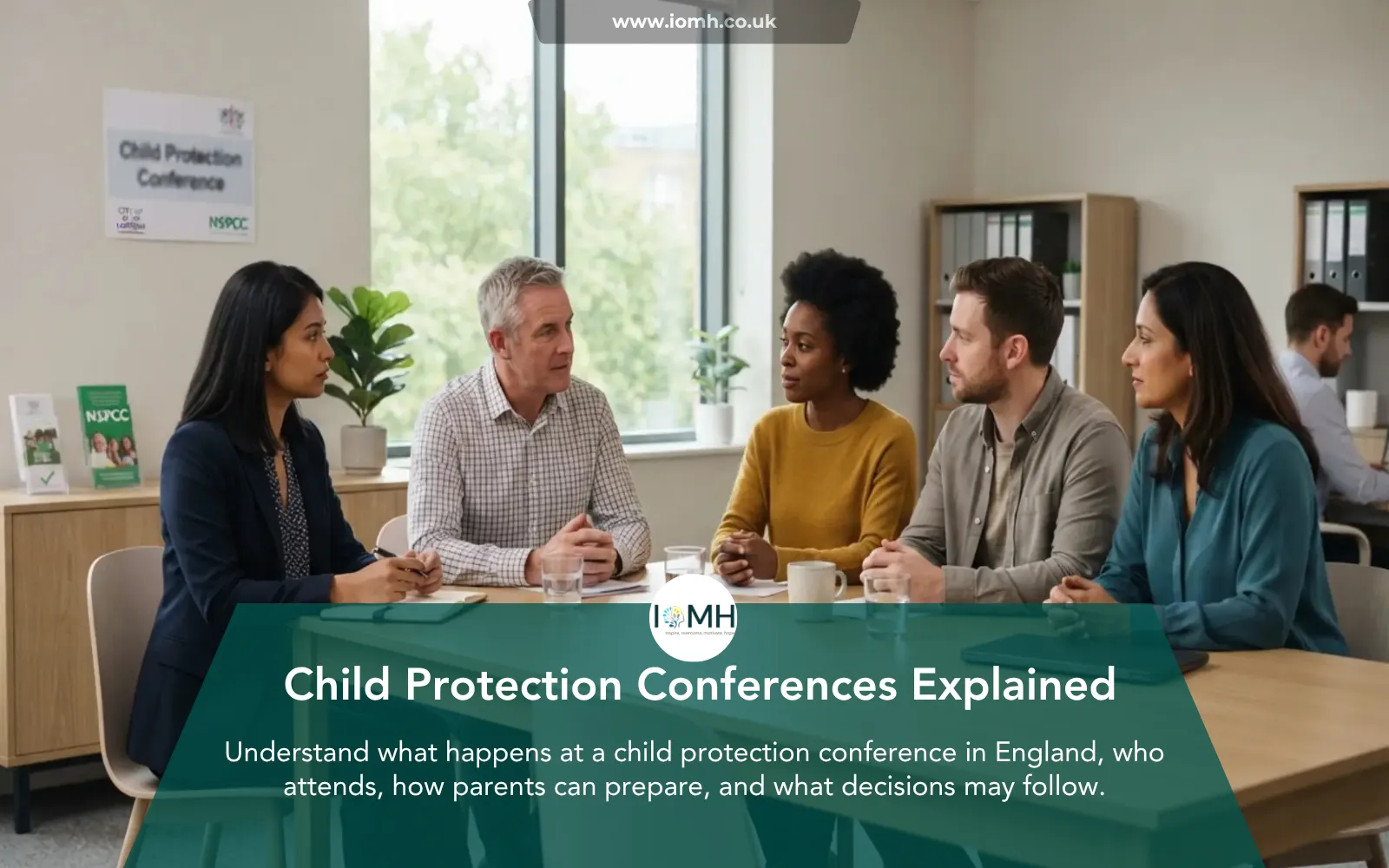
A child protection conference is a formal meeting where social workers, other professionals and family members discuss concerns about a child’s safety. Its main purpose is to decide whether the child is at risk of significant harm and whether a child protection plan is needed.
For parents, receiving an invitation to a conference can raise many questions. Who will attend? What will be discussed? Will you have a chance to explain your views? Professionals may also need guidance on their responsibilities and how to prepare.
This article explains what happens at a child protection conference in England, from preparation to decisions and next steps. It focuses on this important stage of the wider child protection process.



What Is a Child Protection Conference?
A child protection conference is a multi-agency meeting organised by local authority children’s services when there are serious concerns about a child’s safety or welfare.
It brings together people who know the child and family, including social workers, healthcare professionals, education staff and parents or carers. They review available information, discuss safeguarding concerns and consider what action is needed.
Under the Department for Education’s Working Together to Safeguard Children 2026, the conference considers whether the child is suffering, or is likely to suffer, significant harm and whether a child protection plan is necessary.
The meeting also considers the child’s needs, family circumstances and support that could help keep them safe.
A child protection conference is not a court hearing. It cannot itself make a care order or decide to remove a child from their family. Its function is to assess safeguarding concerns and coordinate protective action.
Why Is a Child Protection Conference Held?
An initial child protection conference is usually arranged after a Section 47 enquiry identifies concerns that a child has suffered or is likely to suffer significant harm.
Section 47 of the Children Act 1989 requires local authorities to investigate where there is reasonable cause to suspect significant harm. These enquiries help professionals understand the child’s circumstances and determine what protection may be necessary.
For a closer explanation of this stage, see what happens during a Section 47 enquiry.
Concerns leading to a conference may involve physical abuse, emotional abuse, sexual abuse, neglect or other serious threats to a child’s safety.
However, a conference does not automatically mean that a parent has harmed their child. The purpose is to examine the information available, understand the risks, and decide what should happen next.
Not every family requiring support needs a child protection conference. Some may benefit from earlier, coordinated assistance, as explained in how early help supports families.
Who Attends a Child Protection Conference?
A child protection conference involves professionals who have relevant information about the child, alongside parents, carers and, where appropriate, the child.
The exact attendees depend on the family’s circumstances and the agencies involved.
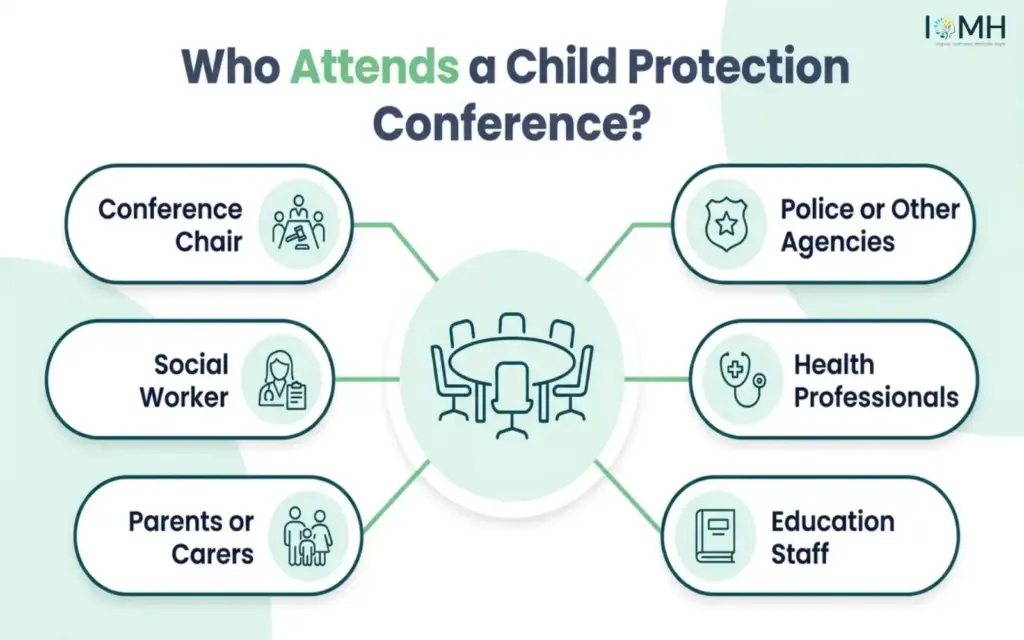
| Attendee | Role in the Conference |
|---|---|
| Conference chair | Leads discussions, supports participation and makes sure decisions are clearly recorded. |
| Child's social worker | Presents assessment findings, concerns and information about the child's circumstances. |
| Parents or carers | Explain their views, share relevant information and discuss the child's needs. |
| Teachers or safeguarding leads | Share relevant information about attendance, behaviour, wellbeing and school experiences. |
| Healthcare professionals | Provide information about health, development and relevant medical concerns. |
| Police representatives | Contribute information relevant to safeguarding risks or investigations. |
| Other involved practitioners | Explain their involvement and the support available to the family. |
The chair is normally someone who is not directly involved in managing the child’s case. This helps provide appropriate oversight of the meeting.
Can Parents and Children Attend the Conference?
Parents and carers should ordinarily be involved and supported to participate meaningfully. They should receive information about the meeting and have opportunities to express their views.
Children may attend when appropriate for their age, understanding and circumstances. If attending would be unsuitable or the child does not wish to participate, their wishes and feelings can be shared in other ways.
For example, a child might speak to an advocate, provide written comments or share their views through their social worker.
Parents may also be able to bring an advocate, friend or solicitor for support, subject to appropriate conference arrangements.
The child’s participation should be considered carefully, with their welfare remaining central to the process. The Family Rights Group’s guidance on initial child protection conferences provides further information about family involvement and advocacy.
What Happens at a Child Protection Conference?
A child protection conference normally follows a structured discussion, although the precise format can vary between local authorities.
The aim is to examine concerns fairly, understand the child’s experiences and agree appropriate safeguarding action.
What Happens Before the Meeting?
Before an initial conference, the social worker prepares an assessment report outlining the child’s circumstances, identified concerns, family strengths and recommendations.
Other professionals may also submit relevant information.
Parents should be told why the conference is taking place, who is expected to attend and what will be discussed. They should receive relevant reports in advance, subject to appropriate information-sharing and safeguarding considerations.
This preparation allows families to identify questions, clarify information and consider whether they need support during the meeting.
What Happens During the Meeting?
Although local procedures differ, a typical conference involves six stages.
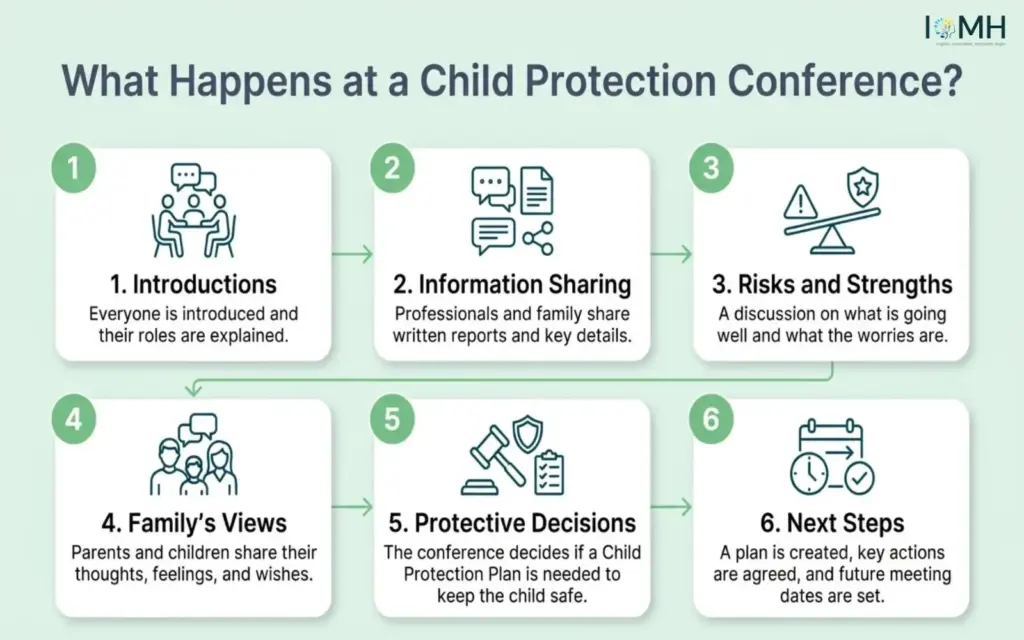
- Introductions and explanation: The chair introduces participants, outlines the meeting's purpose and explains how discussions will proceed.
- Sharing information: The social worker and other professionals present relevant reports, observations and safeguarding concerns.
- Discussing risks and strengths: Participants consider the child's experiences, potential harm, existing support and factors that help keep the child safe.
- Listening to the family: Parents and carers are invited to contribute. The child's wishes and feelings should also inform the discussion.
- Considering protective action: The conference evaluates whether the child needs a child protection plan and what support or action may be appropriate.
- Explaining decisions: The chair summarises the outcome, agreed responsibilities and next steps.
For example, where concerns involve a child’s attendance at school, difficulties at home and unmet support needs, the conference may consider information from education staff, healthcare professionals and family members.
The discussion should distinguish established facts from professional observations and unverified concerns.
What Questions Are Discussed?
Questions vary depending on the child’s circumstances, but discussions commonly explore:
- What concerns have been identified about the child's safety?
- What is working well for the child and family?
- What does the child think about their circumstances?
- What support has already been provided?
- What needs to change to reduce risks?
- Who should be responsible for agreed actions?
These are illustrative questions rather than a mandatory national checklist.
The conference should consider both safeguarding risks and the family’s strengths, giving participants a clearer understanding of the child’s needs.
How to Prepare for a Child Protection Conference

Preparing beforehand can help parents understand the meeting and give professionals the information they need to contribute effectively.
Preparation Tips for Parents and Carers
If you are attending a conference about your child, consider these practical steps:
- Read the reports: Ask for relevant reports before the meeting and check whether they accurately describe your family's circumstances.
- Prepare questions: Write down anything you do not understand or would like professionals to explain.
- Share your perspective: Think about your child's strengths, needs, daily experiences and any support your family requires.
- Ask about support: Contact the social worker if you need an interpreter, accessibility arrangements, or information about advocacy.
- Clarify the arrangements: Check the time, location, expected attendees and whether the meeting will take place online or in person.
You can also prepare written comments if you find it difficult to speak during formal meetings.
You do not need to agree with every professional observation. However, it is helpful to explain disagreements clearly and provide relevant information wherever possible.
Preparation Tips for Safeguarding Professionals
Professionals should prepare accurate, relevant information that helps the conference understand the child’s circumstances.
This may involve reviewing safeguarding records, identifying significant concerns, recognising protective factors and explaining the agency’s involvement.
Information should be factual, proportionate and shared securely. The Department for Education’s information-sharing guidance for safeguarding practitioners, updated in September 2026, explains relevant responsibilities.
Professionals should also be prepared to listen to the family’s perspective and contribute constructively to safeguarding decisions.
What Happens After a Child Protection Conference?
The conference considers the information presented and decides whether the child needs a child protection plan.
The outcome depends on the assessed risks and the child’s circumstances.
What Decisions Can Be Made?
A conference may conclude that a child requires a protection plan because of continuing concerns about significant harm.
Alternatively, it may decide that a child protection plan is unnecessary, although the family could still need other forms of support.
Where a plan is required, professionals identify protective actions, responsibilities and arrangements for monitoring progress. You can explore these arrangements in how a child protection plan works.
Where a child protection plan is not needed, children’s services may consider other appropriate support depending on the child’s assessed needs.
It is helpful to understand the difference between child in need and child protection when considering these outcomes.
What Happens if a Child Protection Plan Is Needed?
If the conference decides a plan is necessary, a lead social worker is identified, and a core group is established.
The core group includes relevant professionals and works with the family to develop and implement the plan.
Under Working Together to Safeguard Children 2026, the first core group meeting should take place within 10 working days of the initial conference.
The child protection plan is then developed further, with agreed responsibilities and arrangements for reviewing progress.
Initial vs Review Child Protection Conference
There are two main types of child protection conferences: initial and review.
An initial child protection conference considers whether a child needs a protection plan. A review child protection conference examines the child’s circumstances after a plan has been established.
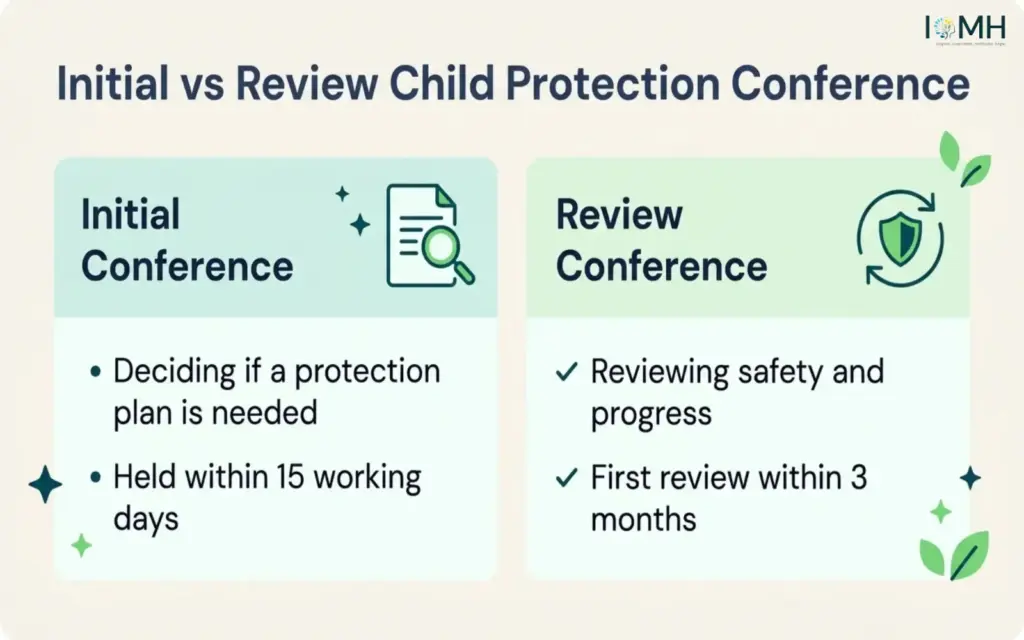
| Feature | Initial Conference | Review Conference |
|---|---|---|
| Main purpose | Consider safeguarding concerns and decide whether a plan is necessary | Review the child's safety and progress |
| Timing | Normally within 15 working days of the relevant strategy discussion | First review within three months, then at intervals of no more than six months |
| Main focus | Risks, needs and protective action | Changes in circumstances and continuing protection needs |
| Possible outcome | Establish a child protection plan or recommend alternative action | Continue, revise or end the plan |
The statutory child protection conference timescales are set out in the Department for Education’s guidance for England.
Review conferences provide opportunities to assess whether agreed actions are working and whether the child continues to need a protection plan.
Parents' Rights and Concerns at a Child Protection Conference
Parents should be supported to understand the conference, contribute their views and receive appropriate information about decisions affecting their child.
Where suitable, they may seek advocacy, request communication support or ask for information about the meeting’s procedures.
Sometimes, the chair may restrict a person’s attendance because of safeguarding or safety concerns. If this happens, the reasons should be explained, and arrangements should be considered for communicating that person’s views.
What if Parents Disagree With the Conference Decision?
If you disagree with the information presented or the conference outcome, you can ask the chair to explain the reasoning.
You can also:
- Identify factual inaccuracies and request that your concerns are recorded.
- Ask how to obtain the conference record.
- Request information about the local authority's complaints procedure.
- Seek independent advice if you have legal concerns.

FAQs
Parents can choose not to attend, but the conference may still proceed. If you cannot attend or have concerns about participating, contact the social worker or conference chair. You can ask how your views may be shared through a written statement or suitable representative.
There is no fixed national duration for an individual conference. The length depends on the number of participants, the complexity of concerns and local arrangements. Ask the conference organiser how much time has been allocated so you can plan accordingly.
You do not automatically need a solicitor to attend. However, independent legal advice may be useful if you are concerned about your legal position or separate court proceedings. You can also ask about advocacy or other appropriate support during the conference.
Yes, a conference may proceed without a parent, including where they cannot attend or where safety concerns require restrictions. However, their views should still be considered appropriately, and arrangements for participation or representation should be explained wherever possible.
No. A child protection conference does not automatically result in a child being taken into care. The meeting considers safeguarding concerns and whether protective action is needed. A care order is a separate legal matter determined by a court.
Yes. A pre-birth child protection conference may be arranged where there are significant concerns about an unborn child’s safety after birth. The aim is to assess risks and coordinate appropriate support and protective arrangements before the baby arrives.

- All Courses
 Personal Development (1283)
 Career Bundle (479)
 Management & Administration (460)
 Employability (439)
 Health & Social Care (416)
 Health and Safety (383)
 Business (320)
 Teaching & Education (268)
 IT & Software (263)
 Health and Fitness (238)
 QLS Endorsed Courses (219)
 Mental Health & Counselling (169)
 Science & Technology (153)
 Accounting & Finance (144)
 Sales & Marketing (128)
 Construction & Engineering (126)
 Art & Design (125)
 Compliance & Law (112)
 Language (86)
 Photography & Lifestyle (58)
 Animal Care (57)
 Food Safety & Hygine (53)
 Diet & Nutrition (49)
 Sports & Fitness (47)
 Makeup & Beauty (43)
 First Aid (39)
 Agriculture (2)
0 responses on "Child Protection Conferences Explained"