




The Prevent Duty is a legal responsibility that requires certain organisations, including schools and childcare providers, to help prevent people from becoming terrorists or supporting terrorism. It plays an important role in safeguarding children and young people from radicalisation.
For teachers, nursery practitioners and childcare staff, understanding the Prevent Duty is essential for recognising potential concerns and responding appropriately. It also helps education providers create safer learning environments and follow their safeguarding responsibilities.
This guide explains what the Prevent Duty is, who it applies to and what it means for schools and childcare settings. You’ll also learn how to recognise radicalisation concerns, follow reporting procedures and understand relevant training requirements.
Working With Children? Build Your Safeguarding Knowledge
Strengthen your wider safeguarding knowledge alongside Prevent awareness with IOMH's online Child Protection course.
- Core safeguarding principles
- Recognising abuse and responding to disclosures
- Reporting safeguarding concerns
What Is the Prevent Duty?
The Prevent Duty is a statutory responsibility introduced under Section 26 of the Counter-Terrorism and Security Act 2015. It requires specified authorities to have due regard to preventing people from being drawn into terrorism.
Prevent forms part of CONTEST, the UK’s counter-terrorism strategy. Its purpose is to identify and support people who may be susceptible to radicalisation before risks escalate.
Radicalisation refers to the process through which someone comes to support terrorism or terrorist ideologies. Having strong political or religious opinions does not automatically indicate radicalisation.
The Home Office’s Prevent Duty guidance explains the statutory responsibilities of specified authorities. The revised guidance for England and Wales took effect on 31 December 2023.
In educational settings, Prevent works alongside existing safeguarding arrangements to help protect children and young people from harm.
Who Does the Prevent Duty Apply To?
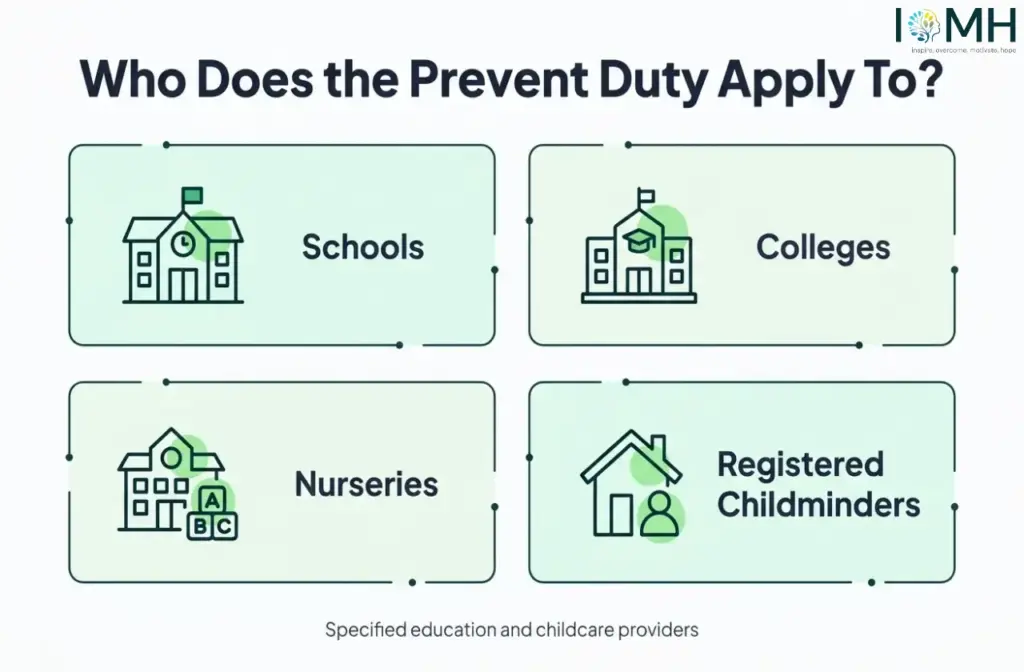
The Prevent Duty applies to specified authorities listed in legislation. In education, this includes relevant schools, colleges and registered childcare providers.
Settings covered in England include:
- Schools: State-funded schools, independent schools and academies.
- Colleges: Further education institutions and other specified education providers.
- Nurseries: Registered early years settings, including relevant private and voluntary providers.
- Childminders: Registered childcare providers covered by the statutory framework.
Although the statutory duty applies to the specified organisation or provider, individual staff members have responsibilities under their setting’s safeguarding procedures.
Understanding safeguarding in schools helps education staff recognise how Prevent fits into their wider responsibilities for protecting pupils.
The arrangements are not identical across the UK. England and Wales follow shared Prevent statutory guidance, while Scotland has separate guidance. The statutory Prevent Duty does not apply in Northern Ireland.
Prevent also sits within the wider framework of child protection legislation, which establishes important safeguarding responsibilities across different settings.
What Are the Prevent Duty Responsibilities in Schools and Childcare?
Schools and childcare providers must consider the risk of people being drawn into terrorism and take proportionate action. However, everyday responsibilities differ according to the setting and staff member’s role.
Prevent Duty Responsibilities in Schools
Schools in England must follow relevant safeguarding requirements, including Keeping Children Safe in Education 2026.
Key responsibilities include:
- Recognising concerns: Staff should remain alert to possible signs of radicalisation.
- Reporting concerns: Teachers and support staff should follow safeguarding procedures and inform the designated safeguarding lead (DSL).
- Assessing risks: Schools must consider relevant radicalisation risks and appropriate protective measures.
- Supporting online safety: Appropriate filtering, monitoring and staff awareness help reduce exposure to harmful online material.
- Promoting British values: Schools should support democracy, individual liberty, mutual respect and tolerance through suitable educational activities.

Schools should also ensure staff receive appropriate training and understand how Prevent fits into their existing child protection arrangements.
A designated safeguarding lead plays a central role in managing safeguarding concerns, supporting staff and coordinating appropriate referrals.
Prevent Duty Responsibilities in Nurseries and Childcare
The Prevent Duty in childcare follows similar safeguarding principles but must be applied appropriately to children’s ages and circumstances.
Registered early years providers in England must follow the relevant EYFS statutory framework.
Nursery practitioners and childminders should understand potential safeguarding concerns, maintain appropriate awareness and know how to raise concerns through their setting’s procedures.
For example, a nursery practitioner might become concerned about a child’s exposure to material promoting terrorist violence. Rather than investigating the family’s beliefs, the practitioner should record relevant observations and seek safeguarding advice.
The central responsibility is to protect children through proportionate, appropriate safeguarding action.
How Can Staff Recognise Radicalisation Concerns?
Recognising possible radicalisation requires professional judgement. There is no single behaviour that proves someone is being radicalised.
Potential concerns may include:
- Repeatedly expressing support for terrorist violence.
- Sharing material that promotes terrorist organisations or activities.
- Showing increasing engagement with online content encouraging terrorist violence.
- Discussing intentions to participate in terrorism-related activities.
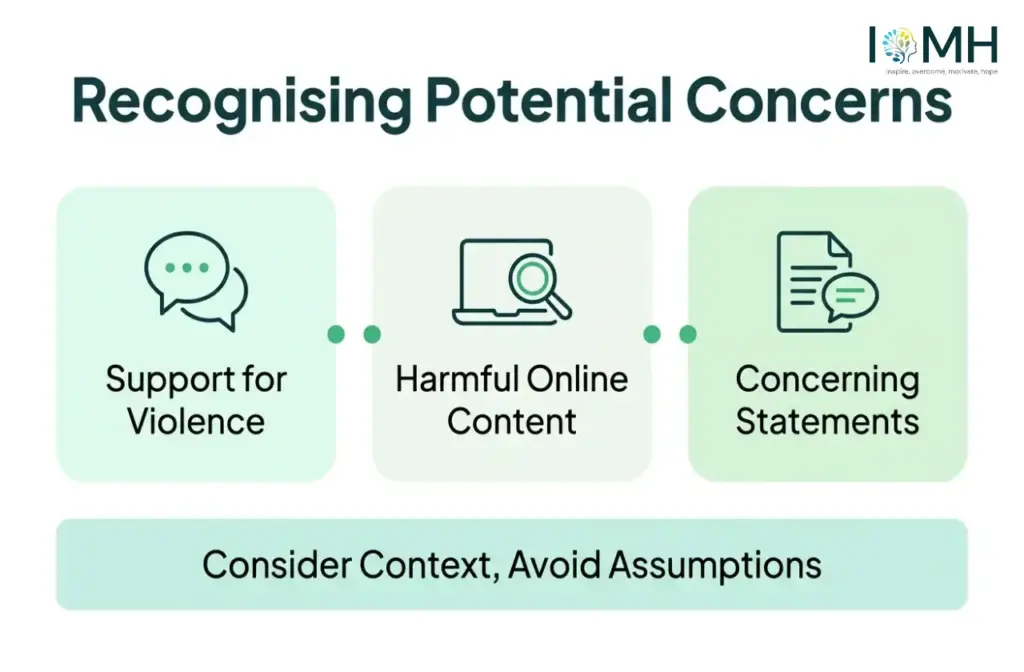
These behaviours must be considered alongside the child’s circumstances and available evidence. Changes in friendships, interests or behaviour alone do not establish radicalisation.
Understanding online safety for children can also help staff recognise harmful online influences and respond appropriately to safeguarding concerns.
Practical example: A secondary school pupil repeatedly shares videos praising terrorist attacks. Their teacher records what was observed and discusses the concern with the DSL.
Staff should avoid assumptions based on religion, ethnicity, disability or political opinions.
The aim is to identify genuine safeguarding concerns, not monitor children’s personal beliefs.
What Should You Do If You Have a Prevent Concern?
If you believe a child may be susceptible to radicalisation, follow your organisation’s safeguarding procedures. You do not need to prove that radicalisation is taking place before raising a concern.
The following process reflects the government’s practical Prevent guidance for designated safeguarding leads.
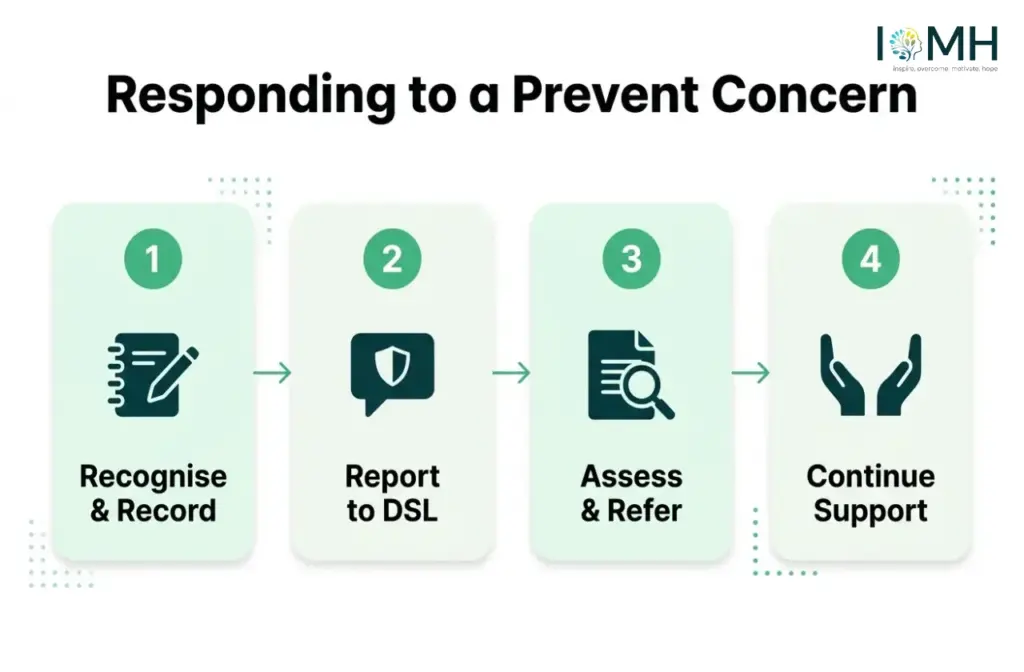
- Recognise and record the concern. Write down relevant observations, statements or incidents accurately. Avoid making unsupported conclusions.
- Report the concern promptly. Inform your DSL or designated safeguarding contact, following your setting’s procedures. If someone is in immediate danger, follow emergency safeguarding arrangements.
- Assess and consider referral. The DSL reviews the available information, considers the wider context and seeks specialist advice where needed. A Prevent referral may be appropriate.
- Continue appropriate safeguarding support. Depending on the assessment, the outcome may involve monitoring, alternative support, a Prevent referral or consideration for Channel.
Channel is a voluntary, multi-agency programme supporting people assessed as susceptible to being drawn into terrorism.
A Prevent referral does not automatically result in Channel involvement.
The important principle is to raise concerns appropriately, maintain accurate records and allow relevant safeguarding professionals to assess the situation.
Is Prevent Duty Training Required for School and Childcare Staff?
Schools and relevant childcare providers must ensure staff have appropriate awareness and understanding of Prevent responsibilities.
Prevent Duty training helps staff recognise possible concerns, understand extremist ideologies and follow referral procedures. The level of training should reflect individual roles and responsibilities.
The government provides free Prevent Duty training covering radicalisation awareness, referrals and available support.
There is no universal requirement for every staff member to renew an identical Prevent certificate annually. However, safeguarding leads require more detailed knowledge and regular updates.
For those seeking broader safeguarding knowledge, IOMH’s child protection training covers safeguarding principles, recognising abuse, responding to disclosures and reporting concerns.
This can complement Prevent awareness, although general child protection training does not replace appropriate Prevent-specific training.
Final Thoughts on the Prevent Duty
Understanding what the Prevent Duty is helps teachers, nursery practitioners and childcare professionals recognise their safeguarding responsibilities. It also supports early intervention when children or young people may be vulnerable to radicalisation.
Schools and childcare providers have an important role in maintaining safe environments through staff awareness, appropriate risk assessments and clear safeguarding procedures. Knowing when and how to report concerns helps ensure children receive suitable support.
Prevent is ultimately about protecting people through awareness, proportionate action and early support. By staying informed and following established safeguarding procedures, education and childcare professionals can contribute to safer learning environments for everyone.

Frequently Asked Questions About the Prevent Duty
The three objectives are tackling the ideological causes of terrorism, intervening early to support people susceptible to radicalisation, and helping individuals already involved in terrorism to disengage and rehabilitate.
Yes. The Prevent Duty is a statutory requirement under the Counter-Terrorism and Security Act 2015. It applies to specified authorities, including relevant schools and childcare providers, rather than automatically imposing the same legal duty on every employee.
Prevent is the wider government approach to stopping people from becoming terrorists or supporting terrorism. Channel is a voluntary, multi-agency programme that provides tailored support to individuals assessed as susceptible to radicalisation.
Yes. The Prevent Duty applies to registered childminders in England who fall within the specified childcare categories. They must consider relevant safeguarding risks and follow appropriate procedures for recognising and responding to concerns.
No. A Prevent referral does not automatically mean someone has committed a criminal offence. The purpose is to assess concerns about susceptibility to radicalisation and identify suitable support or further action where necessary.
Training should be reviewed and refreshed according to staff responsibilities and current guidance. Government guidance recommends that designated safeguarding leads receive advanced Prevent training refreshed at least every two years. This is not a universal two-year requirement for every employee.

- All Courses
 Personal Development (1283)
 Career Bundle (479)
 Management & Administration (460)
 Employability (439)
 Health & Social Care (416)
 Health and Safety (383)
 Business (320)
 Teaching & Education (268)
 IT & Software (263)
 Health and Fitness (238)
 QLS Endorsed Courses (219)
 Mental Health & Counselling (169)
 Science & Technology (153)
 Accounting & Finance (144)
 Sales & Marketing (128)
 Construction & Engineering (126)
 Art & Design (125)
 Compliance & Law (112)
 Language (86)
 Photography & Lifestyle (58)
 Animal Care (57)
 Food Safety & Hygine (53)
 Diet & Nutrition (49)
 Sports & Fitness (47)
 Makeup & Beauty (43)
 First Aid (39)
 Agriculture (2)
0 responses on "What Is the Prevent Duty? Guide for Schools and Childcare"