




When children’s services become involved with a family, you may hear the terms Child in Need and Child Protection. Both involve safeguarding children, but they have different purposes, legal thresholds and support arrangements.
The main difference between Child in Need (CIN) and Child Protection (CP) is that CIN arrangements focus on meeting a child’s assessed needs, while child protection procedures address concerns that a child is suffering or is likely to suffer significant harm.
In England, these arrangements are closely linked to Sections 17 and 47 of the Children Act 1989.
If you work with children, understanding the distinction is an important part of safeguarding practice. IOMH’s Child Protection and Safeguarding course offers flexible online learning covering relevant legislation, risk assessment and responding to safeguarding concerns.
Want to test yourself? Jump to the Section 17 vs Section 47 quiz.
Working With Children? Build Your Safeguarding Knowledge
Study relevant legislation, risk assessment and responding to concerns with IOMH's online Child Protection and Safeguarding course.
- Relevant safeguarding legislation
- Recognising risks and assessing needs
- Responding to and reporting safeguarding concerns
What Is the Difference Between Child in Need and Child Protection?
Child in Need arrangements help children and families access additional support. Child protection procedures focus on assessing and responding to concerns about significant harm.
Both may involve social workers, meetings, assessments and support plans. However, their legal basis and intended outcomes differ.
| Key Difference | Child in Need (CIN) | Child Protection (CP) |
|---|---|---|
| Main purpose | Supporting a child's health, development and welfare | Protecting a child from significant harm |
| Legal framework | Section 17, Children Act 1989 | Section 47 enquiries, Children Act 1989 |
| Threshold | Child meets the statutory definition of a child in need | Circumstances requiring enquiries, including suspected significant harm |
| Assessment | Identifies needs and appropriate support | Investigates safeguarding concerns and determines necessary action |
| Support plan | Child in Need Plan, where appropriate | Child Protection Plan, where required |
| Family involvement | Generally voluntary and collaborative | Formal safeguarding procedures involving family participation |
| Possible outcomes | Continued support, review or case closure | Protective measures, ongoing support or other safeguarding action |
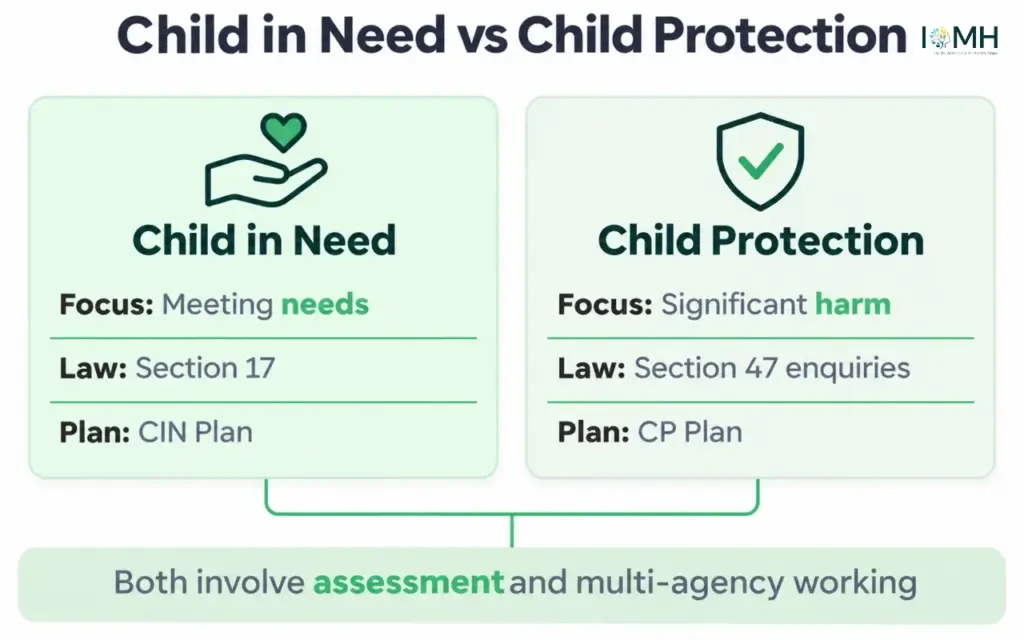
An important distinction is that a child subject to a Child Protection Plan may also be considered a child in need under the broader statutory definition. The two terms are not completely separate legal categories.
For the wider pathway, read our guide to the child protection process.
Section 17 vs Section 47: What Do They Mean?
Understanding these two sections explains why children’s services may take different approaches.
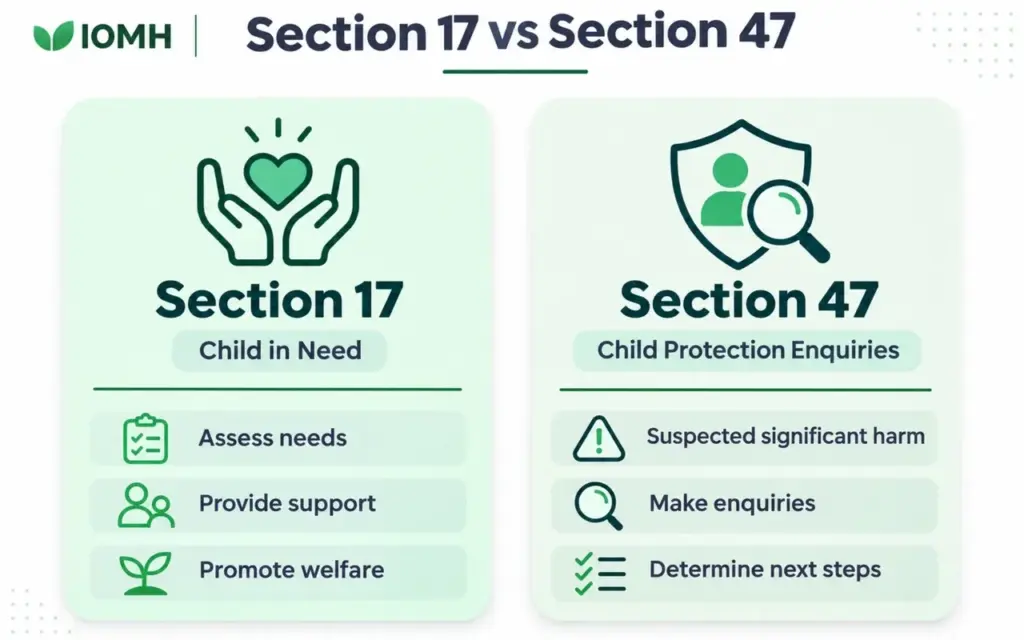
Section 17 — Child in Need
Under Section 17 of the Children Act 1989, local authorities have a general duty to safeguard and promote the welfare of children in need in their area.
A child may be considered in need when:
- They are unlikely to achieve or maintain a reasonable standard of health or development without local authority services.
- Their health or development is likely to be significantly impaired without those services.
- They are disabled, as defined by the legislation.
A Child in Need assessment identifies what help could improve the child’s circumstances. This might involve family support, specialist services or coordinated assistance from different professionals.
Section 47 — Child Protection Enquiries
Section 47 of the Children Act 1989 requires local authorities to make necessary enquiries in specified circumstances, including where there is reasonable cause to suspect that a child is suffering or is likely to suffer significant harm.
Concerns may involve abuse, neglect, exploitation or other circumstances affecting the child’s safety.
A Section 47 enquiry helps determine whether protective action is necessary. It does not automatically result in a Child Protection Plan.
For more information about how these enquiries work, see our Section 47 enquiry guide.
Section 17 vs Section 47: Test Your Understanding
Check you can tell Child in Need support from child protection enquiries.
Child in Need Plan vs Child Protection Plan
The two plans can look similar because both may involve regular meetings, agreed actions and several professionals. The difference lies in what each plan is intended to achieve.
What Happens Under a Child in Need Plan?

A Child in Need Plan sets out the additional support a child and family require.
It usually identifies:
- The child's needs and desired outcomes.
- Services or practical support to be provided.
- Responsibilities agreed with family members and professionals.
- How progress will be monitored and reviewed.
For example, a family may receive coordinated support to address a child’s developmental needs or difficulties affecting their wellbeing.
The plan should reflect the child’s circumstances and include the family’s views.
What Happens Under a Child Protection Plan?
A Child Protection Plan is developed when a child is assessed as requiring formal protection from continuing risks of significant harm.
It identifies actions needed to improve safety, professional responsibilities and arrangements for monitoring progress.
The plan follows decisions made through the child protection conference process.
England’s Working Together to Safeguard Children 2026 guidance explains the expectations for multi-agency assessment, support and protection.
For a closer explanation of the plan itself, read What a Child Protection Plan Is.
What Should Families and Professionals Expect?
Family Involvement and Consent
Child in Need support is generally voluntary. Parents and carers are encouraged to participate in assessments, discuss concerns and agree suitable support.
However, refusing support does not automatically end children’s services’ responsibilities. If concerns suggest significant harm, further safeguarding enquiries may be necessary.
Child protection procedures involve formal statutory responsibilities. Professionals must consider the child’s safety while involving parents and carers appropriately.
In both arrangements, the child’s wishes, feelings and needs should inform decisions.
Professionals and Meetings
Social workers often coordinate assessments and plans, supported by professionals from education, healthcare and other relevant services.
Schools may provide information about attendance, behaviour or wellbeing. Healthcare practitioners may contribute relevant observations and assessments.
Child in Need meetings generally review support and progress, while child protection conferences consider safeguarding risks and protective arrangements.
Our article on child protection conferences explains their purpose in more detail.
Can a Child Move From Child in Need to Child Protection?
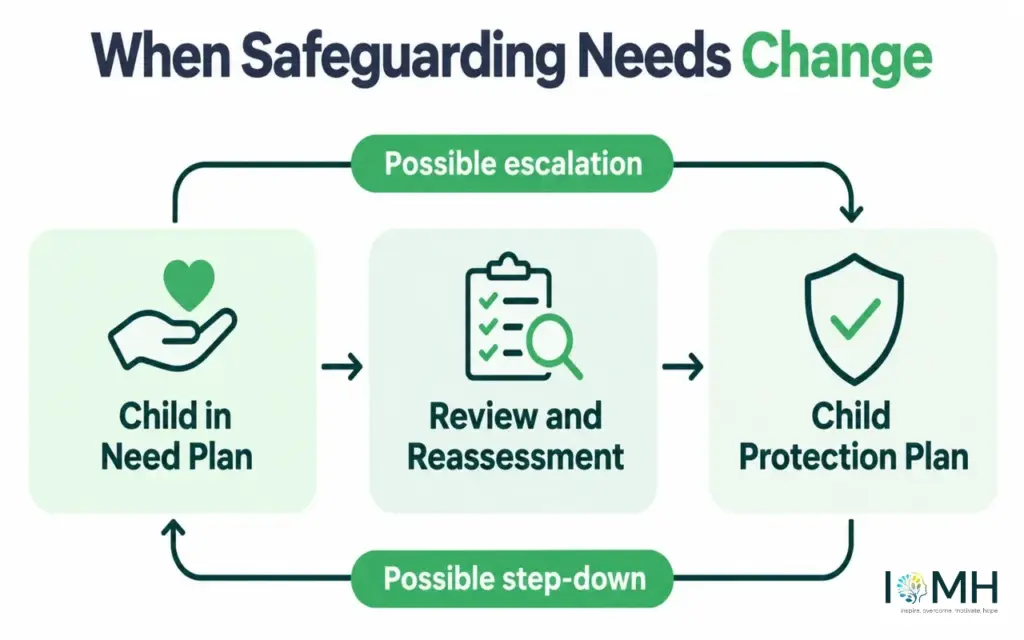
Yes. Safeguarding arrangements can change when a child’s circumstances or assessed risks change.
When Concerns Become More Serious
Suppose a family receives support through a Child in Need Plan, but professionals identify new evidence suggesting significant harm.
Children’s services may reassess the situation and consider whether Section 47 enquiries are required.
This does not mean every Child in Need case progresses to child protection. Decisions depend on the child’s individual circumstances and available evidence.
Moving From Child Protection Back to Child in Need
A child may move from a Child Protection Plan to a Child in Need Plan when the relevant safeguarding concerns have reduced, but additional support remains necessary.
This is sometimes called stepping down.
Support may also continue through other services where appropriate. The aim is to ensure that improvements are maintained and the child’s needs continue to be met.
Child in Need vs Child Protection: Practical Examples
These hypothetical examples illustrate how the distinction may work.
Example 1 — A Child Who Needs Additional Support
A child has ongoing developmental difficulties, and their family needs help accessing suitable services.
Following an assessment, children’s services identifies additional support that could improve the child’s wellbeing.
A Child in Need Plan may be appropriate because the main focus is meeting assessed needs.
Families with less complex needs may also benefit from Early Help in safeguarding.
Example 2 — A Child at Risk of Significant Harm
A school receives information suggesting that a child may be experiencing serious neglect or abuse.
The designated safeguarding lead follows the school’s reporting procedures, and children’s services considers whether Section 47 enquiries are required.
The outcome depends on the findings and the protective action needed.
These examples are illustrative. Actual safeguarding decisions require individual assessment and professional judgement.
Understanding the Difference Matters
The key distinction between Child in Need and Child Protection is the purpose of intervention. CIN arrangements focus on meeting assessed needs, while child protection procedures respond to concerns about significant harm.
For those developing their safeguarding knowledge, IOMH’s Child Protection and Safeguarding course covers relevant legislation, recognising risks, reporting concerns and assessing needs.

Not necessarily. Child in Need arrangements can involve significant and complex difficulties. The main distinction concerns the statutory thresholds and whether formal child protection procedures are necessary.
Yes. A child subject to a Child Protection Plan may also meet the broader statutory definition of a child in need. However, CIN Plans and Child Protection Plans are distinct arrangements.
No. A Child Protection Plan does not automatically mean removal from the family. Its purpose is to coordinate measures to safeguard the child. Taking a child into care involves separate legal arrangements.
There is no single fixed duration for every Child in Need Plan. The length depends on the child’s assessed needs, progress and review decisions. Local arrangements may also differ.

- All Courses
 Personal Development (1283)
 Career Bundle (479)
 Management & Administration (460)
 Employability (439)
 Health & Social Care (416)
 Health and Safety (383)
 Business (320)
 Teaching & Education (268)
 IT & Software (263)
 Health and Fitness (238)
 QLS Endorsed Courses (219)
 Mental Health & Counselling (169)
 Science & Technology (153)
 Accounting & Finance (144)
 Sales & Marketing (128)
 Construction & Engineering (126)
 Art & Design (125)
 Compliance & Law (112)
 Language (86)
 Photography & Lifestyle (58)
 Animal Care (57)
 Food Safety & Hygine (53)
 Diet & Nutrition (49)
 Sports & Fitness (47)
 Makeup & Beauty (43)
 First Aid (39)
 Agriculture (2)
0 responses on "Child in Need vs Child Protection: Key Differences"