




Safeguarding children is not the responsibility of one person or organisation. It depends on professionals recognising concerns, sharing information and working together to protect children.
This Working Together to Safeguard Children summary explains the main points of the 2026 statutory guidance for practitioners in England. It covers safeguarding responsibilities, multi-agency working, the latest changes and what they mean in everyday practice.
Whether you work in education, childcare, healthcare or social care, understanding these principles can help you respond appropriately when a child needs support or protection.



What Is Working Together to Safeguard Children?
Working Together to Safeguard Children is statutory guidance published by the Department for Education. It explains how organisations and professionals in England should cooperate to safeguard children and promote their welfare.
The latest edition, published in March 2026, replaces the 2023 guidance. It applies to organisations with responsibilities relating to children, including schools, local authorities, healthcare providers and voluntary organisations.
As statutory guidance, it must be followed unless there is a good reason not to. The Working Together to Safeguard Children 2026 statutory guidance explains its legal status and scope.
For the wider legal background, explore child protection legislation.
Practitioners developing their foundational knowledge can also explore IOMH’s Child Protection course, which covers recognising abuse, responding to disclosures and relevant legislation.
Working Together to Safeguard Children: Six Key Points
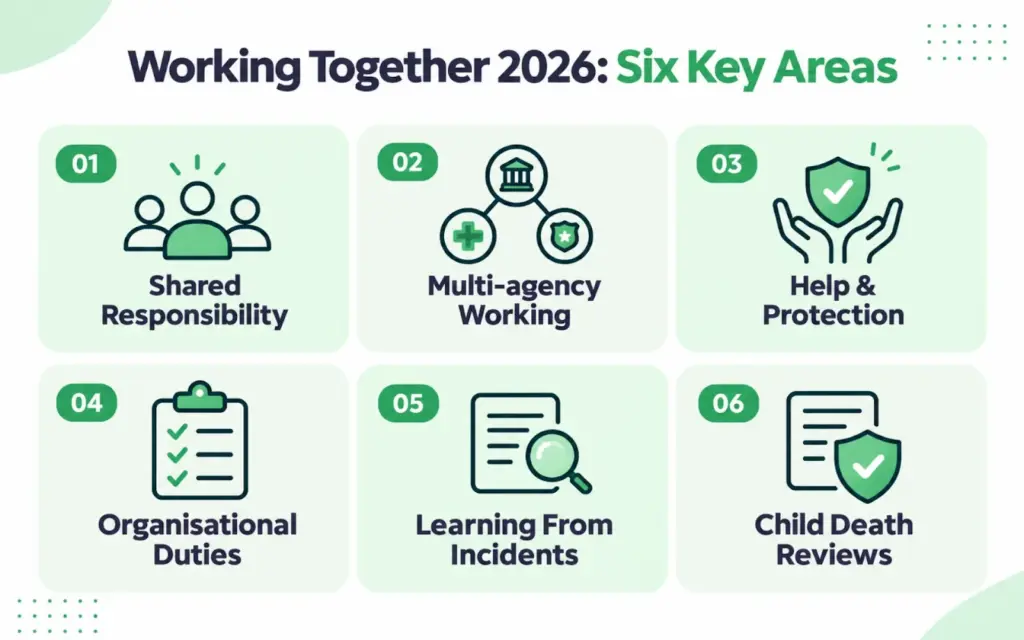
The guidance contains six chapters covering shared responsibilities, safeguarding arrangements and responses to children’s needs.
1. A Shared Responsibility
Safeguarding starts with putting children at the centre of decisions.
Practitioners should listen to children’s experiences, recognise their individual needs and consider how family circumstances affect their safety.
Effective safeguarding also involves challenging discrimination, recognising possible abuse and sharing relevant concerns with appropriate professionals.
2. Multi-Agency Safeguarding Arrangements
No single organisation can address every safeguarding concern.
Multi-agency safeguarding arrangements (MASA) bring together three statutory safeguarding partners:
- Local authorities
- Integrated care boards (ICBs)
- Police
These partners coordinate local safeguarding arrangements and work with schools, healthcare services and other relevant organisations.
Their shared responsibility is to ensure that children receive appropriate help and protection.
3. Providing Help, Support and Protection
Children and families should receive support when problems emerge, rather than waiting until difficulties become more serious.
The guidance describes Family Help, which brings targeted early help and support under section 17 of the Children Act 1989 into a more coordinated approach.
It also explains child protection enquiries under section 47 when there is reasonable cause to suspect significant harm.
For a fuller explanation of these legal duties, see the Children Act 1989.
4. Organisational Responsibilities
Organisations working with children need appropriate safeguarding policies, reporting arrangements and staff training.
Responsibilities include recognising concerns, managing allegations appropriately and ensuring workers understand how to raise safeguarding issues.
Maintaining professional boundaries is also important. Further guidance on safer working practice can help explain expected professional conduct.
5. Learning From Serious Child Safeguarding Incidents
When serious safeguarding incidents occur, relevant organisations must follow applicable notification and review requirements.
Child safeguarding practice reviews examine what happened, identify lessons and help improve safeguarding systems.
The purpose is organisational learning and better protection for children, not simply assigning blame.
6. Child Death Reviews
The final chapter explains arrangements for reviewing child deaths.
Local authorities and integrated care boards act as child death review partners, working with relevant professionals to understand circumstances surrounding deaths and identify opportunities to improve children’s health, safety and welfare.
What Changed in Working Together to Safeguard Children in 2026?
The 2026 update strengthens several existing safeguarding expectations and clarifies how organisations should work together.
According to the Department for Education’s official summary of the 2026 changes, important developments include:
| Area | What Practitioners Should Know |
|---|---|
| Anti-discriminatory practice | Greater emphasis on challenging racism, discrimination and unequal experiences of safeguarding services. |
| Recognising harm | Stronger guidance on child sexual abuse, domestic abuse, coercive control and overlapping risks. |
| Family Help | Clearer expectations for coordinated support and consistent relationships with families. |
| Multi-agency accountability | Stronger expectations for leadership, information analysis and demonstrating safeguarding impact. |
| Child protection | Clearer expectations for robust multi-agency assessments and section 47 procedures. |
The changes also reinforce the importance of protecting children in care and considering safeguarding concerns affecting unborn children.
For practitioners, the central message remains consistent: recognise risks, listen to children and work collaboratively to provide timely support.
Who Is Responsible for Safeguarding Under Working Together?
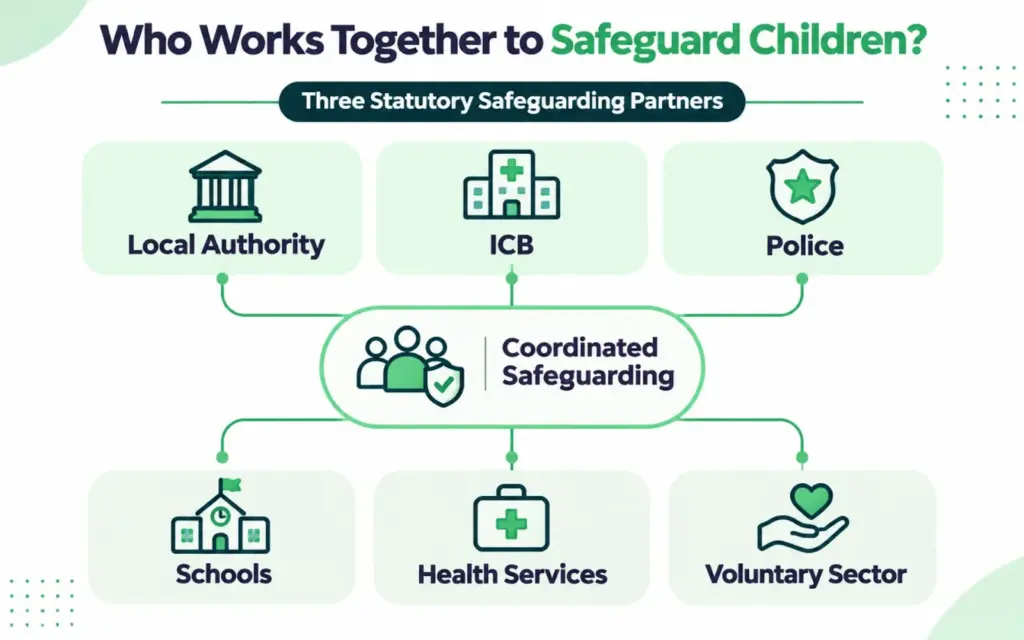
Safeguarding involves both organisational accountability and individual professional responsibilities.
The three statutory safeguarding partners lead local arrangements, but many other services contribute to protecting children.
| Organisation or Role | Safeguarding Responsibility |
|---|---|
| Local authorities | Coordinate children's social care and fulfil relevant statutory safeguarding duties. |
| Integrated care boards | Contribute health-system leadership and partnership working. |
| Police | Investigate suspected crimes and work with partners to protect children. |
| Schools and childcare providers | Recognise concerns, maintain safeguarding procedures and work with relevant agencies. |
| Healthcare professionals | Identify possible harm, share appropriate information and support safeguarding responses. |
| Voluntary organisations | Follow relevant safeguarding requirements and raise concerns appropriately. |
Individual responsibilities depend on professional roles and applicable legal requirements.
Education settings must also consider related safeguarding duties, including the Prevent duty.
Every practitioner should understand their organisation’s reporting procedures and know whom to contact when concerns arise.
What Should Practitioners Do in Everyday Safeguarding Work?
Understanding statutory guidance matters most when it helps professionals respond appropriately to real concerns.
Responding to Concerns About a Child
A practical safeguarding response generally involves five actions:
- Recognise the concern. Notice possible signs of abuse, neglect or changes in behaviour.
- Listen carefully. Take the child's words seriously without asking leading questions or promising secrecy.
- Record accurately. Document relevant facts, observations and the child's own words.
- Report promptly. Follow safeguarding procedures and contact the appropriate safeguarding lead or children's social care service.
- Cooperate and follow up. Share relevant information appropriately and record subsequent actions.
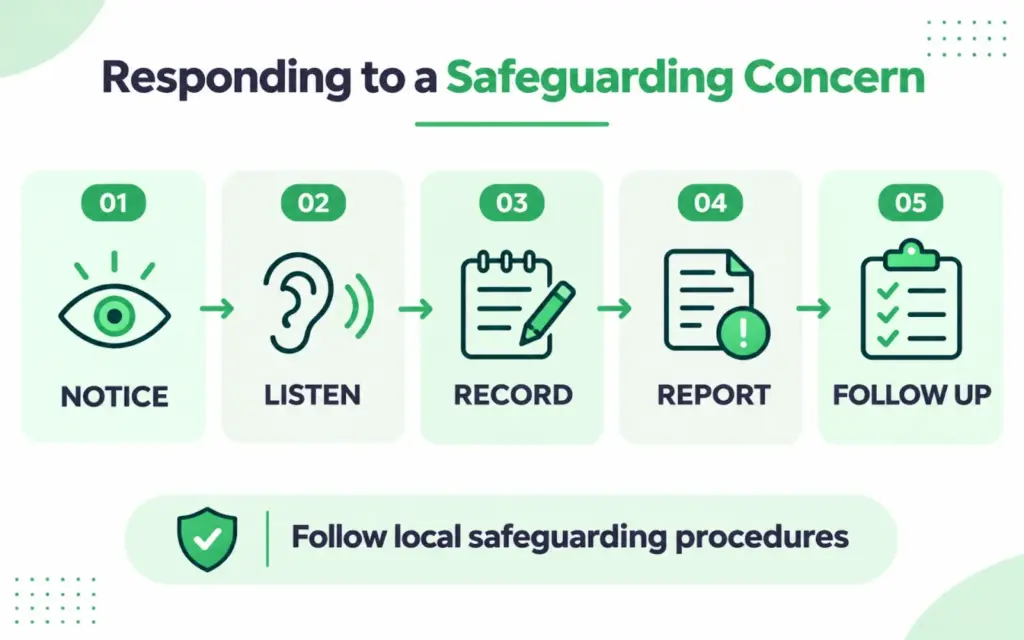
For example, if a nursery practitioner notices unexplained injuries alongside concerning changes in behaviour, they should record their observations and promptly follow safeguarding procedures.
They should not investigate the matter independently.
If a child is in immediate danger, contact emergency services on 999. Urgent safeguarding concerns should never be delayed by routine administrative processes.
Concerns About Adults Working With Children
Safeguarding procedures also address concerns about adults whose behaviour may place children at risk.
Some situations involve low-level concerns that should be recorded and managed appropriately.
More serious allegations may require involvement from the Local Authority Designated Officer (LADO), depending on the circumstances and applicable thresholds.
Understanding the LADO’s role helps organisations follow the appropriate allegations-management process.
Practitioners should follow local procedures rather than deciding investigative outcomes themselves.
Why Is Information Sharing Important in Safeguarding?

Effective safeguarding often depends on professionals combining information held by different organisations.
A teacher may notice changes in attendance, while a healthcare professional has information about a child’s wellbeing. Sharing relevant details appropriately can help identify risks that might otherwise be missed.
However, information must be shared lawfully, securely and for appropriate safeguarding purposes.
The information-sharing duty under section 16LA of the Children Act 2004 came into force on 30 September 2026. Its application depends on the relevant statutory provisions and the organisations involved.
The Department for Education’s statutory information-sharing guidance explains these responsibilities.
Practitioners should understand their specific obligations, follow local procedures and avoid assuming that confidentiality automatically prevents necessary safeguarding information sharing.
Key Takeaways for Safeguarding Practitioners
Working Together to Safeguard Children 2026 reinforces a central principle: protecting children requires coordinated, child-centred action.
Practitioners should understand their responsibilities, recognise safeguarding concerns, share information appropriately and follow local procedures.
Those exploring further professional learning can review child protection training online options.
IOMH’s Child Protection course offers additional learning on safeguarding fundamentals, recognising abuse and responding to disclosures. It should complement, not replace, current statutory guidance and role-specific training.

Frequently Asked Questions
No. Working Together to Safeguard Children 2026 applies to England. Scotland, Wales and Northern Ireland have their own child protection legislation, guidance and safeguarding arrangements.
Professionals should follow the requirements relevant to their jurisdiction.
It is statutory guidance issued under relevant legislation. Organisations and agencies within its scope are expected to comply unless exceptional circumstances justify a different approach.
Specific legal duties vary according to the organisation and the legislation involved.
Section 17 of the Children Act 1989 concerns local authority support for children in need.
Section 47 requires enquiries where a local authority has reasonable cause to suspect that a child is suffering, or is likely to suffer, significant harm.

- All Courses
 Personal Development (1283)
 Career Bundle (479)
 Management & Administration (460)
 Employability (439)
 Health & Social Care (416)
 Health and Safety (383)
 Business (320)
 Teaching & Education (268)
 IT & Software (263)
 Health and Fitness (238)
 QLS Endorsed Courses (219)
 Mental Health & Counselling (169)
 Science & Technology (153)
 Accounting & Finance (144)
 Sales & Marketing (128)
 Construction & Engineering (126)
 Art & Design (125)
 Compliance & Law (112)
 Language (86)
 Photography & Lifestyle (58)
 Animal Care (57)
 Food Safety & Hygine (53)
 Diet & Nutrition (49)
 Sports & Fitness (47)
 Makeup & Beauty (43)
 First Aid (39)
 Agriculture (2)
0 responses on "Working Together to Safeguard Children: Summary for Practitioners"