



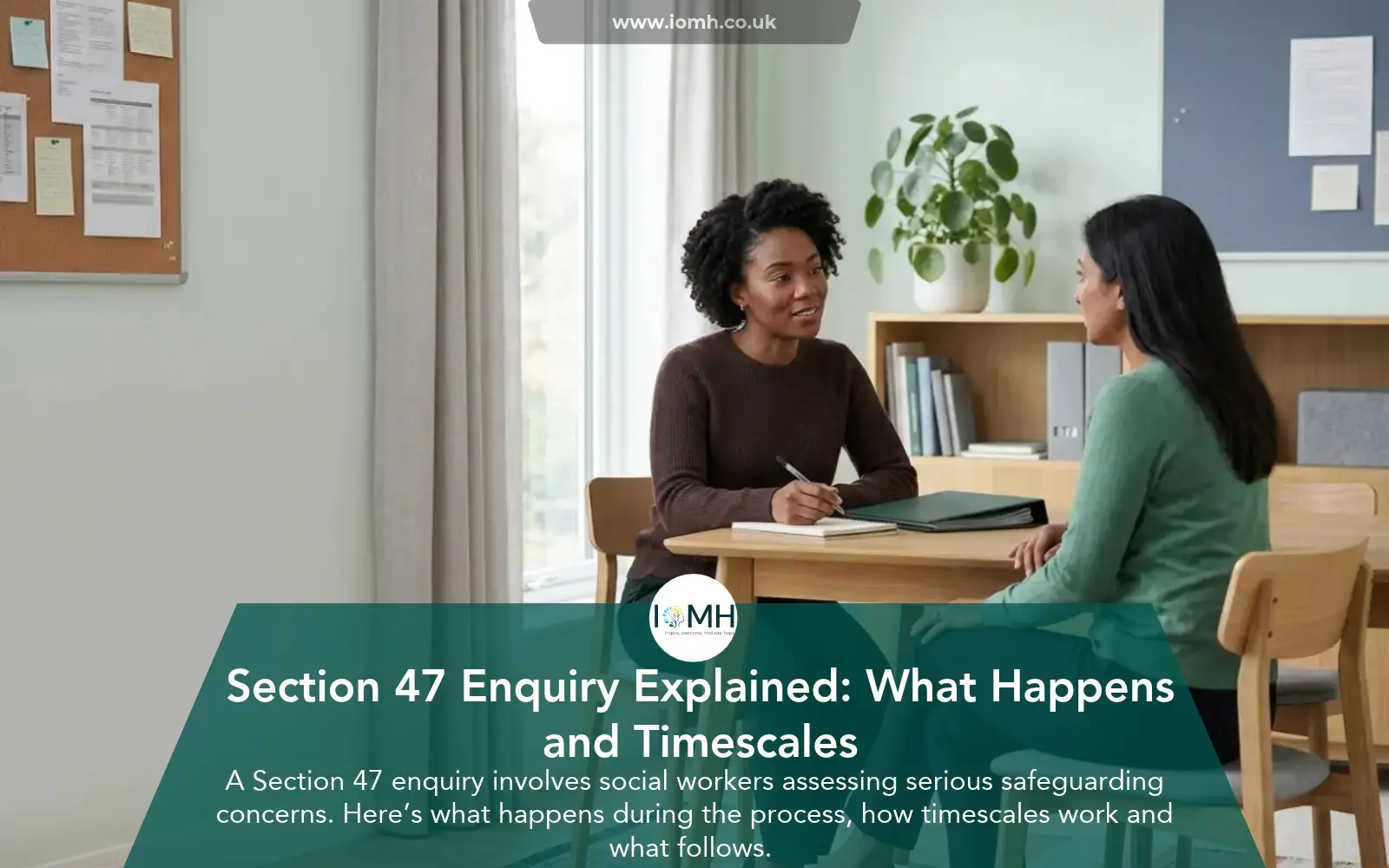
When children’s social care becomes involved in a safeguarding concern, understanding what happens next can make the process clearer for everyone involved. Parents may want to know why an investigation has started, while teachers, carers and safeguarding professionals may need to understand their role.
A Section 47 enquiry is a child protection investigation carried out by a local authority when there is reasonable cause to suspect that a child is suffering, or is likely to suffer, significant harm. Its purpose is to establish the child’s circumstances and decide whether protective action is necessary.
In England, Section 47 enquiries follow statutory safeguarding procedures and often involve several agencies working together. An enquiry does not automatically mean that abuse has been established or that a child will be removed from home.
This article explains what triggers an enquiry, how the process works, the relevant timescales and what may happen afterwards.
What Is a Section 47 Enquiry?
A Section 47 enquiry is a statutory safeguarding process established under Section 47 of the Children Act 1989.
The legislation requires local authorities to make enquiries when they have reasonable cause to suspect that a child in their area is suffering, or is likely to suffer, significant harm. The duty also applies in certain circumstances involving emergency protection orders or police protection.
The main purpose is to determine whether action is needed to safeguard or promote the child’s welfare.
When Is a Section 47 Enquiry Needed?
An enquiry may begin when information suggests that a child faces a serious risk of harm. Concerns could involve:
- Physical abuse or unexplained injuries.
- Sexual abuse or exploitation.
- Emotional abuse or persistent harmful behaviour.
- Neglect affecting the child's health or development.
- Domestic abuse or other circumstances that may place the child at significant risk.
For example, a teacher might notice repeated unexplained injuries and receive information suggesting that a child feels unsafe at home. Children’s social care would consider the available evidence and decide whether the concerns meet the threshold for Section 47 enquiries.
Not every safeguarding referral leads to a Section 47 enquiry. Some situations can be addressed through a child and family assessment, family help or other appropriate support.
A Section 47 enquiry is therefore one important stage within the wider child protection process in England, rather than a process that automatically follows every referral.
The distinction between safeguarding and child protection helps explain why some concerns require statutory enquiries while others can be addressed through earlier support.



What Happens During a Section 47 Enquiry?
A Section 47 enquiry involves gathering information, assessing potential harm and deciding what action is necessary to protect the child.
The process is led by local authority children’s social care, with relevant professionals contributing information and expertise.
The Department for Education’s Working Together to Safeguard Children 2026 provides the statutory guidance for multi-agency safeguarding arrangements in England.
Although the circumstances differ between cases, the following stages explain how enquiries generally proceed.
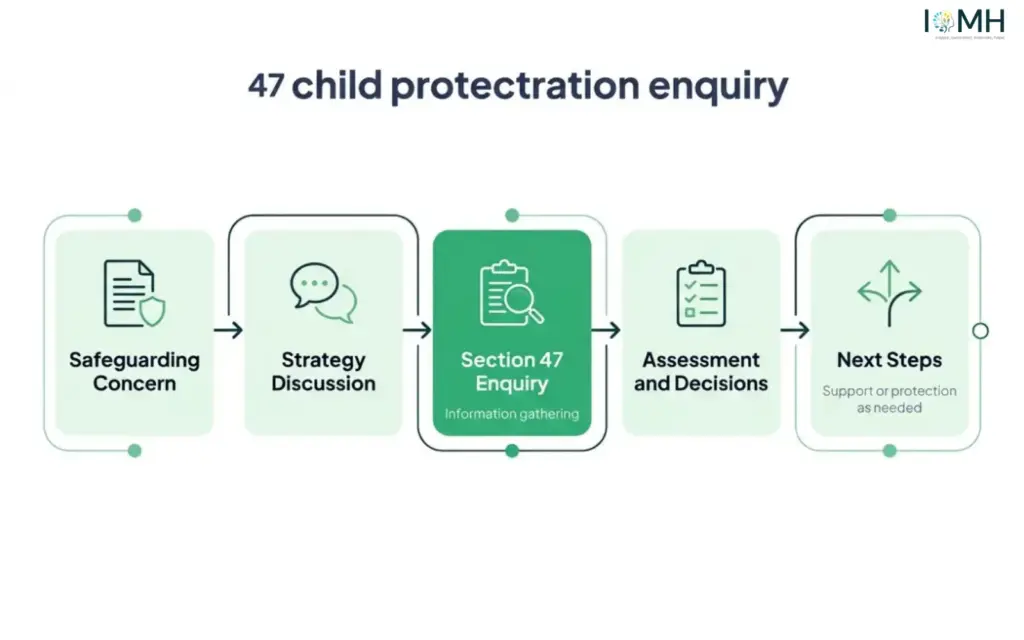
1. A Safeguarding Concern Leads to a Strategy Discussion
When information indicates that a child may be suffering, or is likely to suffer, significant harm, children’s social care arranges a strategy discussion.
This involves relevant agencies, normally including children’s social care, police and health professionals. Other practitioners may contribute depending on the child’s circumstances.
The discussion considers:
- What is currently known about the child.
- Whether there is reasonable cause to suspect significant harm.
- Whether immediate protective action is necessary.
- What further information should be collected.
- Whether Section 47 enquiries should begin.
- Which professionals will undertake particular actions.
A strategy discussion may take place through a meeting or another suitable communication arrangement.
If immediate safeguarding concerns are identified, professionals consider the protective measures needed without delaying necessary action.
2. Social Workers Gather and Assess Information
Once Section 47 enquiries begin, an appropriately experienced social worker leads the assessment and coordinates information gathering.
The activities depend on the concerns involved. They may include speaking with the child, visiting the family home, consulting parents or carers, and reviewing information held by relevant services.
Professionals from schools, healthcare services, police and other agencies may contribute observations or records.
In some circumstances, specialist assessments or medical examinations may be considered.
The social worker also considers the child’s wider circumstances, including relationships, development, family support and factors that may reduce or increase risk.
For example, a school may report concerning changes in a child’s behaviour. Healthcare professionals may provide relevant medical information, while conversations with the child and family help establish a fuller picture.
The purpose is to understand the child’s experiences and needs, assess the available evidence and determine what action is appropriate.
3. Professionals Assess Risk and Agree Next Steps
As information becomes available, children’s social care evaluates whether the child is suffering, or is likely to suffer, significant harm.
The assessment considers the child’s wishes and feelings, family circumstances, available evidence and any protective factors.
Professionals then agree the next steps and record the reasons for their decisions.
Possible actions include providing additional support, continuing relevant assessments, arranging protective measures or convening an initial child protection conference.
Where a criminal offence may have occurred, the police may conduct a separate but coordinated criminal investigation.
The agencies involved have different responsibilities, but effective communication helps ensure that decisions reflect the child’s circumstances and safety needs.
How Long Does a Section 47 Enquiry Take?
There is no single fixed 45-working-day deadline that applies separately to every Section 47 enquiry in England. The time required depends on the child’s circumstances, the seriousness of the concerns and the information needed to make safeguarding decisions.
The commonly quoted 45-working-day period relates to the broader child and family assessment, rather than a separate statutory deadline for completing every Section 47 enquiry.
Section 47 Enquiry Timescales in England
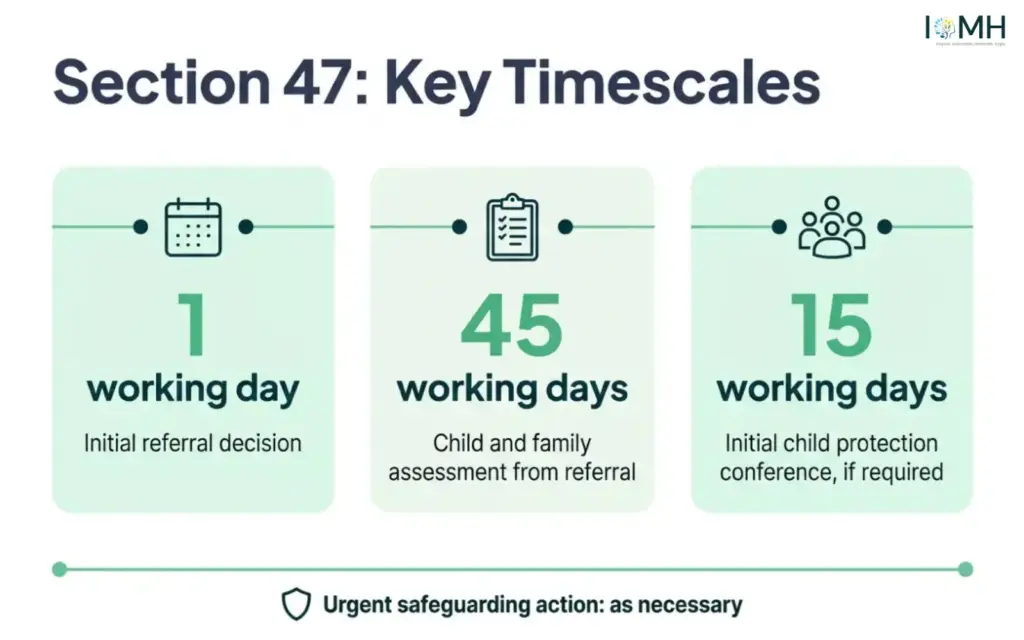
| Stage | Relevant Timeframe |
|---|---|
| Initial referral decision | Children's social care should decide on the next response within one working day |
| Strategy discussion | Arranged according to the urgency of the safeguarding concerns |
| Child and family assessment | Should decide on next steps within 45 working days of referral; reasons for exceeding this timeframe should be recorded |
| Immediate protective action | Taken as necessary according to the child's circumstances |
| Initial child protection conference, if required | Within 15 working days of the strategy discussion that initiated Section 47 enquiries |
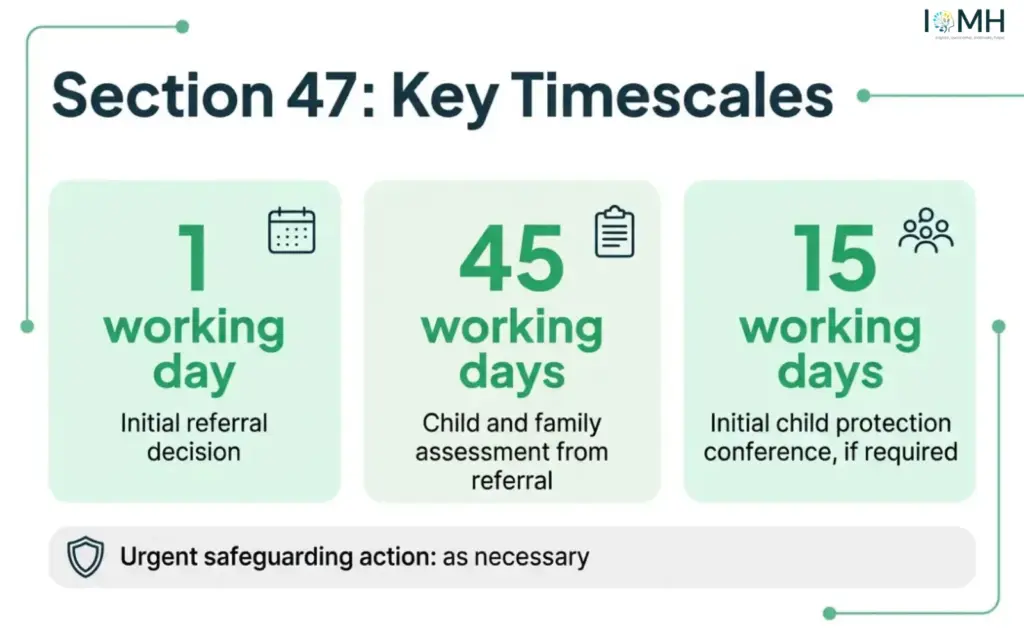
These timeframes are explained in the Department for Education’s statutory guidance on safeguarding assessments and child protection procedures.
The distinction between assessment and conference timescales matters.
For example, when Section 47 enquiries identify significant and continuing concerns, an initial child protection conference may need to take place before the wider child and family assessment period has ended.
Some situations require urgent decisions, while others involve further information gathering and assessment.
The child’s safety and individual circumstances determine how quickly safeguarding action should progress.
What Happens After a Section 47 Enquiry?
A Section 47 enquiry can lead to several outcomes. Children’s social care considers the findings, the level of risk and whether additional protection or support is needed.
When Concerns Are Not Substantiated
Sometimes, the available information does not substantiate the concerns of significant harm.
This does not necessarily mean that the child or family has no additional needs.
Depending on the assessment, children’s social care may decide that:
- No further statutory involvement is required.
- The family would benefit from additional support.
- Further assessment or services under Section 17 of the Children Act 1989 are appropriate.
The decision should reflect the child’s circumstances, and the reasons should be recorded.
When Significant Harm Concerns Are Substantiated
Where enquiries establish that a child is suffering, or is likely to suffer, significant harm, an initial child protection conference should be arranged.
The conference brings together relevant professionals and family members to consider the risks and decide whether a child protection plan is necessary.
Understanding what happens at a child protection conference can help families and professionals prepare for this stage.
A child protection plan sets out arrangements for protecting a child where a conference decides that continuing child protection measures are required.
The plan identifies safeguarding concerns, actions to address them and responsibilities for the professionals involved.
However, a plan is not an automatic outcome of beginning a Section 47 enquiry. Decisions depend on the assessment findings and the subsequent conference.
Other cases may involve support under Section 17. The difference between child in need and child protection is important because these pathways address different circumstances and levels of risk.
How Are Children and Parents Involved in a Section 47 Enquiry?
Children and families play an important role in safeguarding assessments.
Social workers seek to understand the child’s experiences, wishes and feelings, taking account of their age, development and communication needs.
A child may be spoken to separately from their parents when this is considered appropriate for the enquiry.
This can help professionals understand the child’s experiences and identify information they may find difficult to share in front of others.
Parents and carers are normally informed about the concerns and involved in discussions where it is safe and appropriate.
There may be circumstances where sharing particular information could place a child at further risk or affect a police investigation. Professionals must take these considerations into account.
Parents can provide information about family circumstances, explain their perspective and ask questions about the process. They may also seek independent advice where necessary.
An enquiry does not automatically lead to a child being removed from home. Any protective intervention must have an appropriate legal basis.
Where families need assistance but ongoing child protection measures are unnecessary, other support may be available.
Early help and family support arrangements can address emerging difficulties, strengthen family circumstances and support children’s wellbeing.
What Should Safeguarding Professionals Know About Section 47 Enquiries?
Professionals working with children may contribute important information during Section 47 enquiries, even when they are not responsible for leading them.

Teachers, designated safeguarding leads, healthcare professionals, childcare practitioners and support workers may be asked to provide records, observations or information relevant to a child’s circumstances.
Their responsibilities include recognising safeguarding concerns, recording information accurately and following appropriate reporting procedures.
These responsibilities reflect the wider safeguarding principles used in health and social care, where identifying risks and sharing concerns appropriately are essential parts of professional practice.
The Department for Education’s statutory guidance on information sharing to safeguard children and young people, updated in September 2026, explains relevant information-sharing responsibilities and legal considerations for safeguarding organisations and practitioners.
Professionals should share relevant information lawfully and appropriately, while considering confidentiality, the child’s welfare and applicable duties.
Practitioners should also follow their organisation’s safeguarding procedures rather than independently investigating suspected abuse.
If new information indicates that a child remains at risk, professionals should use the appropriate safeguarding and escalation routes.
Effective safeguarding depends on timely communication, accurate records and cooperation between agencies.
Building Your Child Protection Knowledge
Understanding Section 47 enquiries helps professionals recognise how safeguarding concerns are assessed and how different services contribute to protecting children.
For those considering further training, knowing what an online child protection course covers can help them choose learning that suits their safeguarding responsibilities.
IOMH’s Child Protection and Safeguarding course covers safeguarding legislation and guidance, recognising different forms of abuse, risk assessment, responding to disclosures, reporting concerns and actions following referrals.
The course also includes topics such as child development, domestic abuse, early help and safeguarding trafficked children.
Learners can study online, with optional CPD-accredited completion certificates available to order separately.
The training supports safeguarding knowledge and professional development, helping learners better understand their responsibilities when concerns arise.
Conclusion
A Section 47 enquiry is an important part of England’s child protection arrangements. It helps children’s social care understand serious safeguarding concerns, assess risks and decide what protection or support a child needs.
Knowing how enquiries work, the relevant timescales and possible outcomes helps families and professionals understand the process and their roles within it.

FAQs
No. A Section 47 enquiry does not automatically result in a child being removed from home. Any protective action depends on the child’s circumstances and must follow the appropriate legal requirements.
Parents can raise questions, explain their views and seek advice. However, disagreement does not automatically prevent children’s social care from fulfilling its statutory duties. Particular actions may require consent or appropriate legal authority.
Yes. Police may participate in strategy discussions and safeguarding enquiries, particularly where a criminal offence is suspected, or immediate protective action may be necessary.
Duration depends on the course content and assessment requirements. Self-paced learning allows you to organise your study around existing commitments, subject to the provider’s access period.
Children’s social care considers whether further assessment or support is needed. Depending on the findings, the case may close, or the child and family may be offered appropriate services.

- All Courses
 Personal Development (1283)
 Career Bundle (479)
 Management & Administration (460)
 Employability (439)
 Health & Social Care (416)
 Health and Safety (383)
 Business (320)
 Teaching & Education (268)
 IT & Software (263)
 Health and Fitness (238)
 QLS Endorsed Courses (219)
 Mental Health & Counselling (169)
 Science & Technology (153)
 Accounting & Finance (144)
 Sales & Marketing (128)
 Construction & Engineering (126)
 Art & Design (125)
 Compliance & Law (112)
 Language (86)
 Photography & Lifestyle (58)
 Animal Care (57)
 Food Safety & Hygine (53)
 Diet & Nutrition (49)
 Sports & Fitness (47)
 Makeup & Beauty (43)
 First Aid (39)
 Agriculture (2)
0 responses on "Section 47 Enquiry Explained: What Happens and Timescales"