


Safeguarding training is often described as Level 1, 2, 3, 4 or 5. At first glance, that makes choosing a course seem straightforward: start at Level 1 and work upwards. In practice, it is more complicated.
Safeguarding levels generally reflect increasing knowledge, responsibility and competence, but they are not one universal UK qualification ladder. The meaning of a level can vary according to your role, sector, employer and UK nation. The NSPCC explains that safeguarding training level definitions can vary by sector and UK nation.
So, what do Levels 1 to 5 actually mean? Here is how to make sense of them.
Looking for Online Safeguarding Training?
If you want to build your safeguarding knowledge alongside this guide, IOMH offers an Online Safeguarding Course covering safeguarding principles, recognising concerns, procedures, documentation and relevant legislation.
The course is described by IOMH as a Level 2 QLS Endorsed Course. It is a non-regulated training programme and is not regulated by Ofqual, so check the requirements of your role, employer or relevant safeguarding framework before deciding whether it meets your training needs.



What Do Safeguarding Training Levels Mean?
Safeguarding training levels help distinguish between different degrees of knowledge, competence and responsibility. Someone who needs basic awareness, for example, is unlikely to have the same training needs as a professional responsible for complex safeguarding decisions or strategic oversight.
One of the clearest numbered systems comes from healthcare. The current safeguarding children and young people competency framework sets out five increasing competency levels for healthcare staff, alongside an additional level for senior managers and executives.
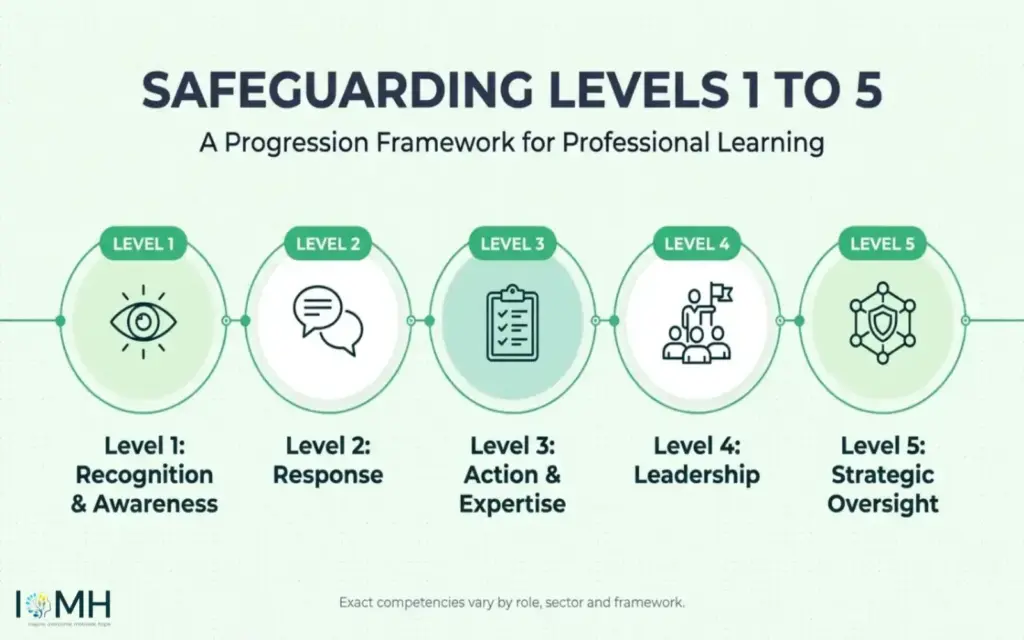
Broadly, the progression can be understood as:
recognition → response → action and expertise → leadership → strategic oversight.
However, this is a useful framework for understanding the levels, not a universal definition for every UK workplace.
There is another distinction worth making: a safeguarding training level is not necessarily the same thing as a regulated qualification level. A course described as “Level 3 safeguarding”, for example, should not automatically be assumed to be an Ofqual-regulated Level 3 qualification.
Safeguarding Levels 1 to 5 at a Glance
The table below gives a simple overview based on the broad progression used in numbered safeguarding competency frameworks.
| Level | Broad Focus | Typical Responsibility |
|---|---|---|
| Level 1 | Recognition and awareness | Recognise safeguarding concerns and know how to report them |
| Level 2 | Response | Respond appropriately and follow relevant procedures |
| Level 3 | Action and expertise | Take safeguarding action within the responsibilities of the role |
| Level 4 | Leadership and additional responsibility | Provide specialist input or safeguarding leadership |
| Level 5 | Strategic oversight | Support safeguarding governance, systems and organisational responses |
Safeguarding Levels 1 to 5 Explained
Level 1 Safeguarding – Recognition and Awareness
Level 1 generally focuses on basic safeguarding awareness and recognition. A learner may need to recognise possible signs of abuse, neglect or other safeguarding concerns, understand their organisation’s basic procedures and know who to approach when something concerns them.
The purpose is not usually to make complex safeguarding decisions. It is to help people recognise concerns and take the appropriate first step.
The exact distinction between introductory and more advanced training can depend on the framework. If you are deciding between the first two levels, see Level 1 vs Level 2 safeguarding.
Level 2 Safeguarding – Responding to Concerns
Level 2 generally moves beyond recognition towards responding appropriately.
Depending on the sector and framework, this can include knowing how to respond to concerns, following reporting or escalation procedures and understanding safeguarding responsibilities in greater depth.
It should not be assumed that everyone with a particular job title automatically needs the same course. Responsibilities and organisational requirements matter.
For a deeper explanation of Safeguarding Level 2, including what it covers and how to approach training, use the dedicated Level 2 guide rather than relying on the overview here.
Level 3 Safeguarding – Action and Expertise
Level 3 represents greater safeguarding action and expertise in frameworks that use this terminology. It can involve assessing safeguarding situations, contributing to decisions, taking appropriate action and working with other professionals or agencies where the role requires it.
One common source of confusion is the assumption that Level 3 always means Designated Safeguarding Lead (DSL) training. That is too broad. Appropriate training depends on the person’s sector, responsibilities and the guidance or competency framework that applies to their role.
Level 4 Safeguarding – Leadership and Specialist Responsibility
Level 4 is associated with greater leadership, expertise or additional safeguarding responsibility in frameworks that use numbered levels.
For example, the current healthcare framework places professionals performing senior safeguarding leadership roles at Level 4. Their responsibilities can involve supporting colleagues, providing specialist safeguarding input, quality assurance and contributing to complex cases.
That does not mean every UK safeguarding lead automatically requires a course carrying a “Level 4” label. Sector-specific requirements still need to be checked.
Level 5 Safeguarding – Strategic Oversight
Level 5 moves towards strategic and system-level safeguarding responsibility.
Within the current healthcare competency framework, it applies to professionals delivering senior leadership and strategic roles. Their work can extend to governance, service planning, safeguarding systems and organisational responses.
Again, this should not be interpreted as meaning every organisation has, or needs, someone holding a generic “Level 5 safeguarding qualification”.

Which Safeguarding Level Do I Need?
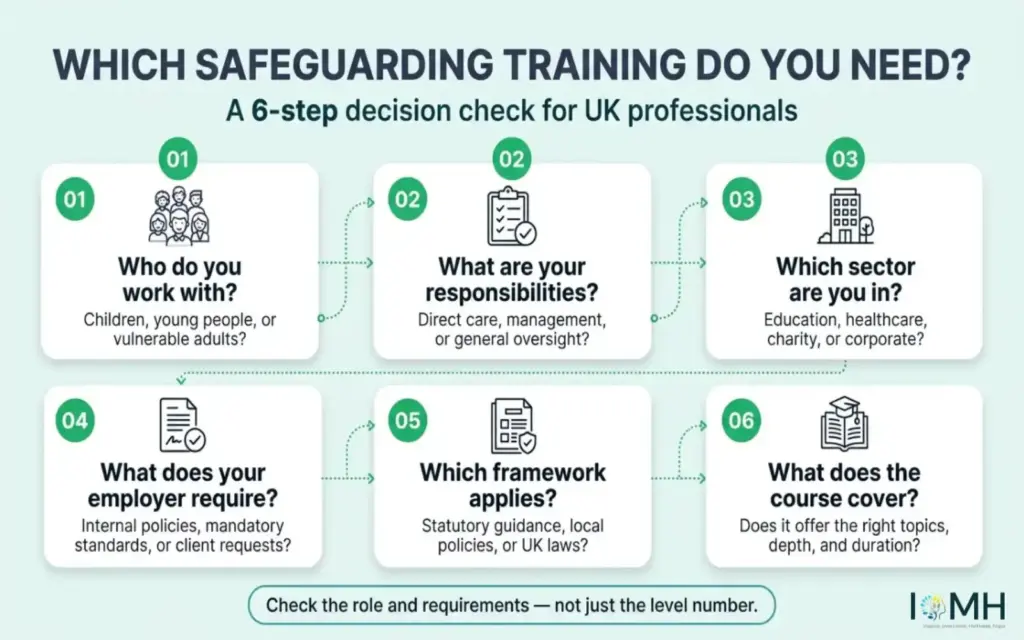
There is no reliable answer based on a job title alone. Instead, start with the responsibilities attached to your role.
Consider:
- Who do you work with? This may include children, young people, adults at risk or a combination of groups.
- What safeguarding responsibilities do you have? Recognising a concern is different from assessing cases or leading an organisational response.
- Which sector do you work in? Healthcare, education and social care can operate under different frameworks and guidance
- What does your employer require? If training is needed for your job, check your organisation's training requirements rather than choosing solely by a course title.
- Does an official or professional framework apply to your role?
- What does the course actually teach? Check the learning outcomes rather than relying on the number attached to the course.
If Level 2 appears relevant, the separate guide to who needs Level 2 safeguarding training explores that question in more detail.
Employers choosing training across a workforce may instead need guidance on safeguarding training requirements for staff.
Are Safeguarding Levels the Same Across the UK?
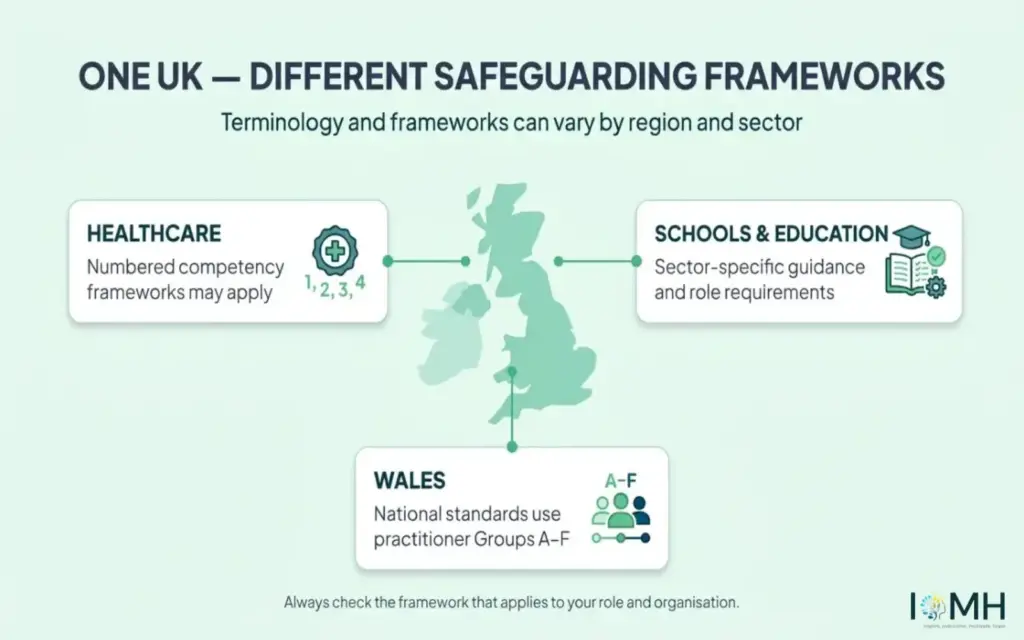
No. Safeguarding terminology and training frameworks are not identical across every sector or UK nation.
Healthcare provides a clear example of a numbered competency framework. However, other sectors may organise safeguarding responsibilities differently.
In England’s schools and colleges, for example, Keeping Children Safe in Education is statutory guidance. The 2026 guidance requires staff to follow their school’s or college’s safeguarding policies and procedures and complete required safeguarding training and refreshers. It does not simply tell every member of school staff to obtain the same generic numbered safeguarding certificate.
Wales provides another useful example. Its National Safeguarding Training, Learning and Development Standards organise practitioners into Groups A to F, from basic awareness through intermediary, advanced and specialist responsibilities to sector and public-service leadership.
Frameworks and terminology can also differ in Scotland and Northern Ireland.
The practical lesson is simple: don’t select safeguarding training solely because a particular number appears in its title.
What Should You Check Before Choosing Safeguarding Training?
Once you know roughly where your responsibilities sit, look beyond the level number.
Check the course’s intended audience, safeguarding focus, learning outcomes, assessment, delivery method and certificate. If training is required for your work, compare those details with your employer’s requirements and any relevant professional or sector framework.
IOMH’s Online Safeguarding Course is described by IOMH as a Level 2 QLS Endorsed Course covering safeguarding principles, concerns, procedures, documentation and relevant legislation. The course page also makes an important distinction: it is a non-regulated training programme and is not regulated by Ofqual. Learners should therefore consider what their role or employer requires before deciding whether it is suitable.
If the type of certificate matters, see online safeguarding training with a certificate.
Price may also influence your decision, but it should be considered alongside suitability and learning outcomes. See the guide to safeguarding training costs for that separate comparison.
FAQs
Not automatically. “Level 3” and “DSL training” should not be treated as universally interchangeable terms. The appropriate training depends on the sector, organisation, role and applicable guidance.
Not necessarily as a universal rule. Some frameworks build higher competencies on knowledge from lower levels, but individual courses may have different prerequisites. Check the course requirements and, for workplace training, your employer’s expectations.
Course duration and refresher requirements are two different things. There is no single expiry period that applies to every safeguarding course and every UK role. Check the relevant framework, employer requirements and current sector guidanc
Appropriate training helps people recognise concerns, understand their responsibilities and respond through the correct procedures. For the wider context, see why safeguarding is important.

- All Courses
 Personal Development (1283)
 Career Bundle (479)
 Management & Administration (460)
 Employability (439)
 Health & Social Care (416)
 Health and Safety (383)
 Business (320)
 Teaching & Education (268)
 IT & Software (263)
 Health and Fitness (238)
 QLS Endorsed Courses (219)
 Mental Health & Counselling (169)
 Science & Technology (153)
 Accounting & Finance (144)
 Sales & Marketing (128)
 Construction & Engineering (126)
 Art & Design (125)
 Compliance & Law (112)
 Language (86)
 Photography & Lifestyle (58)
 Animal Care (57)
 Food Safety & Hygine (53)
 Diet & Nutrition (49)
 Sports & Fitness (47)
 Makeup & Beauty (43)
 First Aid (39)
 Agriculture (2)
0 responses on "Safeguarding Training Levels 1 to 5 Explained"