


Safeguarding Level 2 training helps people recognise signs of abuse or neglect, respond appropriately to concerns and follow the correct reporting procedures. It builds on basic safeguarding awareness, although the exact training requirements depend on your job, employer and sector.
If you work in healthcare, education, social care or another setting involving vulnerable people, safeguarding knowledge may be an important part of your responsibilities. However, choosing a course can be confusing. Some providers offer short online training, while others provide longer, formally regulated qualifications.
This guide explains what Safeguarding Level 2 covers, who may need it, what UK guidance says, and how to choose suitable training and certification.
What Is Safeguarding Level 2?
Safeguarding Level 2 generally refers to training that develops practical knowledge of identifying, responding to, and reporting safeguarding concerns. It moves beyond basic awareness by exploring how safeguarding responsibilities apply in everyday professional situations.
For example, someone completing Level 2 training may develop the knowledge to recognise indicators of harm, respond appropriately to a disclosure and understand when concerns must be escalated.
However, Level 2 is not a universally standardised safeguarding qualification across the UK.
The NSPCC’s guidance on safeguarding training levels explains that training-level definitions vary between sectors and UK nations. Therefore, two courses described as Level 2 may have different learning outcomes.
It is worth checking how safeguarding training levels differ before choosing a course.
Most importantly, completing Level 2 training does not automatically make someone a designated safeguarding lead or qualify them for specialist safeguarding responsibilities.



What Does Level 2 Safeguarding Cover?
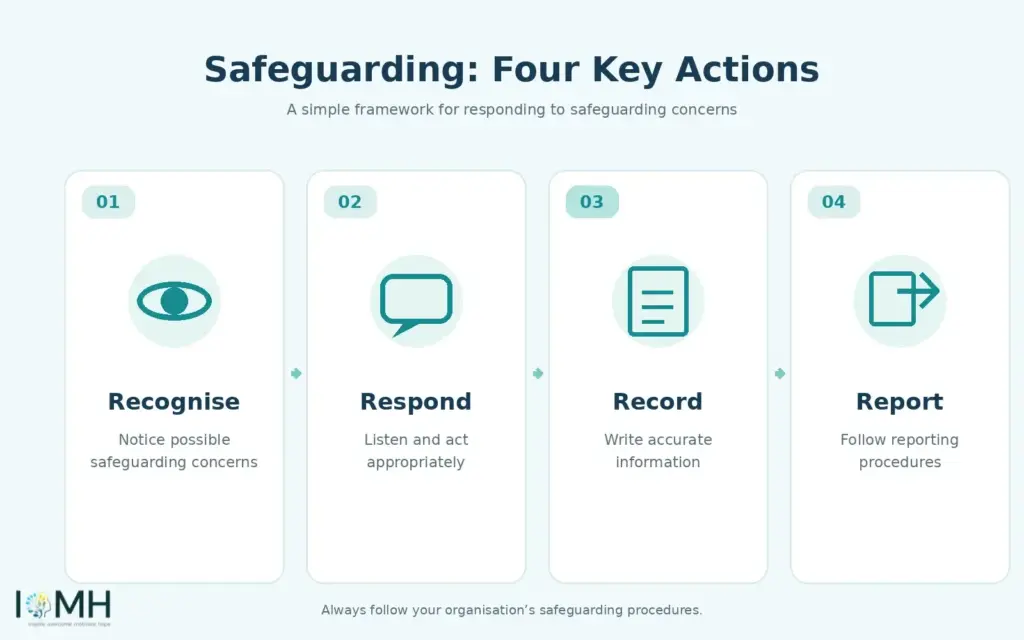
Level 2 safeguarding training usually focuses on recognising risks, understanding professional responsibilities and taking appropriate action when someone may be experiencing harm.
Although course content varies, the following subjects are commonly relevant.
Recognising Abuse, Neglect and Safeguarding Risks
A central part of safeguarding training involves recognising situations where someone may be at risk.
Learners may explore different forms of abuse, including:
- Physical abuse: Deliberate physical harm, including hitting, pushing or inappropriate restraint.
- Emotional abuse: Threats, humiliation, intimidation or persistent behaviour that damages someone's wellbeing.
- Sexual abuse: Sexual activity without consent, exploitation or inappropriate sexual contact.
- Financial abuse: Theft, fraud or controlling someone's money without proper authority.
- Neglect: Failing to meet essential physical, emotional or care needs.
- Online abuse: Harassment, grooming, exploitation or other harmful behaviour through digital platforms.
Safeguarding concerns are not always obvious. Someone may become unusually withdrawn, appear frightened around particular individuals or show unexplained changes in behaviour.
Training helps learners recognise possible warning signs without jumping to conclusions.
Responding to Concerns and Disclosures
Recognising a concern is only the beginning. Knowing how to respond is equally important.
Imagine a care worker notices that someone they support has become distressed during visits from a particular person. Rather than ignoring the change or making accusations, the worker should follow their organisation’s safeguarding procedures.
If someone discloses abuse, appropriate practice generally includes listening carefully, taking the concern seriously and avoiding leading questions.
Staff should not promise absolute confidentiality or investigate allegations independently.
Where someone faces immediate danger, urgent action may be necessary.
Recording, Reporting and Sharing Information
Accurate record keeping is another important safeguarding skill.
A safeguarding record should explain what happened, when the concern arose, what was observed or disclosed and what action was taken.
Professionals should distinguish factual observations from personal opinions.
For instance, recording someone’s actual words is more useful than writing an unsupported assumption about their situation.
Concerns should be reported through the appropriate safeguarding procedures. Depending on the circumstances, this may involve a manager, designated safeguarding lead or relevant external agency.
The Working Together to Safeguard Children 2026 guidance explains the importance of coordinated action between organisations involved in protecting children in England.
Working With Other Professionals
Safeguarding often requires cooperation between different professionals, including social workers, healthcare staff, education providers and safeguarding leads.
Level 2 learning may introduce the importance of professional boundaries, appropriate information sharing and understanding individual responsibilities.
These skills demonstrate why safeguarding matters in professional settings, particularly when vulnerable people depend on coordinated support.
Who Needs Safeguarding Level 2 Training?
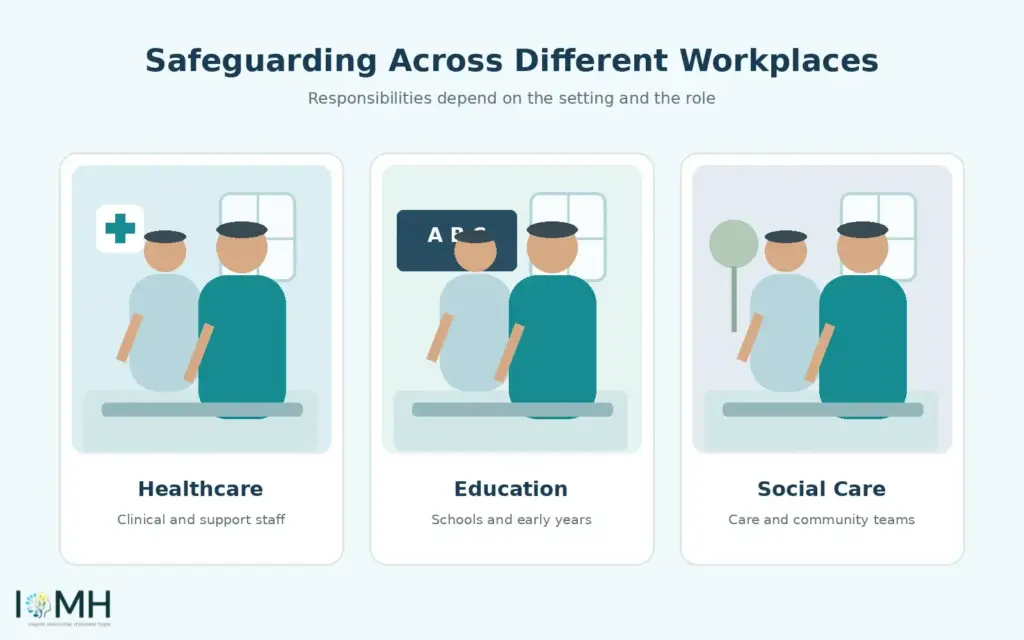
Safeguarding Level 2 training may be relevant to employees and volunteers who regularly work with children, adults at risk or people requiring additional support.
However, not every person in these roles automatically needs a certificate labelled Level 2. Actual requirements depend on professional frameworks, workplace policies and responsibilities.
Healthcare and Social Care Workers
Relevant roles may include healthcare assistants, care workers, nursing support staff and community support workers.
The Royal College of Paediatrics and Child Health’s Level 2 safeguarding competencies describe expectations for relevant healthcare staff working with children and young people.
Employees should check which competencies apply to their specific position.
Education, Childcare and Community Workers
Safeguarding training is also relevant to teaching assistants, nursery practitioners, youth workers, charity employees and volunteers.
| Work Setting | Example Roles | What to Check |
|---|---|---|
| Healthcare | Healthcare assistants, support staff | Professional competency requirements |
| Social care | Care workers, support workers | Employer safeguarding policies |
| Education | Teaching assistants, school staff | School safeguarding requirements |
| Early years | Nursery and childcare practitioners | EYFS safeguarding requirements |
| Community services | Youth workers, volunteers | Organisational responsibilities |
Is Safeguarding Level 2 Mandatory in the UK?
Safeguarding responsibilities are legally important in many sectors, but there is no universal UK law requiring every relevant worker to obtain the same standalone Level 2 safeguarding certificate.
The distinction is between legal duties, statutory guidance, professional competency frameworks and employers’ training requirements.
Safeguarding Requirements in Schools and Early Years
In England, schools and colleges must follow Keeping Children Safe in Education 2026.
The guidance requires staff to receive appropriate safeguarding and child protection training, including relevant updates. All staff must also read Part One in full and follow their organisation’s safeguarding procedures.
However, this does not mean every teacher or teaching assistant must purchase a separate commercial Level 2 certificate.
Early years providers must follow the applicable EYFS statutory framework, which establishes safeguarding and welfare requirements for registered settings in England.
Healthcare and Adult Social Care Requirements
Healthcare uses more clearly defined safeguarding competency levels.
The Royal College of Nursing’s adult safeguarding competency framework identifies Level 2 competencies for healthcare staff who regularly encounter patients, their families, carers or members of the public.
In adult social care, employers must ensure staff have appropriate knowledge and skills to carry out their safeguarding responsibilities.
Requirements across Scotland, Wales and Northern Ireland may differ from those in England.
Before enrolling, check your employer’s training policy and any professional standards relevant to your role.
Level 1 vs Level 2 vs Level 3 Safeguarding: What's the Difference?
Safeguarding levels are often used to describe increasing knowledge and responsibility. However, the precise meanings depend on the sector and framework.
The following comparison provides a general illustration.
| Training Level | Main Focus | Typical Learning Emphasis |
|---|---|---|
| Level 1 | Basic awareness | Recognising potential concerns and knowing how to report them |
| Level 2 | Applied safeguarding knowledge | Responding, recording, escalating and understanding responsibilities |
| Level 3 | More advanced responsibilities | Applying safeguarding competencies in roles requiring greater involvement |
In healthcare, the competency expectations for each level are more specifically defined. Other sectors may use different training structures.
For example, someone working in a school may receive safeguarding training that meets their employer’s requirements without completing a course specifically labelled Level 2.
If you are deciding between introductory and more developed training, explore the difference between Level 1 and Level 2 safeguarding.
The right choice depends on your responsibilities rather than simply selecting the highest-numbered course.
How to Get a Safeguarding Level 2 Certificate
Obtaining a safeguarding certificate usually involves choosing suitable training, completing the learning activities and meeting the provider’s assessment requirements.
However, before enrolling, it is important to confirm what type of certificate you actually need.
Step 1: Check Your Workplace Requirements
Start by asking your employer or training coordinator what safeguarding knowledge your role requires.
Consider whether your responsibilities involve children, adults at risk or both.
You should also establish whether your workplace expects a particular competency framework, recognised qualification, practical assessment or refresher programme.
This helps prevent enrolling in training that does not meet your intended purpose.
Step 2: Choose a Suitable Training Course
Once you understand your requirements, compare course learning outcomes.
A suitable course should clearly explain its syllabus, assessment arrangements, delivery method and certificate type.
Online training can provide flexibility for people balancing study with employment or other commitments.
For those seeking general professional development, IOMH offers an Online Safeguarding Course covering safeguarding principles, professional responsibilities, documentation, legislation and organisational procedures.
The course is QLS-endorsed at Level 2 and provides online learning with an assessment. It is a non-regulated training programme rather than an Ofqual-regulated qualification.
Learners concentrating specifically on adult safeguarding may also consider IOMH’s Safeguarding Adults Training, which covers recognising abuse, responding to disclosures and reporting concerns. Whichever course you choose, confirm that its learning outcomes match your workplace expectations.
Step 3: Complete the Learning and Assessment
After enrolling, work through the course materials and complete any required assessments.
Training may include reading materials, recorded lessons, practical examples, quizzes or written assignments.
For IOMH’s Online Safeguarding Course, learners complete an assignment-based assessment and must achieve the published pass mark of 60%.
Take time to understand the procedures and principles rather than concentrating only on obtaining the certificate.
Step 4: Obtain and Retain Your Certificate
After successfully completing training, follow the provider’s process for obtaining your certificate.
IOMH offers a CPD Certificate of Achievement and an optional QLS-endorsed certificate for its general safeguarding course. Certificate charges are listed separately on the course page.
Keep a copy of your certificate alongside your professional development records.
Your employer may request evidence of completion, particularly when monitoring safeguarding training and refresher requirements.
Is Safeguarding Level 2 a Recognised Qualification?
A Level 2 safeguarding certificate can provide evidence of learning, but not every course described as Level 2 awards a formally regulated qualification.
The terms used by training providers can have different meanings.
| Certificate Type | What It Means |
|---|---|
| Course-completion certificate | Confirms that specified learning or assessments have been completed |
| CPD certificate | Provides evidence of continuing professional development |
| QLS-endorsed certificate | Recognises completion of learning endorsed through the Quality Licence Scheme |
| Ofqual-regulated qualification | A formally regulated qualification awarded through an approved awarding organisation |
IOMH’s Online Safeguarding Course is QLS-endorsed but explicitly does not lead to an Ofqual-regulated qualification.
This distinction matters when an employer requests a specific recognised qualification rather than general safeguarding training.
You can use the government’s Register of Regulated Qualifications to check whether a particular qualification is formally regulated in England or Northern Ireland.
For qualifications regulated in Scotland or Wales, consult the relevant national regulatory arrangements.
Before paying for a course, check both the certificate’s status and whether the intended employer or professional body will accept it.
How Long Does Safeguarding Level 2 Training Take and Last?
Two questions commonly arise when choosing safeguarding training: how long it takes to complete and when it needs refreshing.
These are different issues.
How Long Does the Course Take?
There is no single duration for every Safeguarding Level 2 course.
Short online professional-development courses may take a few hours, while longer programmes leading to regulated qualifications can involve substantially more study and assessment.
Completion time depends on the content, delivery method, assessments and required learning hours.
Before enrolling, check the provider’s estimated duration alongside its syllabus. A shorter course is not automatically less useful, but it may cover different competencies from a longer qualification.
Does Safeguarding Level 2 Expire?
Not every safeguarding certificate has a fixed expiry date.
However, this does not mean training remains sufficient indefinitely.
Employers and professional frameworks may require safeguarding knowledge to be refreshed periodically, particularly when responsibilities or procedures change.
For example, healthcare safeguarding frameworks establish expectations for continuing learning and maintaining competencies.
School staff must also receive safeguarding updates in accordance with applicable guidance and organisational arrangements.
The safest approach is to check your employer’s policy rather than assuming all Level 2 certificates remain acceptable for two or three years.
FAQs
Often, yes. Some Level 2 courses accept beginners without a separate Level 1 certificate. However, workplace competency requirements and individual course entry conditions may differ. Always check before enrolling.
Yes. Many providers offer online safeguarding training. However, whether a particular online course meets your professional requirements depends on its content, assessment and your employer’s expectations.
Free or publicly funded safeguarding learning may be available through employers, sector organisations or eligible training programmes. Check the course’s eligibility conditions, learning outcomes and certificate status before enrolling.

- All Courses
 Personal Development (1283)
 Career Bundle (479)
 Management & Administration (460)
 Employability (439)
 Health & Social Care (416)
 Health and Safety (383)
 Business (320)
 Teaching & Education (268)
 IT & Software (263)
 Health and Fitness (238)
 QLS Endorsed Courses (219)
 Mental Health & Counselling (169)
 Science & Technology (153)
 Accounting & Finance (144)
 Sales & Marketing (128)
 Construction & Engineering (126)
 Art & Design (125)
 Compliance & Law (112)
 Language (86)
 Photography & Lifestyle (58)
 Animal Care (57)
 Food Safety & Hygine (53)
 Diet & Nutrition (49)
 Sports & Fitness (47)
 Makeup & Beauty (43)
 First Aid (39)
 Agriculture (2)
0 responses on "Safeguarding Level 2: What It Covers, Who Needs It and How to Get It"